Repairing Israel And The World: One Body At A Time
Long ago, a king owned a beautiful diamond. One day, his deeply cherished gem crashed to the ground and suffered a deep crack. He searched desperately throughout his kingdom for someone who could restore the gem. A beggar stepped forward and said, “I can fix it. In fact, I can make it more beautiful than before.” Believing in miracles, the king handed over the precious stone. The beggar couldn’t eliminate the crack. Instead, he turned it into the stem of a unique and lovely rose. The king was ecstatic.
The lessons from this beautiful parable are obvious. Some may apply to Israel’s extraordinarily deep, post-October 7 cracks. Putting fables aside, lyrics to “Haskiveinu,” sung by Jewish country music star Joe Buchanan, may be more apt: “We pray for life … we pray for peace … now and when the drums are at ease … we’re gonna live with all that we’ve got left.”
In either case, there’s no question that Israel’s many heart-wrenching post-war cracks need repair.
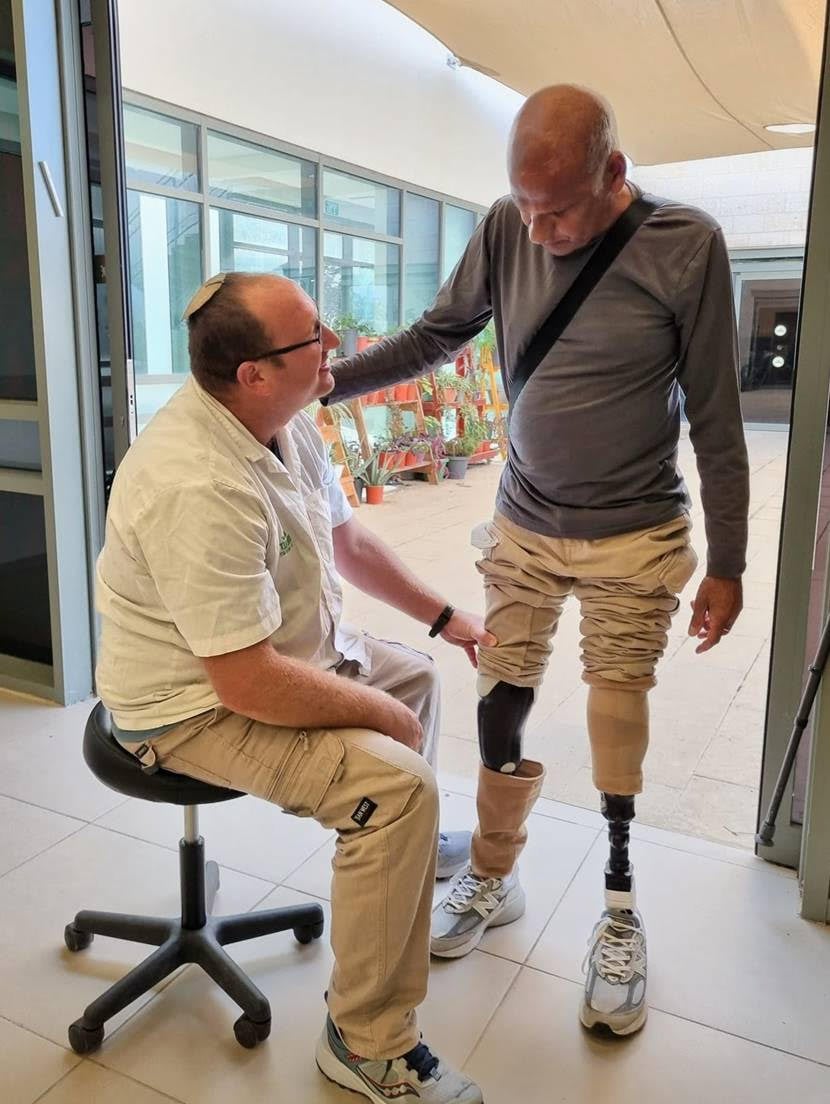
Here is one harsh reality. There are now 20,000 people in Israel who require prostheses for limb replacement. Each person is precious; many are war-wounded young people with long, productive lives ahead of them.
ADI Negev Nahalat Eran (ADI-Negev), a nonprofit Jewish National Fund-USA (JNF-USA) affiliate, and Tikkun Olam Makers (TOM), an Israeli-turned-global nonprofit, are repairing these immense fissures — one body at a time.
There are only five internationally-Certified Prosthetists-Orthotists (CPOs) in all of Israel. Each one studied overseas. International certification requires four years of academic and clinical training, including a Masters’ Degree.
Biomechanics, kinesiology, pathology, gait analysis, clinical measurements, impression taking, materials science, manufacturing and post-operative patient rehabilitation are all part of the rigorous training.
Despite the decades-long need, Israel has never had any formal CPO training. The majority of Israeli prostheses technicians learned from mentors in the field. Not surprisingly, amputees generally travel to the US to be fitted for a prosthetic.
This formidable reality is changing real-time with the November 2025 opening of Israel’s first School of Prosthetics and Orthotics (School) at the Harvey and Gloria Kaylie Rehabilitation Medical Center (Kaylie Center) on Adi Negev’s extraordinary campus.
I visited ADI-Negev in 2019 as part of a JNF-USA Disabilities Mission and, again, in 2024 with a JNF-USA volunteer mission. Located twelve miles from the Gaza border, ADI-Negev’s almost magical 40-acre campus serves more than 300 residents, special education students with severe disabilities, wounded soldiers and many others. Along with the Kaylie Center, this beautiful oasis houses an innovative kindergarten, therapeutic horseback riding, petting zoo, physical and occupational therapy, hydrotherapy center, adaptive sports, mental health programs and more.
Partnering with Ben-Gurion University of the Negev, with funding from Israel’s Ministry of Health, Jewish National Fund-USA and the Jewish Federations of North America, the new School is the result of the years-long, visionary efforts of Itzhak Siev-Ner (Kaylie Center’s pioneering Medical Director), Carey Glass (renowned CPO and educator) and Yael Dotan-Marom (the School’s dedicated Academic Director.)
With 29 years of rehabilitation-related work at Israel’s Sheba Hospital, Dotan-Marom is modest about her own credentials but passionate about the School’s mission. “With an entire new profession” coming to Israel … there will be profound change in how patients will be taken care of.” Over the long term, she sees a future where the use of proper fitting, advanced technology and extraordinary skill will make lifelong use of prosthetics functional and pain-free, even as they are modified and replaced over time.
The eleven students in the School’s inaugural class were selected with “utmost care,” says Dotan-Marom. Each one is already a licensed physical or occupational therapist with significant rehabilitative work experience. More intangibly, she told me “each is a special person with special qualities” including zeal, motivation and compassion.
Ranging in age from 30-60, the class is carefully curated: there are religious and non-religious men and women, an Arab, and two war-wounded veterans. Stipends from JNF-USA (to pay for transportation, books and other school expenses) enabled exceptional people from all parts of Israel to upend their lives to be part of this transformative endeavor.
Students split their time between theoretical studies at Ben-Gurion University and practical instruction at ADI-Negev’s Prosthetics Center. Abigail Aronson, a physical therapist with a Masters’ Degree from Columbia and many years of experience in geriatric, pediatric and gait rehabilitation, wants to be at the forefront of the exciting and rapidly changing rehabilitation movement.
She says “there’s only so much you can do as a physical therapist with muscles and range of motion … but the amazing technology improvements with prosthetics allow us to do so much more.” It’s an “endless field of change” so people “can do whatever they want to do.”
The light and optimism flickered when Carey Glass passed away one week before the School’s opening. Sharing her great personal and professional sense of loss, Dotan-Marom says Glass’ spirit is still present and the School must move forward to make the shared dream a reality.
To this end, she continues to “aim high” and is successfully recruiting talented, highly-credentialed professionals who all want to come to the Negev to participate in this extraordinary endeavor. She is also focused on future plans for a prosthetics workshop (initially for training purposes) on ADI-Negev’s campus and attaining international accreditation for the School.
Abigail told me that “her heart opened” when she first visited ADI-Negev. As a self-described “problem solver,” she plans to use her skilled hands, knowledge and advanced technology to solve problems and make life better for each ADI-Negev patient.
When I played with special kids on ADI-Negev’s accessible playground in 2024, my heart also opened. I knew nothing then about Tikkun Olam Makers or its collaborations for ADI-Negev’s physically challenged patients, including: specially designed musical instruments; a one-handed teffilin-laying aid; a flotation device for independent swimming; and 3-D-printed child-sized wheelchairs.
As a primary civil partner for rehabilitation innovation with Israel’s Ministry of Defense, including the Rehabilitation Branch (Agaf HaShikum) and the Advanced Development Branch (MAFAT), TOM works closely with Israel’s government to assist wounded soldiers and civilians.
The Company’s name and very special business model epitomize the ancient Jewish principle of tikkum olam (repair the world), that encourages everyone to do what they can to make the world a better place.
Our organization “cannot work siloed,” says Roy Goldenberg, TOM’s Israel Director. Its operating model makes this clear. “Challenges” are brought to “TOM Communities” by “Need Knowers” (often individuals, hospitals or rehabilitation centers), who request “Solutions” to address unmet challenges of people with disabilities.
In response, the “TOM Communities” (industry, schools, universities, rehabilitation centers and hospitals throughout Israel and around the world) organize various kinds of events where volunteer “Makers” collaborate with “Need Knowers” to develop specific concepts, working models, prototypes and products. “Challenges” may also be solved using existing solutions adapted to TOM’s standards.
Adding to this, TOM has two “Innovation Centers” (in Israel and New York City). These hubs foster outreach to all of Israel and the US. It hopes to open a similar operation in Israel’s south.
Most of TOM’s “Solutions” can be manufactured using basic tools and technologies. Visualize, for example, TOM’s easily-made prosthetic attachment allowing a below-the-elbow amputee to safely carry a plate with both hands and use his oven; modular end units for above-and-below elbow prostheses making it possible to do balanced strength training and wash kitchen utensils; and wheelchair accessible cribs so parents can easily put their babies to bed.
Every TOM “Solution” is held to a uniform standard with documentation of materials production process, tools and assembly.
Remarkably, every “Solution” is open-source and free of intellectual property rights. This means anyone, anywhere around the world can access and download all projects (in varying stages of development) from TOM’s “Online Marketplace” for production, customization or further development.
In the days after the October 7 Hamas atrocities, TOM’s volunteers and partners tackled many urgent needs. Working closely with Israel’s Ministry of Defense, TOM is now invested in long-term efforts toward rehabilitation and recovery across Israel – including prosthetics manufacturing. It is working with Israeli hospitals and universities to accommodate basic needs and reach new audiences, including those from the Orthodox, Bedouin and Druze communities.
TOM’s prosthetics are not the sophisticated, high tech, superhuman artificial body parts of movie fame. They are generally very light, customizable and 3D printed. Each one is unique.
As part of the manufacturing process, TOM employs “human-centered” parametric design software technology that measures and customizes the limb for each individual. If desired, individuals can measure themselves using the parametric technology, print the design at home or elsewhere, and follow up with assembly and post-processing procedures. TOM also utilizes “Care Designers” (physical therapists and occupational therapists) who work with patients.
Dr. Nitzan Shauloff, TOM’s Negev Community Manager, says these prostheses “let amputees do whatever they want … including skydiving, travel, exercise and high level jobs.”
Unlike internal grief and loss, amputations and their aftermath are visible. Consistent with the Jewish principle of kavod habriyot (respect for human dignity), TOM’s focus includes quality of life — think about attractive prosthetic travel accessories instead of plastic grocery bags for prosthetic storage. Shauloff also told me about TOM’s work with Israel’s Ben-Gurion University to create prosthetics that “look like leg structure” and “make prostheses into fashion.”
WWII created immense change including advances in aviation, nuclear power to run cities. radar, computers and battlefield medicine. If there is a bright spot to this war, it will be growth of a rehabilitation industry (fostered by Israel’s nonprofits along with the country’s commercial sector), additional employment opportunities, and new infrastructure in the Negev and other parts of Israel. As with so many other Israeli innovations, its rehabilitative advancements will ultimately be shared with the world.
While we’ve seen many miracles over the last two years, the fable of the king and his cracked diamond goes only so far. This fix isn’t quick or easy. Healing takes years of physical and mental strength.
But with highly trained CPO professionals and advanced prosthetics technology, Israel’s amputees have opportunities to do almost everything they want to do and do it well with “all [they’ve] got left.”