Learning The Lessons Of History
Researching My Mothers Holocaust Journey
Researching "Taken. Numbered. Survived." Available on Amazon
What I’ve Learned Researching My Mother’s Holocaust Journey
I wrote Taken. Numbered. Survived. because I needed to understand what had happened to my mother and her family during the Holocaust.
My mother, Maria Katz Claman, rarely spoke about Auschwitz when I was growing up. I knew she had survived. I knew she had been deported, tattooed, forced into labour, marched near the end of the war, and displaced before coming to Canada. But I did not really know the story.
I wanted to know what had happened to her. I wanted to know what had happened to her parents, her sister, and the world they had known before everything was taken from them.
I thought I understood the Holocaust. Like many people, I knew the broad history. I knew about ghettos, deportations, Auschwitz, antisemitism, and mass murder. Only when I began researching my mother’s journey did I realize how much I did not know.
Even more painfully, I realized how little I knew about my own mother’s life before, during, and after the Holocaust.
What began as a personal effort to preserve her story became something much deeper. It changed the way I understood not only my mother’s life, but history itself.
A Story That Began With Silence
My mother rarely spoke in detail about Auschwitz when I was growing up.
Like many Holocaust survivors, she rebuilt her life instead of revisiting the past. She immigrated to Canada, raised a family, and carried memories that were always present, but seldom fully explained. The Holocaust existed in our home through silence, fragments, emotion, and the knowledge that something terrible had happened before I was born.
Years later, after her recorded testimony for the USC Shoah Foundation and after beginning archival research into her wartime experience, I started to understand something important.
The Holocaust was not only a story of death. It was also a story about ordinary life collapsing faster than people believed possible.
My research into my mother’s journey became the foundation for Taken. Numbered. Survived. But the deeper I researched, the more I understood that the lessons extended beyond my own family.
Ordinary Life Before Catastrophe
One of the first things I learned was how normal life still appeared shortly before catastrophe.
My mother grew up in Kisvárda and Pátroha in northeastern Hungary, in a close Jewish family rooted in faith, routine, and community. There were Shabbat dinners, school, holidays, summers with relatives, and the ordinary rhythms of rural life. Her father farmed land. Her mother managed the home. They considered themselves Hungarian as well as Jewish.
That mattered.
Holocaust history is often remembered through its final horrors. But my mother’s story forced me to begin earlier, before Auschwitz, before deportation, before the tattooed number. It forced me to see the people, the homes, the families, and the ordinary lives that existed before destruction.
The Holocaust happened to people who had been living normal lives only months earlier. They did not wake up one morning knowing they were living at the edge of genocide.
The Danger Was Not Fully Understood While It Was Happening
Another thing I learned was how difficult it is to recognize danger while still living inside it.
My mother later recalled that her family never believed something like Auschwitz could happen in Hungary. Even as restrictions increased and antisemitism deepened, many Jewish families still believed there were limits that civilized society would not cross.
Looking backward, we see the warning signs clearly. But people living through events do not experience history with hindsight.
The Holocaust did not begin with gas chambers. It developed through exclusion, propaganda, legal restrictions, confiscation of property, forced concentration, deportation, and bureaucratic dehumanization.
By the time the danger became undeniable, meaningful options had often narrowed dramatically.
That is one of the hardest lessons I took from this research. History does not usually announce its worst moments in advance. People are often asked to make decisions before they fully understand what they are facing.
What the Records Revealed
Researching my mother’s experience also taught me how systematic the destruction was.
Before I began this work, I understood Auschwitz mainly as a place of horror and mass murder. What I came to understand more deeply was the enormous administrative and logistical machinery required to make the Holocaust function.
Railways. Registries. Police structures. Property seizures. Deportation schedules. Labour systems. Government ministries. Camp administration.
The Holocaust was not carried out only by fanatics screaming hatred. It also depended on clerks, transportation officials, bureaucrats, and institutions operating with chilling efficiency.
That realization unsettled me. It showed how modern systems can become instruments of persecution when law, morality, and human dignity are stripped away.
I also learned how much of Holocaust history survives in fragments.
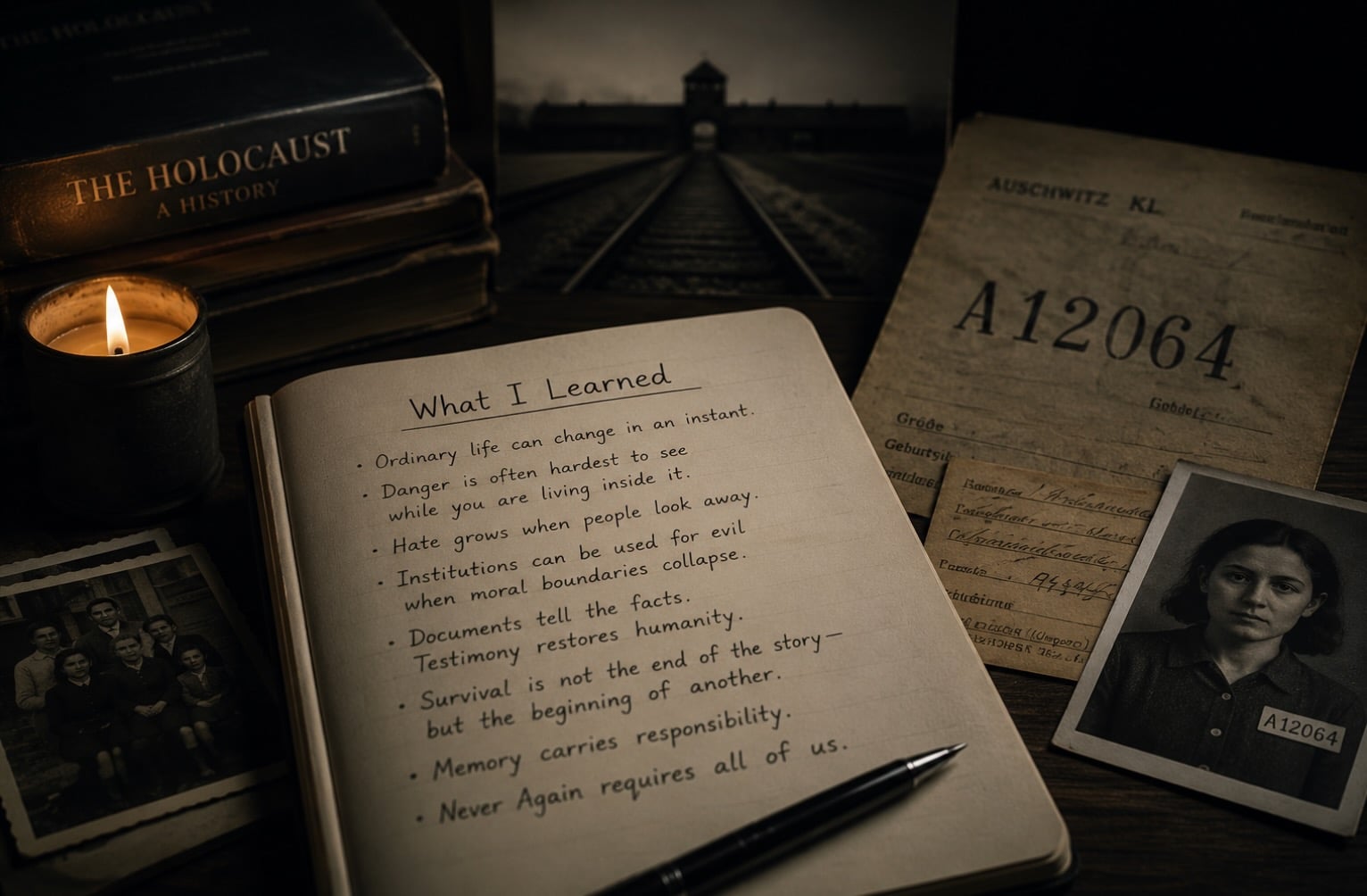
A transport document. A displaced persons registration card. A prisoner number. A testimony recorded decades later.
My mother was tattooed A12064 at Auschwitz. That number appears in records, but the archival trail alone cannot explain what it meant to be a teenage girl arriving at Birkenau in 1944 after days in a sealed cattle car.
The documents establish facts. The testimony restores humanity.
That combination became essential to me as I wrote. I wanted the history to remain grounded in evidence while never losing sight of the people trapped inside it.
Silence, Survival, and Responsibility
Another difficult lesson involved silence.
Researching the Holocaust forced me to confront not only what perpetrators did, but how many others looked away, remained passive, or convinced themselves that events did not concern them.
My mother remembered being marched through familiar streets toward deportation while local residents watched in silence.
That silence stayed with me.
The Holocaust depended not only on ideological hatred, but also on indifference, fear, social conformity, and the normalization of exclusion. Those forces did not disappear with the end of the Second World War. They remain recurring human vulnerabilities.
Perhaps the most personal thing I learned was that survival did not mean the suffering ended in 1945.
My mother survived Auschwitz, forced labour, a death march, and postwar displacement before eventually immigrating to Canada. But survival was not the conclusion of the story.
Survivors had to rebuild their lives while carrying memories that never entirely disappeared. Many spoke little about what they endured. Some could not speak about it at all.
Yet they rebuilt anyway.
That resilience may be one of the most extraordinary parts of my mother’s story.
What Never Again Really Requires
Researching her life changed the way I think about the phrase “Never Again.”
Too often, we treat it as a slogan attached to remembrance ceremonies. But history asks more of us than remembrance alone.
Never Again requires early recognition.
It requires recognizing the dangers of dehumanization, antisemitism, conspiracy thinking, democratic erosion, and normalized hatred before society reaches its darkest stage.
Genocide does not begin with killing.
It begins when human beings become easier to isolate, blame, exclude, and dehumanize.
In recent years, especially after October 7, I have become increasingly concerned by how quickly antisemitism can again become normalized in public discourse. That concern is one reason I felt compelled to preserve my mother’s story carefully and factually.
Survivor testimony matters not only because it records the past. It matters because it helps us recognize warning signs in the present.
Researching my mother’s Holocaust journey taught me about history. But it also taught me about human nature.
It taught me how fragile normal life can be. It taught me how difficult it is to recognize danger while living inside it. It taught me how quickly civilized systems can deteriorate once hatred becomes normalized.
Most importantly, it taught me that memory carries responsibility.
The generation that survived Auschwitz is disappearing. Soon, there will be no survivors left to speak for themselves.
What remains will depend on whether others are willing to tell the truth clearly, honestly, and without distortion.
That responsibility now belongs to all of us.
Related Topics
Related Posts