Resolutions of Evil – Photos and Negatives
Our personal mission. A friend or relative comes to visit, not on an organized trip – we have a day trip planned.
First time, late spring 2024. We planned to take a couple visiting from the UK. Attacks from Gaza interfered. Two months later, Haim and I first visited sites to forever be synonymous with October 7. We went with a friend who mastered the itinerary. His friend at Kibbutz Be’eri showed us burned homes, burned books, a lawn with the shoe she remembered her murdered friend buying on one of their shopping sprees, dirty dishes in the burnt kitchen’s dishwasher, spots where neighbors hid, attempting escape, until found by a Nukhba terrorist.
Without a scheduled group visit or private invitation, you can’t visit the kibbutz. Much has been leveled, rebuilding visible from the road.
In late 2025, my uncles’ friend visited. We took him to Sderot, to the car cemetery – burned cars, motorcycles, ambulances, Israelis’ cars, Nukhba vehicles. From there to the Nova site. Printed explanations appear by the bar, the main stage, the dumpster, and police command post. The site developed and maintained by victims’ families and private donors. Not the government, lest that suggest responsibility taken.
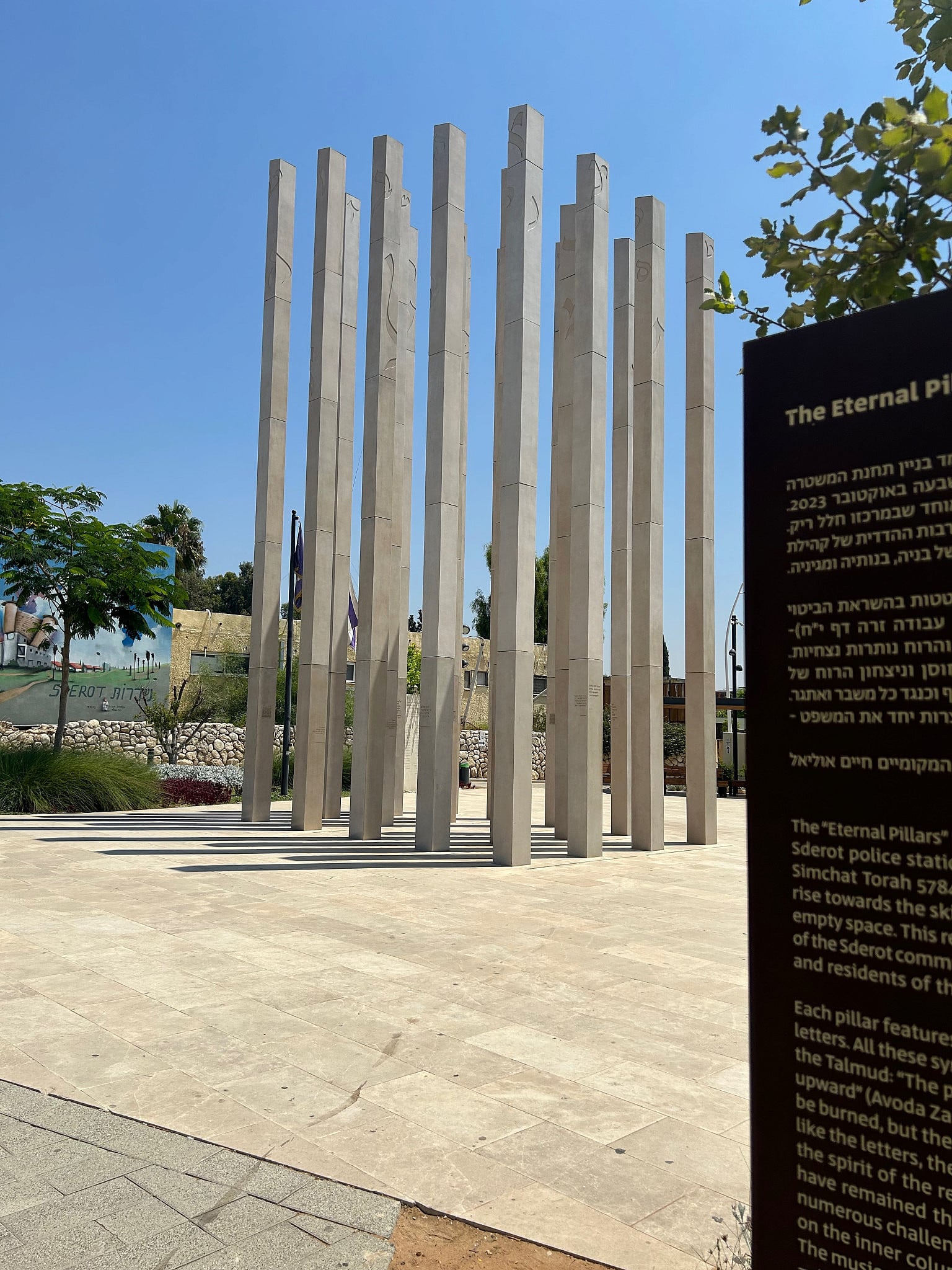
This time, Friday, July 17, 2026, the visitor – my sister, with two full days for this first visit in Israel since October 7. We drove to the lookout point, Givat Kobe, in Sderot and the memorial sculpture at the site of the 26-hour battle at the former police station. We drove to the car cemetery. I looked. I moved into the shade and looked at my sister looking and looked again.
We drove to the Nova site. This time, observing the vacated yellow ribbon distribution. A world beyond hostages in Gaza.
Signs remain. Names of victims stand motionless on the dirt dance floor. Newer signs, more stable, suggesting permanence, decorate side paths leading from the stage to the dumpster, and on the right of the entrance road. Names, photo collages, stories, who was married, who engaged, who survived – 400 lives lost, lives never lived, promises never kept, the promising never held to the test, weddings never celebrated, honeymoons never taken, children never born.
“This is the last time. I can’t come here again,” I whispered. Haim quietly responded, “We’ll bring our next visitor from abroad here too.”
I recalled saying I would never visit Auschwitz again after my first visit. Not comparing, just noting avoidable, emotionally intense experiences. But visiting Poland the fifth time, Haim’s first, I couldn’t let him visit Auschwitz alone. Visiting the Nova site a second time not mandatory. In fact, for Israelis, October 7 living in the margins of their lives daily, it’s not a mandatory one-time visit in my book.
The next day, as my sister described the visit to Haim’s son, again, without drawing any comparisons, my summary emerged: as generations born after World War II, visiting Auschwitz in 1998, and in the 21st century, we thought the world was on a new trajectory. “Never again.” The disturbing impact of the Nova site: the humidity and a breeze pronounced the resolutions of evil.
As we drove home, I opened Haaretz online to read Nir Hasson’s piece in the weekend magazine. “A Child A Day: The Air Force Continues to Kill Children in Gaza as a Routine Matter.” Photos. Data. Children killed since the ceasefire in October 2025: 274. And the staggering statistic: since October 7, 2023, over 21,000 children killed, 38 Israeli. The photographs resonated. And the negatives.
Saturday night reprieve, strolling from the Tel Aviv Port towards the Reading Power Plant, the screen by the lighthouse, ready for the Mondial. Sinking sun and lone seagulls led us to loud music, crowds dancing. Over the blasting music, Haim explained to my sister, “this is Israelis releasing the tension.” We approached, moving to the music. Haim and my sister in unison, “Nova.”
Harriet Gimpel – July 20, 2026