Teacher and activist in Jerusalem
Restoring our Dignity and our Hope
On October 5th, 2023, we held a gathering of Praying Together in Jerusalem. It was the beginning of our ninth year in which Jewish, Christian, Muslim and other believers in the power of prayer met monthly to share wisdom and pray side-by-side. Corona sent us onto Zoom and enabled us to build a global following, which we maintained by continuing to broadcast our gatherings, even when we resumed meeting in-person.
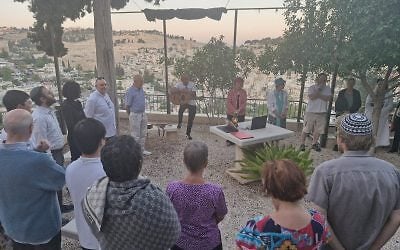
Two days later was October 7th. On October 8th, 2023, the leading team sought comfort and hope from one another: “What can we do?”
Of course, we knew that we had to pray, and we informed our participants that we could not wait a month but would meet on Zoom in a week. Rabbi Jonathan Wittenberg of London provided the theme. He had said that what is most undermined, most decimated in war is human dignity – the dignity of the victims and the dignity of the aggressors. We studied and prayed for “Upholding the Dignity of the Human Person in Times of Conflict.”
Teachers and religious leaders from around the world joined us. Despite initial misgivings, Palestinians and other Muslim leaders who had been part of our community, came on board, recognising that these prayers were authentic expressions of our shared humanity and shared aspirations for peace and human dignity. We met weekly (and for a short period daily). A compilation of some of the prayers are teachings can be found here: https://www.youtube.com/watch?v=WC0KX1jUrzc
The months of focused praying and learning had a profound impact on me and strengthened my commitment to upholding and promoting human dignity. Last week, I had the honour of participating in a workshop, “Human Dignity and Holiness Revisited,” bringing together women scholars and practitioners from Judaism, Christianity, and Islam to reflect on the relationship between concepts of “holiness” and the dignity of the human person.
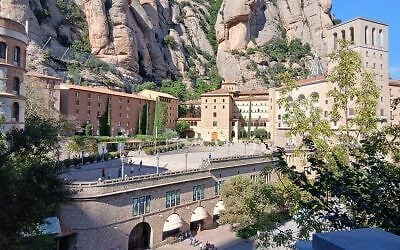
The workshop was a collaboration between the Catholic Academy in Berlin and the Sincletica Monastic School in Montserrat. It was the second of three workshops initiated by the Catholic Academy aiming to make women’s voices more audible in the dialogue between the Abrahamic Religions. The program was designed to deepen interreligious dialogue through focused theological exchange and shared reflection. Particular attention was given to how concepts of holiness shape understandings of human worth, responsibility, and vulnerability across the Abrahamic traditions.
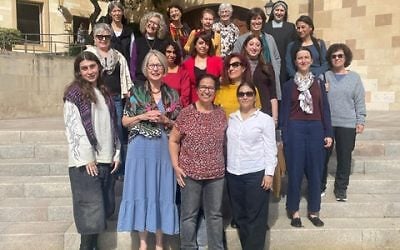
The group consisted of three Jewish women, from different segments of Israeli society and diverse backgrounds, six Muslim women, three Afghani, two Turkish and one German, and Christian women from both Catholic and Protestant backgrounds and practice.
A Christian scholar led us through Rabbinic teachings on the creation of humans in the image of the Divine, challenging us to ask what is “life” and why we were created. Can a woman claim to be in the Divine image in the same way that a man can, and what are the implications of that doubt for our dignity? Do we value our own people (Israelites/ Jews/ Children of Abraham) more than others? How do we reconcile religious tradition with contemporary realities (in any age), particularly the realities of conflict and lack of trust of the other?
The questions she raised, although timeless, seemed to speak directly to our current situation.
The next paper, by a Turkish, Muslim woman, spoke of her personal transformation and movement towards Sufism. She used the image of the pomegranate to explain the reality of the created world and those parts of creation that are hidden from us, in the Divine reality but outside our own ability to experience or perceive.
For us, the pomegranate is a symbol used in the New Year to represent the blessings and the obligations that are part of Jewish life. Our Turkish friend held her hand in the shape of a pomegranate to symbolize that all of creation can be imagined that way: for Israelis, it was dangerously close to the hand-sign we use to ask people to wait – often used in a state of impatience. It was a moment of humour – not the only one – while we contemplated our ethical responsibilities to one another and beyond, and our relationship with our Creator.
We were treated to a poetic personification of Jerusalem as a woman who, bearing all the weight of her troubles, goes to the sea at Tel Aviv to become cleansed and refreshed. Then, just a couple of presentations later, we had a similar depiction of Kabul, a city in the shadows of war and injustice, exhausted and burdened, seeking the cleansing power of the ocean.
The conflict here (Israel-Gaza) received some attention but the affront to human dignity was best illustrated and condemned through the stories of the Afghani women who bravely shared their personal experiences and their dreams of a different future.
One had simply been a teenager – an orphan – who wanted to study. This unattainable dream in a society governed by fanatics determined to remove women from the public sphere entirely and to have them exist only to serve men, forced her to flee, on foot with the perils of people smugglers, unfriendly terrain and hostile governments, until she received asylum in Germany. The second had been a lawyer in Kabul and became a leader of demonstrations when the Taliban reasserted their power. She was arrested and tortured and forced to flee. The third had the remarkable experience of living for a decade as a boy, so that she could go out to the streets and support her family, after recovering from serious injuries sustained when a bomb hit her house. Her work to help other refugees, her commitment to the principle of forgiveness and her optimism were inspirational.
These women asked repeatedly why we and the rest of the world, cannot help the millions of Afghani women living as prisoners in their own country. Why are European governments engaged in diplomatic and economic agreements with a regime that oppresses half its population?
Iran has not reached the nadir of Afghanistan and the Iranian regime is a few steps away from the Taliban, but we also were forced to ask what we can do for Iranian women. We were reminded that the Taliban are enabled by tribal attitudes towards women whereas in Iran, there were years of freedom, when women had equality, and this heritage has not been erased. Nevertheless, clerics are still using a distorted version of Islam to demand the wearing of headscarves and the silencing of women’s voices.
One of the topics of discussion was the covering of women’s hair. I choose to cover mine with a scarf or hat and another of the Israeli women, the director of Magen, the organisation which deals with sexual abuse in the Haredi world, wears a sheitl (wig). We both do this out of choice. She was quick to say that if she were forced to cover her hair, then she would refuse! Colleagues living in Europe complained that the fight for the right of Muslim women to wear a hijab has overshadowed the real battle – the rights of women NOT to wear a hijab. They asserted that many with good intentions are unable to see the issue from the perspective of the truly oppressed.
My presentation was on October 7th. I was asked to speak about the “Theological Underpinnings of Women’s Peace Movements in Israel and Palestine.” I began by reading from Rachel Goldberg-Polin in Time Magazine, a moving piece from a mother who lost a son because of human brutality. There was no need to explain the connection between war and the loss of human dignity and the fact that without peace, there cannot be dignity.
I spoke of the primacy of Peace in both Judaism and Islam, about how every prayer-service ends with a prayer for peace and I shared my personal motto: “If it’s worth praying for, it’s worth working for.” I reminded the participants that three generations of Israelis and Palestinians have known nothing but war. Pictures of the participants in various peace initiatives were stronger than words in showing that until now, we have not been able to achieve an inclusive, just peace for our region because two factors have been ignored: the need to include religious leaders and religious values and the need to have women at the negotiations table.
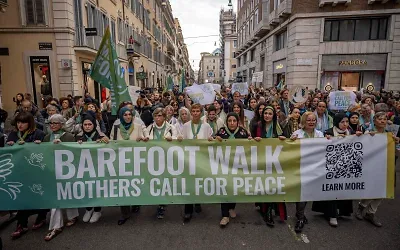
I spoke about the love of mothers for their children and the Mothers’ Call, the joint call of the Israeli Women Wage Peace and the Palestinian Women of the Sun, and I spoke about the religious symbolism in our barefoot walks. My clear message was that anyone who claims to support Israel must support peace; anyone who claims to support the Palestinian people must support peace. Peace is a shared religious value and only peace provides the basis for human dignity for all, men and women alike.
The following day, a presentation about the suffering of the Palestinian people under our occupation, from a former Archbishop of Oslo who has spent significant time in our region, was able to be viewed through the prism of hope. We Israeli women, who are prepared to fight for peace, are not the enemies of the Palestinian people but their potential partners. This is not rhetoric designed to deflect from our responsibilities towards Palestinians who live, not by choice, under our domination; it is a call from the heart for us all to recognize our shared humanity and for us to commit ourselves to respecting the dignity of every human person.
What a privilege it was to live and learn with strong, committed women from different faiths. Each of us went away feeling supported in her work, understood and understanding just a little more.
Related Topics
Related Posts