Return and Repair, North and South: The Long Road Ahead
We’ve emerged into the “day after the war” period, eyes squinting and tearing as we try to adjust to the vast horizon that lies ahead. I longed for us to get to this stage since the early days of the war, so very long ago. I knew it wouldn’t be easy. But at least we would be moving in a forward direction.
Yet, these past weeks I have found myself struggling to stay grounded given the enormity and complexity of what lies ahead. By chance, traveling with visiting family over the last week or so, I was in war-affected Israeli communities in the North and South. In both areas residents were forced to flee and wait out the war elsewhere. Though the situation in Gaza and Lebanon is still – each in its own way – ongoing, residents are in the process of trying to return and rebuild. I was able to get a glimpse into what makes this process so incredibly complicated, and also into what is needed to make it more feasible.
The North
Driving along a narrow ribbon of road which twists and turns with the hillside curvatures, more or less paralleling Israel’s border with Southern Lebanon, we passed some of the surrounding kibbutzim and areas impacted by Hezbollah.
As we passed Kibbutz Manara, we craned our necks up the steep hillside to see blackened windows staring out vacantly from bombed out abandoned buildings. These lie nakedly exposed to the Lebanese villages sprawled out on the rolling hills on just the opposite side of the road. It’s easy to understand why Manara is one of the hardest hit communities in the North, with some 75% of the kibbutz’s buildings destroyed by Hezbollah rockets. Now the community is working to rebuild, however they are doing so on the other side of the hill so as to no longer be as exposed. But this will take a long time.
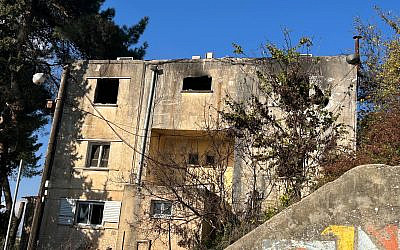
Manara was always a small community, I learn a few days later when I meet Ariela Lerman who leads development efforts on behalf of the Kibbutz Movement Rehabilitation Fund. It was also an aging community. Known as the kibbutz of 70 over 70 – meaning 70 members over the age of 70, half of their community was older and they struggled to bring in younger members. They had just been on a pathway to grow before the war, with fifty new families with kids gearing up to move in and make this their home. Now the kibbutz is back to wondering who will come live there, given the very real risks.
Then we drove by Kibbutz Yiftah, also situated right along the border with Lebanon. Some years ago, I had stayed there with my family for a weekend getaway, and we’d been astonished to see just how close. With the kibbutz’s back fence literally right up against the security road winding alongside the border with Lebanon, our hosts’ windows looked out over the area and we took morning walks paralleling that road. When we asked the hosts how safe they felt, they shrugged with heavy stoicism, saying that they hoped for the best in the same tired tone I have heard so often from people living in exceptionally difficult circumstances.
Like all the northern communities, Yiftah’s residents had to evacuate at the start of the war, thrown into the limbo existence of being refugees in their own country.
Now, as we drove by the kibbutz and started on the twists and turns of the descent, we could see their agricultural fields below the road. They had all been burnt in the fires from Hezbollah’s rockets during the war. But even from the road we can see that there has been replanting since then. Ariela explains to me that after the fires, kibbutz members waited for a governmental representative to come, assess the damage and help them determine what kind of governmental assistance they could qualify for. Weeks turned to months, with no such visit materializing.
But agricultural life cycles don’t adapt to political or bureaucratic cycles. Yiftah’s members realized they had no choice but to undertake the effort on their own. With the help of the Kibbutz Movement Rehabilitation Fund’s program “Wandering Kibbutz,” young people from around the country came and helped them replant their vineyards – the same vineyards we now see as we drive by. The same program helped Kibbutz Manara pick their cherries – amidst rockets hailing down on them from Hezbollah.
Now, at least, the return rate to Kibbutz Yiftah is exceptionally high, with some 95% having come back.
Southern Lebanon
We pulled off the road to a point overlooking southern Lebanon, where we can see villages spread across the rolling curves of the hills just opposite. Each and every building we see is in various states of ruin. Once sturdy cement walls, metal bars, roofs of homes where people went about the daily business of living, now lie crumpled up, strewn about. There are no signs of human life – with the exception of one civilian car we see making its way along the roads and wonder about.
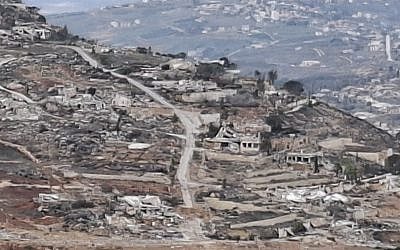
Like Kibbutz Manara, the villages’ buildings also lie nakedly exposed to Israel. When Israel withdrew from Southern Lebanon in 2000, Hezbollah immediately took control, intensifying its efforts to build a tunnel network which now consists of hundreds of kilometers beneath Lebanon’s surface to advance their goal of attacking Israel.
Hezbollah also positioned itself with the villages and houses whose ruins we were looking at. The no-nonsense Israeli friend who is with us says that of course the villagers didn’t want this. The magnitude of risk must have been quite clear to them, but they had no choice. Looking at the ruins of their lives, I wonder where are these villagers now? What kind of lives or future do they have?
As we gaze at the Lebanese village ruins opposite us, we can also see a UN outpost just a few hundred meters to their left. UN forces had been positioned there as part of its commitment to prevent Hezbollah from doing exactly this type of thing. So that Israel would not have to be in Lebanese territory doing this work of protective prevention.
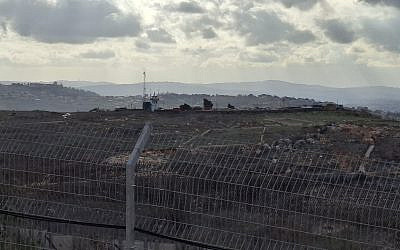
I have read about how close the UN outposts were, but in seeing for myself just how close they were while Hezbollah took over above and below ground, I feel anger rising up. I can see why these UN soldiers from around the world wouldn’t want to truly risk their lives for this. But given the UN’s utter failure to do this job, Israelis are inevitably skeptical about any outside force ensuring their safety. I have no desire for Israeli forces to be on Lebanese territory risking their lives and imposing control. But with Hezbollah’s decades of dedicated efforts and its continuing threats to attack and to conduct further October 7ths, and the Lebanese government’s lack of ability or will to control them, the security dilemma which this presents is obvious.
The South
A few days later we were down south visiting Kibbutz Nirim, which is just a few kilometers from the border with Gaza. Like all the surrounding communities, the kibbutz was hit hard on October 7, with 150 terrorists infiltrating that day, five kibbutz members taken hostage, five killed and extensive physical damage.
Now Nirim is one of the kibbutz communities with an exceptionally high rate of return and rebuilding. In discussions with Ariela and kibbutz member Adele Raemer, a few points stand out to explain their success, and shed light on the post-war challenges and needs across the affected communities.
Firstly, though kibbutzim comprise some .2% of Israel’s population, some 25% of the victims on October 7 were kibbutznikim (kibbutz members), with 318 murdered, 150 kidnapped (more than half of the total number of hostages), because these residential communities are located along the border areas. And these are the primary communities which had to evacuate – 56 in total, some 30,000 people who were displaced. So they have absorbed a considerable amount of damage from the war at every level imaginable.
Your pre-war capacity affects your trajectory during and post-war:
Resilience: Communities that were stronger and more resilient prior to the war, were better able to weather the traumas and challenges of being evacuees during the war as it dragged on endlessly. Likewise, they are better equipped now to deal with the challenges of return. Those who were weaker – economically and communally – are struggling more.
For this reason, Ariela explains that one focus of their rehabilitation efforts includes strengthening community resilience. This includes a range of efforts: workshops for the leadership; day trips for youth; meetings for seniors; full community events and more.
Evacuation plans: Another key factor which strikes me: kibbutzim which had evacuation plans in place in the event of such an emergency, were better off than those lacking such plans. That’s because this meant that their relocation site was predesignated; they mostly stayed together when they moved; and were better able to retain their communal structures, routines and – again – resilience. Such plans were in place for the kibbutzim in the southern area around Gaza, but not the northern areas bordering Lebanon, which made their situation harder throughout the war and now as well.
Ongoing needs assessments, information sharing and mutual support: The Kibbutz Movement’s Rehabilitation Fund keeps a close read on needs and issues across the kibbutzim through, among other things, a rapid needs assessment conducted via WhatsApp on a monthly basis. They also brought together the leadership from all the kibbutzim for a retreat, giving people the opportunity to meet, support and learn from each other.
Trauma: Signs of trauma are everywhere among Israelis generally, and of course for Palestinians as well, but each has its own unique aspects. Given the extensive impact on these northern and southern kibbutz communities, they will be dealing with trauma’s myriad effects for a long time to come.
Adele tells us that she knows more people who were killed or taken hostage than she can count. When she finally pushed herself to try to come up with some tally the list went on for pages. These were her fellow kibbutznikim; neighbors from nearby communities; students from across the entire area who she knew from years and years of teaching.
Now as people debate whether they will return or not, some former residents of these areas are too traumatized to do so. Others are returning but struggle to cope. Teens and young people from the kibbutzim are contending with high rates of depression. And the elderly are dying at much higher rates than usual. “It’s as though they were just hanging on throughout the war, and now that they are home, they are letting go,” observed Lehrman.
“We can’t reestablish our lives while Hamas’ tunnels are still operating,” Adele says. During our visit and throughout our day down South, we hear explosions in Gaza, all IDF. The situation is still in limbo. Nonetheless, she and some of her family members are starting to come back. And as we walk through Kibbutz Nirim we can see new buildings painted white glinting in the sun which they hope will soon house young people and families.
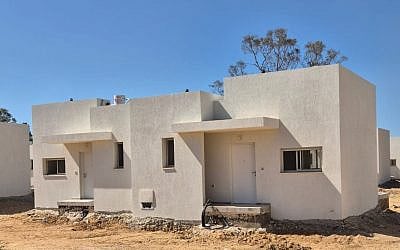
These are just fragments of the extensive challenges of return and rebuilding. There is much more to know and understand, and clearly Gazans face many multiples of this. It is the work of decades.
But as Ariela, Adele, Yiftah’s vineyards, and Nirim’s glittering white buildings also testify: the life force pushes people forward, giving us no choice but to keep apace.