Writing on Jewish life, relationships, trauma, and resilience
Returning to Israel With My Brother — This Time, to Serve
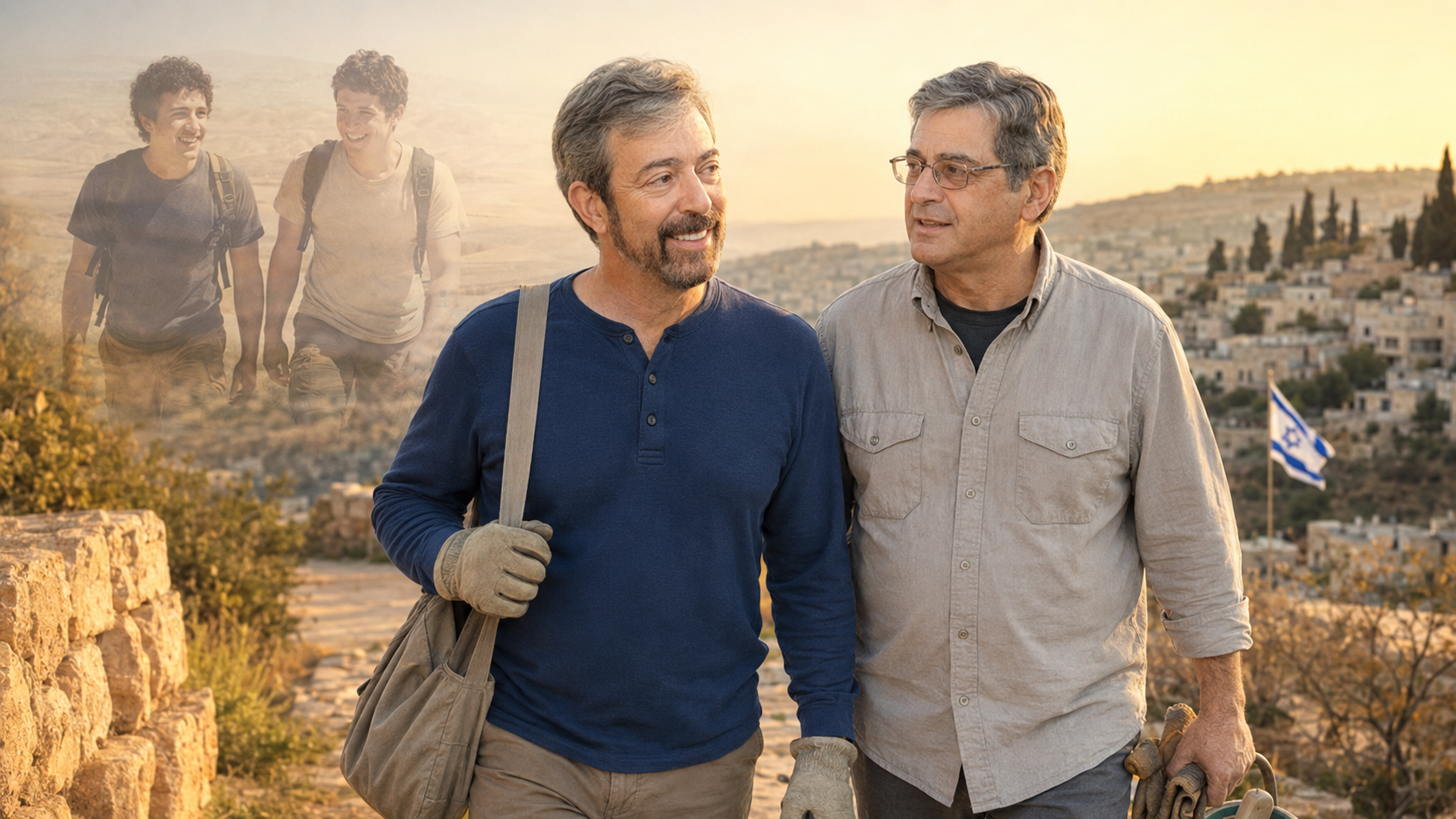
Illustrative. The author, left, and his brother. AI image created by the author.
The first time I went to Israel, I was 20 years old. My older brother David was 27.
We visited Sharm el Sheikh. We trekked through Sinai, which today is part of Egypt. I remember the desert — not perfectly, because memory is not a photograph, but vividly enough to still feel something of the silence, the heat, the stone, the sky, and the strange awareness that a place I had first encountered in Bible stories was suddenly under my feet.
At 20, I was old enough to think I knew who I was and young enough for Israel to unsettle and enlarge that answer.
David was beside me then.
That matters more to me now than it did at the time.
When you are young, you often think the journey is about where you are going. Later you understand it is also about who was with you before you knew what the journey would mean.
Since that first trip, my brother and I have both been back to Israel many times — dozens of times. Israel is not a place we visited once and preserved in memory. It has been part of our adult lives: a place of return, argument, love, concern, belonging, heartbreak, pride, and responsibility.
But this trip will be different.
Approaching 65, I am preparing to return to Israel with David again, this time on a Taglit-Birthright trip built around intense service.
We are not going back simply to see Israel.
We are going back to show up for Israel.
That distinction feels important.
When I was 20, Israel helped me understand something about who I was. Now, after October 7, I am returning with a different question: what does who I am require of me?
That question has followed many Jews since the massacre.
It is there when we read the names of the murdered. It is there when we see the faces of hostages. It is there when we hear from families who have lived for months inside an agony the rest of us can barely imagine. It is there when soldiers return home changed. It is there when communities near the borders try to decide whether safety can ever again feel ordinary. It is there when Jewish students on campuses wonder whether they must explain their grief before they are allowed to feel it.
What does who I am require of me?
For me, the answer begins with presence.
Not performance. Not slogans. Not social media declarations that disappear by morning. Presence.
The willingness to go. To listen. To serve. To be useful. To stand close enough to grief that it cannot remain an abstraction.
That is not because I imagine my presence can fix what is broken. It cannot. I do not confuse a volunteer trip with policy, security, diplomacy, or the impossible labor of a nation at war and in mourning. I know the humility required of distance. I live in America. I do not wake each morning in Sderot, Kiryat Shmona, Metula, Be’eri, Ofakim, Tel Aviv, or Jerusalem. I do not carry the daily weight Israelis carry.
But humility is not the same as absence.
Sometimes the most honest thing a Diaspora Jew can say is: I cannot carry what you carry, but I can carry something.
I can come.
I can help.
I can bear witness.
I can return.
That word — return — has become more powerful to me with age.
At 20, return was not yet my language. I was still in the age of arrival. Everything felt like a beginning. Israel was vivid, physical, overwhelming. The desert was not metaphor to me then. It was landscape. It was dust on my shoes, heat on my skin, mountains against the sky. I was meeting a place that had lived in Jewish memory long before it lived in mine.
Now, after decades of going back, I understand that Jewish life is made of returns.
Return to memory.
Return to responsibility.
Return to peoplehood.
Return to grief.
Return to questions we thought we had outgrown.
Return to each other.
In Hebrew, teshuvah means return. It is often translated as repentance, but the word is larger than regret. It is the movement back toward what is true. It is the refusal to let distance, confusion, failure, or fear have the final word.
Maybe every serious trip to Israel is a kind of teshuvah.
Not because Israel is perfect. It is not.
Not because every Jew must experience Israel the same way. We do not.
Not because going to Israel resolves every question. Often it deepens them.
But because Israel has a way of bringing Jewish identity out of abstraction and into the body. It asks questions that cannot be answered only from a comfortable distance.
What do I owe the past?
What do I owe the future?
What does peoplehood mean when it is not just a word?
How do I love something complicated?
How do I stay honest without becoming distant?
How do I stay close without becoming blind?
These are not questions I knew how to ask at 20.
At 20, I crossed Sinai with my brother and felt the grandeur of the Jewish story.
Approaching 65, I am returning with a quieter and harder question: what does it mean to remain faithful to that story when you have lived long enough to know how fragile everything is?
That is part of why traveling on a Birthright trip feels so meaningful now.
The young adults on this trip will be close to the age I was when Israel first entered me. They will bring their own assumptions, doubts, loyalties, discomforts, griefs, and hopes. Some may arrive with deep Jewish confidence. Some may come with questions they have not yet found language for. Some may feel pulled by family history. Some may wonder whether Israel has anything to do with them at all.
I understand that.
Identity is not handed down fully formed. It has to be encountered. Tested. Complicated. Made personal.
We do young Jews no favor when we offer them a flattened Israel — all miracle, no wound; all pride, no complexity; all defense, no moral questioning. Nor do we serve them by handing them only accusation, shame, and distance.
They deserve something better.
A real relationship.
A relationship with Israel that includes wonder and grief.
A relationship with Jewish peoplehood that includes pride and humility.
A relationship with history that includes both inheritance and responsibility.
A relationship with one another that leaves room for questions.
Birthright is a powerful word. It suggests that something belongs to us because we were born into it. But I have come to believe a birthright is not only something we receive. It is something we must learn how to carry.
At 20, I thought my birthright was the chance to see Israel.
Now I wonder if my birthright is the obligation to keep returning — not only to the land, but to the conversation, the people, the pain, the responsibility, and the unfinished work of Jewish life.
This time, returning means service.
I do not yet know exactly what that service will ask of us. Perhaps it will be physical labor. Perhaps it will be listening. Perhaps it will be standing with people who need to know they have not been forgotten. Perhaps it will be small, ordinary tasks that do not look heroic from the outside but matter because someone needs them done.
That, too, feels right.
Service is often less dramatic than solidarity. It is quieter than advocacy. It does not always announce itself. It asks not, “What do I want to say?” but “What is needed here?” It moves the center away from the self and toward the other.
That is a discipline many of us need now.
After October 7, Jews around the world have had to speak, defend, explain, grieve, organize, and argue. Much of that has been necessary. But there is also a time to stop explaining and start serving. A time to stop trying to win the conversation and simply show up for the people living inside the consequences.
That is what I hope this trip will be.
A way to show up.
For Israel.
For the young adults traveling with us.
For David.
For the 20-year-old I once was, walking through Sinai before I understood how much Jewish history would ask of me.
And perhaps also for the nearly 65-year-old I am becoming, who has fewer illusions than he once did but not less love.
That is one of the surprises of aging. Love does not necessarily become simpler. Often it becomes more honest. Less dazzled. Less performative. Less interested in proving itself. More willing to sit with contradiction. More willing to serve.
The Israel I first saw as a young man was luminous, intense, and unforgettable.
The Israel I am preparing to visit now is wounded, brave, divided, grieving, alive, and still demanding to be loved honestly.
I do not know exactly what I will feel when I land.
I imagine I will think of the desert.
I imagine I will think of David at 27 and myself at 20, walking through Sinai, unaware of how much life was still ahead of us.
I imagine I will look at the young people around me and wonder what memories are being planted in them, what questions are beginning, what part of the Jewish story is waking up.
And I imagine I will feel grateful — not for certainty, because I have less of that than I did when I was young, but for the chance to return.
With my brother.
With my questions.
With my people.
With memory under my feet.
And with the hope that service, however small, is one way love becomes real.
Related Topics