Reuniting with my parents during the Days of Awe
The Yamim Noraim, the Days of Awe starting on Rosh Hashanah and culminating on Yom Kippur, described by the late Rabbi Lord Jonathan Sacks as the “holy of holies of Jewish time,” are meant to be a period of introspection and soul searching. This ten-day span resonates very personally with me.
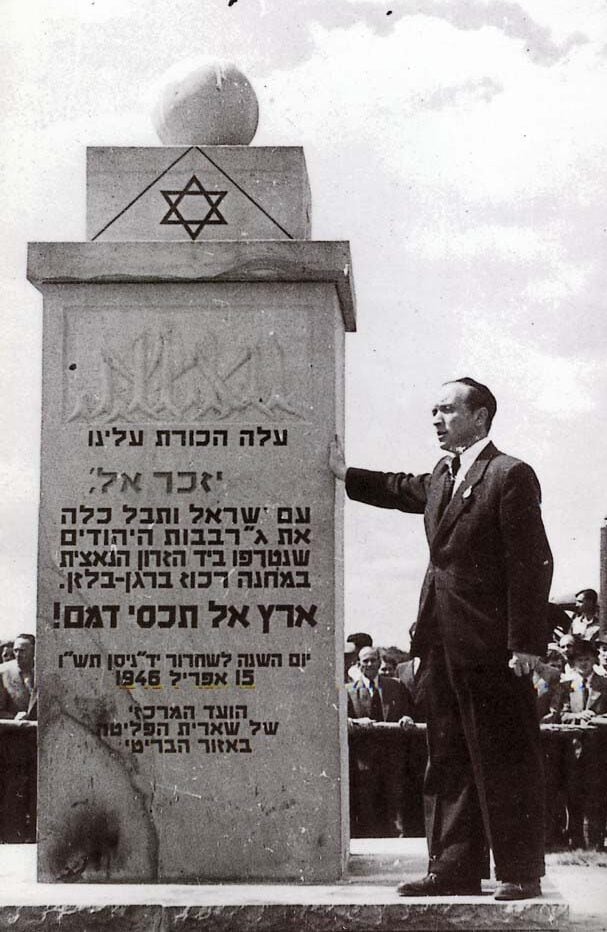
My father, Josef Rosensaft, died 51 years ago midway through the Yamim Noraim. A survivor of the Nazi German death and concentration camps of Auschwitz and Bergen-Belsen, he was the fiery, seemingly indomitable leader of the Holocaust survivors whom he helped to rebuild their lives in the Displaced Persons camp of Bergen-Belsen for five years after the end of World War II.
My mother, Dr. Hadassah Bimko Rosensaft, died 22 years later, several hours after the end of Rosh Hashanah. At Auschwitz-Birkenau, she saved the lives of countless women by performing rudimentary surgeries in the camp’s infirmary and sending them on work details ahead of selections for the gas chambers by SS doctors. At Bergen-Belsen, she was instrumental in keeping 149 Jewish children alive during the bitter winter of 1944-1945, despite a raging typhus epidemic. Five months after the liberation of Bergen-Belsen, she was the principal witness for the prosecution at the first war crimes trial of the perpetrators of the Holocaust.
Rosh Hashanah marks my last memories of them alive. On Rosh Hashanah in 1975, my parents were in London. I remember speaking with them by phone. We wished each other a good year, a sweet year. We said that we would be together for Kol Nidre. It was not to be.
On Rosh Hashanah in 1997, my mother was at NYU Hospital in New York, succumbing to the hepatitis she had contracted at Birkenau. My wife Jeanie, our daughter Jodi, and I were with her as the Jewish New Year came to an end. Again, we wished each other a good year, a sweet year, fully aware of the shadow hovering over us. She died holding our hands, with us telling her that we loved her. My mother’s funeral was on my father’s yahrzeit.
These are the memories that overwhelm me each year as I remember every moment of those Days of Awe 51 and 29 years ago. But sometimes sparks of different memories manifest themselves unexpectedly.
One of the things I used to love to do was sit with my father as he listened to recordings of Hasidic niggunim, melodies that brought him back to his home, to his family, before the cataclysm. On the second day of Rosh Hashanah, as Cantor Azi Schwartz, our chazan at Park Avenue Synagogue in New York City and himself the grandson of Holocaust survivors, began the powerful Hineni (Here I Am) meditation, I realized that he was using a different melody than usual. He davened (the Yiddish term for praying that means so much more than praying) rather than chanted the prayer using the Ashkenazic Hebrew pronunciation of pre-war Eastern and central Europe. The niggun caught me off guard. Without warning, I was back sitting with my father, just the two of us, and I had the surreal sense that Cantor Schwartz’s voice carried within it echoes of that same Hineni in my two grandfathers’ Hasidic prayer rooms and then, intoned almost in a whisper, in clandestine Rosh Hashanah services in the ghettos and camps.
And I remembered how my father never abandoned himself to nostalgia. The niggunim of his youth, of the world before, were a bedrock for him, a foundation stone, on which he built living in his here and now.
Four days later, I am in the morning minyan at Cornell University’s Center for Jewish Living on my father’s Yahrzeit when a friend texts me an article from that morning’s Washington Post. Using the much-maligned AI Chatbot, Daniella Greenbaum Davis had been able to locate and access an article her grandmother, then-19-year-old Masha Rolski, had written in the Yiddish newspaper of the Bergen-Belsen DP camp, on the first anniversary of the liberation.
In the article, Masha described April 15, 1945, when British soldiers had entered the camp. She wrote about “The heavy scraping of damp earth and the noise of tanks” and the hundreds of voices, though weak and faint, shouting, ‘We are free!'” Writing one year after, Masha remembered that on that day, “I am weeping and don’t know if these are tears of joy or sorrow.” She also remembered seeing a British soldier standing on a tank who also “doesn’t know whether to laugh or cry, because hundreds of eyes, fearful and glistening from hunger and pain, are surrounding him. Lips are kissing his boots, his uniform, and even the filthy wheels of the tank.”
As I read Daniella Greenbaum Davis’s article minutes before reciting Kaddish for my father, I can hear my mother describing the same scene of liberation, recalling the same emotions.
For my mother, just as for Masha Rolski, liberation had been the transition between death and survival, between an inability to laugh and the prospect of sun-filled tomorrows without “hunger and pain.” She devoted herself to saving lives. For weeks on end, starting on the day of her liberation, my mother and a group of doctors and volunteers from among the survivors worked with a skeleton British military medical team to save the lives of as many of the thousands of critically ill former inmates of Bergen-Belsen as possible. A herculean task, to be sure, but one that replaced the hopelessness of captivity with an ability to control one’s destiny by undoing at least some of the horrors she had endured. Her recent past may have become a permanent prologue, but it did not determine how she would cast the remainder of her days and years on earth.
Cantor Azi Schwartz brought me back to my father on Rosh Hashanah, and Daniella Greenbaum Davis awoke my mother’s voice that had been slumbering in my subconscious.
As we approach Yom Kippur, I do so from a different perspective this year than in the past. My mourning for my parents has been enveloped in a reminder of who they were and what it was like to be with them. The virtual transmitted memories that came to me so clearly and vividly on Rosh Hashanah and on my father’s Yahrzeit were memories that reunited me with my parents, if only for a brief moment, not in sorrow but as the towering, loving, forward-looking individuals they were.
This is as it should be. And so I am deeply, everlastingly grateful to Cantor Schwartz and Daniella Greenbaum Davis for reminding me what the Yamim Noraim are all about.