May the Schwartz Be With You
Rev. Dr. MLK Jr. and the Practice of Resilience
@timmossholder on Unsplash
I. Saturday Morning: Breaking Down Fences and Defenses
I logged onto the livestream of Shabbat morning services at B’nai Jeshurun, a 200-year-old, non-affiliated synagogue in New York City. (Side note: I was one small degree of separation from BJ when I worked for Rabbi Rachel Cowan, z”l, in the mid-1990s, but alas, in my early 20s, I was not yet at a point on my Jewish journey to appreciate what getting involved might have offered me.) In any case, when our local services were canceled due to snow, the opportunity to check out services presented itself. I was not disappointed. I spent the morning making small watercolor paintings as I sang along with the three rabbis at the bimah whose voices blended so beautifully.
What I didn’t know when I hopped on YouTube was that there would be a special guest speaker that morning in honor of Martin Luther King, Jr. My soul was tenderized after two hours of praying and following along with the Torah service when Rabbi Felicia Sol introduced Eric Ward, a writer, civil rights strategist, Executive Vice President of Race Forward, and a former Senior Fellow with the Southern Poverty Law Center.
I listened closely as she spoke:
“Belonging, not fear, is the foundation of a just society,” she began. “In a moment… when the Jewish community has been filled with a lot of fear and is pulling away from intersectional spaces, and there’s been a lot of challenge around the intersection of antisemitism and racism, and the Jewish community has not always had the resilience to stay and try to work through where there’s challenge… Eric has been a gem.”
She went on to address Ward directly: “I want to thank you not only for your persistence and your commitment and your saying hard things when we need to hear them, but for staying, which is not always true for many, many people…”
I want to pause here to tell you something. When Rabbi Sol said the words “pulling away from intersectional spaces,” I nodded, recognizing my own reticence around formerly welcoming intersectional spaces that became hostile to anyone who expressed a shred of solidarity with Israel after October 7, 2023.
I also need to say that I noticed how defensively I reacted, internally, when she said, “the Jewish community has not always had the resilience to stay…” This isn’t easy for me to admit, but you need to know this part of my whole truth.
The Jewish community didn’t have the resilience to stay? Stay, when we were called baby-killers? Stay, when Jewish students were being ostracized and alienated? Stay, when we were lectured about what counted as antisemitism, despite years of practicing “impact over intent,” stay, when hostage posters with babies’ faces were torn down, when Israeli survivors of sexual violence were ridiculed and doubted?
Like I said: Defensive.
I also know better, and I also knew that there was some truth in it, a truth maybe I didn’t and don’t particularly want to face or grapple with. But grapple I must, because the Jewish people are not the only people in peril. We are all connected, and to forget this would be a terrible casualty of my own trauma.
I am not ashamed of burrowing into Jewish spaces and relationships with such passion and ferocity. I am not willing to disavow my whole complex Jewish self to be nominally or conditionally accepted by the progressive left. But these do not diminish my commitment to civil rights, socioeconomic and racial justice, human rights, immigrant rights, women’s rights, LGBTQIA+ rights, interfaith work, multiracial belonging, education, the arts, freedom of speech, and the hope of living in a country where these are paramount and, most importantly, constitutionally protected.
In a word, I was ready to listen with an open mind and heart to Eric Ward, who began his talk with an invitation I fully took him up on: “Take a breath with me. Not a polite breath. A true breath.”
(Go ahead, try it. Never gets old.)

Ward spoke of MLK Day as not a tribute, but a covenant. He spoke clearly, compellingly, and challengingly about the relationship between racism and antisemitism and how, together, they pit us against each other and create a wedge that “breaks our ability to tell the truth about power.”
He warned of what the Torah warns us this week: That “a hardened heart is what happens when suffering becomes background noise, and cruelty becomes routine.” When a society gets trained to harden its heart, when we forget how to hold grief without turning into hate, when we forget the multiracial and interfaith requirements of a “grown-up” democracy, that’s when we’re in real trouble.
None of those requires uniformity of politics, perspectives, or beliefs. What it does require is something far more precious, and potentially more difficult: A refusal to harden our hearts. He insisted that our work is to show that it’s possible to “hold tension and still belong to each other.”
He ended the talk with a vow, “out loud, so it does not just remain a nice idea.”
“No more rehearsal. Divide and conquer must end here, and it must end now. We will not abandon the vulnerable. Again: No more rehearsal, divide and conquer ends here. We will not abandon the vulnerable. Rather, may we be the kind of people that Dr. King demanded. May we be the kind of people the Torah requires. And may we be the kind of people our children will thank. Amen.”
The kind of people our children will thank.
Whew. That got me.
Before services ended, Rabbi Sol offered blessings to members of the BJ community who would be flying to Israel the next morning on a solidarity mission. This expression of commitment to the land and people of Israel as the Jewish homeland bears absolutely no contradiction to the work of building strong coalitions between vulnerable groups. Quite the opposite, I would argue.
Saturday afternoon and yesterday, I read more stories from Minnesota and considered the challenges Eric Ward laid out so clearly, and Dr. King before him. I knew – and know – that the either/or myth is just that, a myth. That anyone who insists I trade my love of Israel as part and parcel of my Jewish self to prove my “real” commitment to progressive values is not for me.
And this truth also demands something of me – to remember to listen to and respect others’ whole selves, not just the parts I agree with or find comfortable.
I do not exile my defensiveness, nor do I want to allow it to entomb me.
Most of all, I want to be that kind of person my children will thank. I want to honor Dr. King’s legacy. I want to wrestle with what it means to live the Torah at a time when political violence is rampant, at a time when the doors have slammed on Jewish acceptance and inclusion in a way many people of my generation have found completely jarring.
II. Monday Morning: Whiplash
Two mornings later, after feeding Chalupa and taking her outside, writing in my journal, reading some news, and doing my battery of New York Times games, I checked WhatsApp, where I am a member of just two groups.
One of those consists mostly of rabbis across a pluralistic spectrum, who share writings, news, and stories about the threats of antizionism and antisemitism, misinformation, and how best to support our imperiled Israeli and American democracies.
And that’s where I learned that the organizers of the All Peoples Celebration, a major MLK commemoration event hosted by Alliance San Diego, had disinvited a local rabbi who had been slated to offer a benediction, owing to his “Zionist views.” Not only that, but when he asked if a different Jewish clergy member could go in his stead, he was told no. In effect, no rabbis were welcome to speak.
Now, I know there is a great deal of disagreement about what constitutes the difference between anti-Zionism and antisemitism. This case, however, leaves no room for splitting hairs.
This was an act of antisemitism, plain and simple.
As soon as groups premised on inclusion start trading political litmus tests for a seat at the table (and the podium, in this case), they are no longer serving ALL Peoples. The message is clear, and it is so unrelenting.
(As an aside: I wish the board of Alliance San Diego would sit down with Eric Ward for a conversation to understand why this is unacceptable. And I hope the members of the Jewish community who chose not to attend the celebration aren’t chided for a lack of resilience.)
Rabbi Jason Nevarez, President of the San Diego Board of Rabbis and Cantors and Senior Rabbi at Congregation Beth Israel of San Diego, responded with an Open Letter to Our San Diego Community from The San Diego Board of Rabbis and Cantors, which I strongly, strongly encourage you to read in its entirety.
Rabbi Nevarez writes: “To exclude rabbis from an MLK celebration because of their connection to Israel is not only a distortion of Jewish identity – it is a betrayal of Dr. King’s vision.” He concludes: “Justice demands better. Dr. King’s legacy demands better. And our shared future depends on it.”
The All People’s Celebration theme this year was “Choose Courage.” How about having the courage to risk tension in the name of a greater cause, one that is urgent and should unite us, rather than making a decision that caused needless exclusion, hurt, and further division?
Alliance San Diego put forth the following explanation and “apology” for their decision.
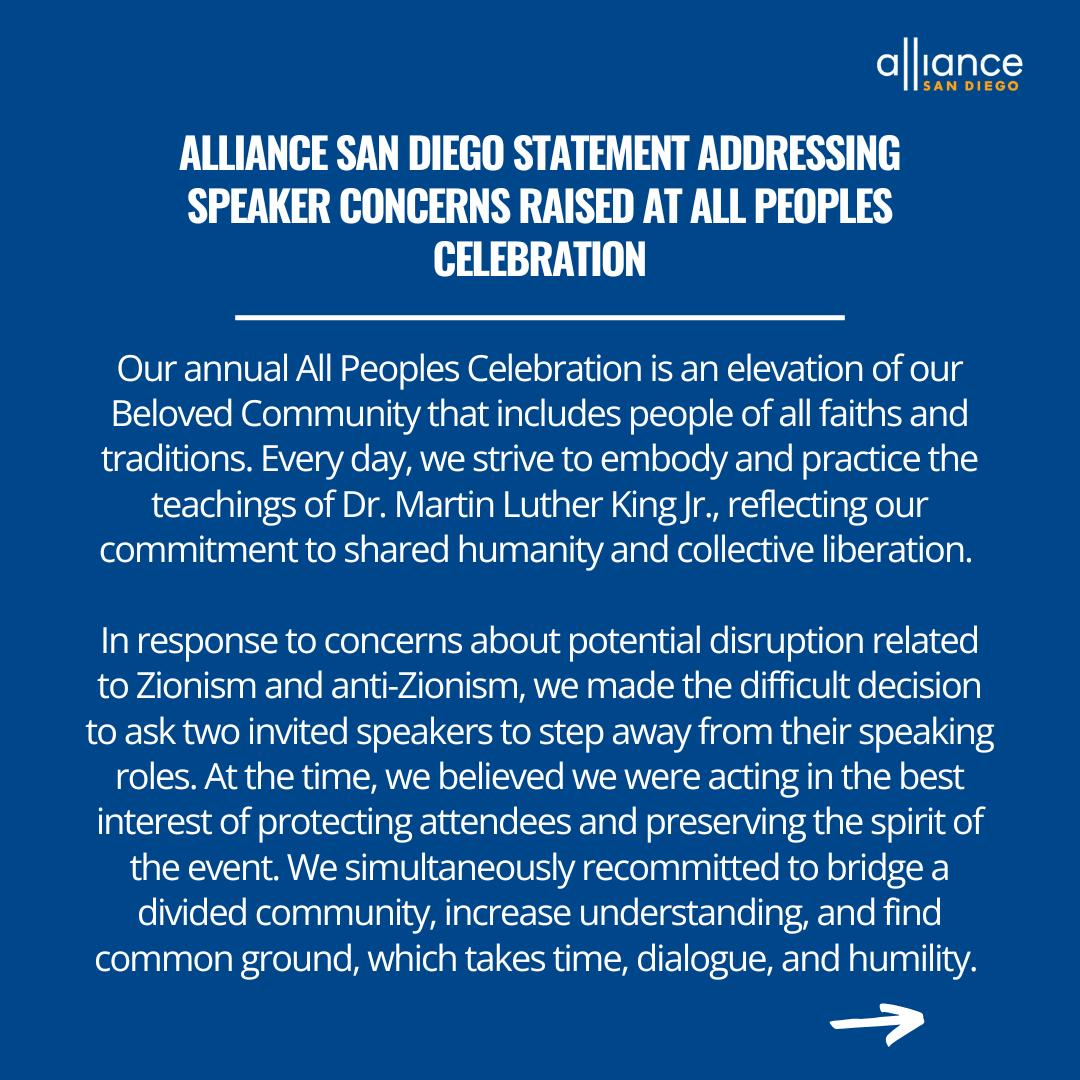
Three things stand out to me here.
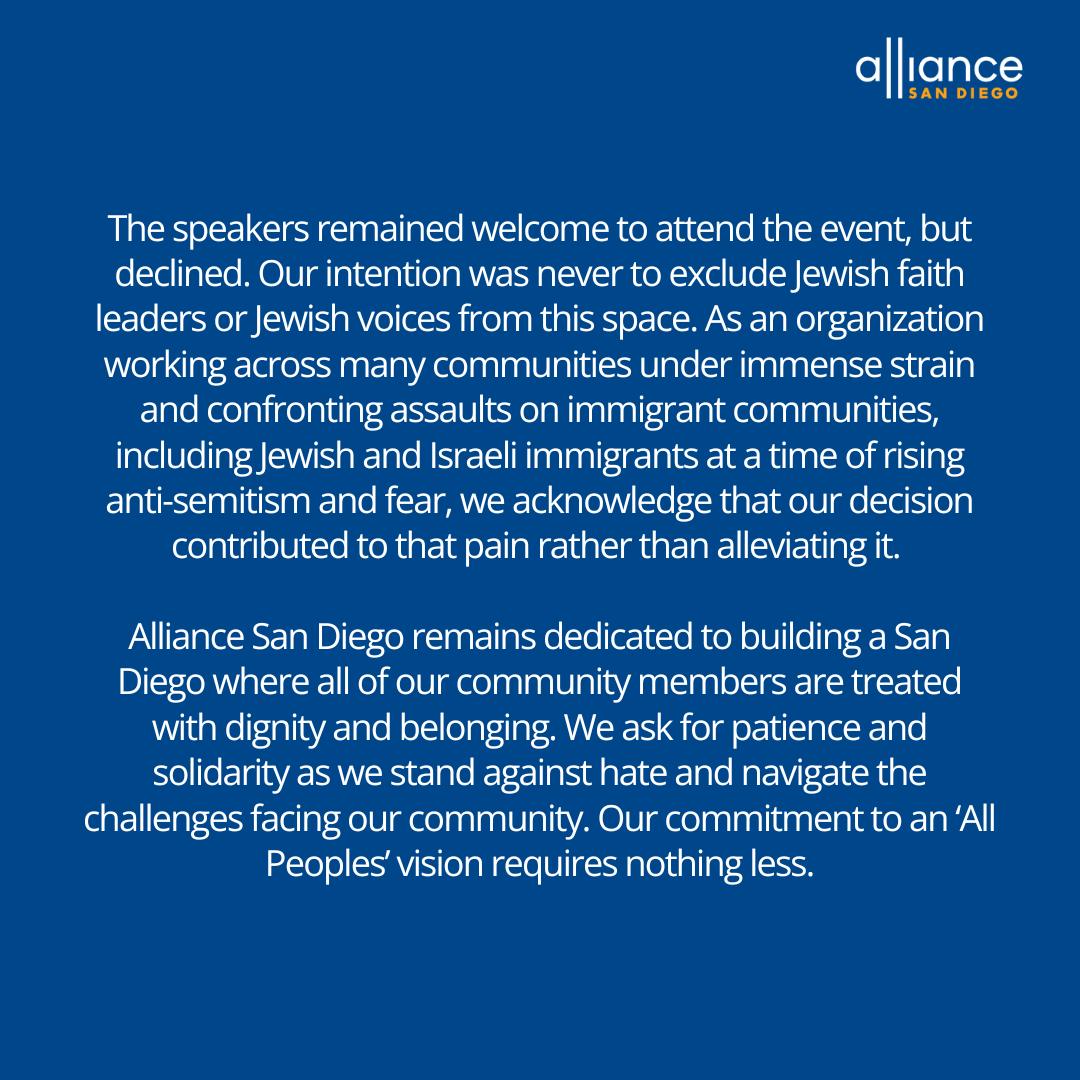
-
- If their intention wasn’t to exclude Jewish faith leaders or Jewish voices, can someone explain to me why they… um…. excluded Jewish faith leaders and Jewish voices?
- In anti-racism work, we learned that when it comes to causing harm, impact matters more than intention. Are Jews the exception there, too?
- I find the call for “patience and solidarity” deeply ironic. It would be funny if it weren’t so painful. The solidarity I hear is one-sided. It conveys: Stand with us, though we disinvited you. I bristle at how transactional that sounds when I write it, and I want to be clear that true solidarity should not be, cannot be, transactional. That is why the language here feels like such a setup. As for patience, let me quote Dr. King himself from his 1963 Letter from a Birmingham Jail, Dr. King wrote: “There comes a time when the cup of endurance runs over, and men are no longer willing to be plunged into an abyss of despair. I hope, sirs, you can understand our legitimate and unavoidable impatience.”
III. In the Words of Rep. John Lewis
On January 21, 2002, Rep. John Lewis, of blessed memory, wrote an op-ed in the San Francisco Chronicle, I have a dream” for peace in the Middle East / King’s special bond with Israel. I want to share the whole piece here:
THE REV. MARTIN Luther King Jr. understood the meaning of discrimination and oppression. He sought ways to achieve liberation and peace, and he thus understood that a special relationship exists between African Americans and American Jews.
This message was true in his time and is true today.
He knew that both peoples were uprooted involuntarily from their homelands. He knew that both peoples were shaped by the tragic experience of slavery. He knew that both peoples were forced to live in ghettoes, victims of segregation. He knew that both peoples were subject to laws passed with the particular intent of oppressing them simply because they were Jewish or black. He knew that both peoples have been subjected to oppression and genocide on a level unprecedented in history.
King understood how important it is not to stand by in the face of injustice. He understood the cry, “Let my people go.”
Long before the plight of the Jews in the Soviet Union was on the front pages, he raised his voice. “I cannot stand idly by, even though I happen to live in the United States and even though I happen to be an American Negro and not be concerned about what happens to the Jews in Soviet Russia. For what happens to them happens to me and you, and we must be concerned.”
During his lifetime King witnessed the birth of Israel and the continuing struggle to build a nation. He consistently reiterated his stand on the Israel — Arab conflict, stating “Israel’s right to exist as a state in security is uncontestable.” It was no accident that King emphasized “security” in his statements on the Middle East,
On March 25, 1968, less than two weeks before his tragic death, he spoke out with clarity and directness stating, “peace for Israel means security, and we must stand with all our might to protect its right to exist, its territorial integrity. I see Israel as one of the great outposts of democracy in the world, and a marvelous example of what can be done, how desert land can be transformed into an oasis of brotherhood and democracy. Peace for Israel means security and that security must be a reality.”
During the recent U.N. Conference on Racism held in Durban, South Africa, we were all shocked by the attacks on Jews, Israel and Zionism. The United States of America stood up against these vicious attacks.
Once again, the words of King ran through my memory, “I solemnly pledge to do my utmost to uphold the fair name of the Jews — because bigotry in any form is an affront to us all.”
During an appearance at Harvard University shortly before his death, a student stood up and asked King to address himself to the issue of Zionism. The question was clearly hostile. King responded, “When people criticize Zionists, they mean Jews, you are talking anti-Semitism.”
King taught us many lessons. As turbulence continues to grip the Middle East, his words should continue to serve as our guide. I am convinced that were he alive today he would speak clearly calling for an end to the violence between Israelis and Arabs.
He would call upon his fellow Nobel Peace Prize winner, Yasser Arafat, to fulfill the dream of peace and do all that is within his power to stop the violence.
He would urge continuing negotiations to reduce tensions and bring about the first steps toward genuine peace.
King had a dream of an “oasis of brotherhood and democracy” in the Middle East.
As we celebrate his life and legacy, let us work for the day when Israelis and Palestinians, Jews and Muslims, will be able to sit in peace “under his vine and fig tree and none shall make him afraid.”
***
U.S. Rep. John Lewis, a Democrat, represents the 5th Congressional District of Georgia and worked closely with Martin Luther King Jr. during the civil rights movement.
IV. Where Resilience Becomes a Practice
Honestly, my personal “cup of endurance” began to run over as early as October 8, when former allies posted images applauding Hamas paragliders and wrote things like “resistance by any means necessary.”
Now Gaza is in ruins, Israeli society is strained to breaking with trauma, the American Jewish community is politically and spiritually fractured, distrust is rampant between Jews and Palestinians, and Israel and US are both not only vulnerable to political violence and extremism but under attack from within by our respective authoritarian regimes.
I have failed to keep my heart open at all times, but I have not given up. As with every practice, I truly believe that it’s the return that matters.
And so I return. I acknowledge my edges. The defensiveness and anger. I do not tell myself these are wholly unjustified, nor do I let them consume me and blind me to the common struggles that are bearing down on the multitudes of us who love humanity, who love democracy, and who tremble for our children’s and grandchildren’s futures on this planet, no matter their race, religion, gender, sexuality, or immigration status.
I search my soul for moral blindspots and do my best to continue to bear witness and be a small voice not only for the Jewish people but for ALL people. Refusing to trade one for the other may turn out to be the steepest practice of all. May I have enough resilience to meet the task, however that may look, in my daily interactions, thoughts, and actions.
* *
Rabbi Sol’s introduction and Eric Ward’s talk take place between 2:11:40 and 2:33.
To listen (and sing along) to We Shall Overcome, go to 2:50:50.
We shall live in peace someday. May it be so.
Related Topics
Related Posts