
"These fragments I have shored against my ruins"
Revoking the Alhambra Decree of 1492: Justice Delayed, Not Justice Earned
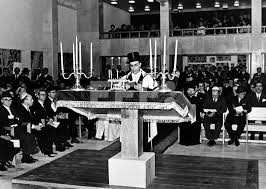
The inauguration of Madrid's Beth Yaacov Synagogue on December 16, 1968
(Photo credit: EFE, Reference: 8002416976)
On December 16, 1968, Madrid witnessed a moment that seemed almost unimaginable: the inauguration of the Beth Yaacov synagogue, the first new synagogue built in Spain in nearly five centuries. Six hundred guests filled the Chamberí district’s Balmes Street as Jewish dignitaries from across the world looked on. From the pulpit, a letter from the Ministry of Justice was read aloud, announcing the formal repeal of the Alhambra Decree of 1492 — the edict that had expelled Spain’s Jews at pain of death. Its annulment ended the requirement that Jews obtain state permission to worship and symbolically reopened a door that had been bolted shut for centuries.
Yet, the gesture was belated, symbolic, and deeply uncomfortable: Spain was inviting Jews back into a country where they had been forbidden even to exist, and where full citizenship rights would not be granted until 1978.
To understand the weight of that repeal, one must trace the longer arc of Spain’s relationship with its Jews. Jewish communities had lived in Iberia for more than a millennium before 1492, moving through cycles of tolerance and repression under Roman, Visigothic, Muslim, and Christian rule. Under Muslim rule, Jews as dhimmi were restricted but protected, and many thrived in diplomacy, medicine, poetry, and philosophy; under the Almohads, coercion and exile shattered that world and sent families like that of Maimonides into flight.
Under Christian monarchs, antisemitism hardened: the massacres of 1391 devastated communities across Castile and Aragon, and the Inquisition after 1478 institutionalised suspicion towards conversos accused of secret Judaism. When Ferdinand and Isabella completed the Reconquista with the fall of Granada in 1492, they sought religious unity; the Alhambra Decree of March that year ordered all Jews to convert or leave, ending centuries of Jewish presence in Iberia and scattering communities across North Africa, the Ottoman Empire, and Italy.
The expulsion was not without desperate resistance. Isaac Abarbanel, one of the most brilliant Jewish figures of the age, poured his fortune into Spain’s crown, hoping loyalty might shield his people. When the decree was issued, he offered Ferdinand vast sums to revoke it; the king hesitated, but Tomás de Torquemada, the first Grand Inquisitor, stormed in with a crucifix, warning against betraying Christ for silver.
The edict stood, and Abarbanel left with his fellow Jews; his exile through Italy and the eastern Mediterranean embodied the futility of Jewish appeals against entrenched antisemitism. By then, riots, forced sermons, and inquisitorial scrutiny had already made clear that Spain no longer saw its Jews as subjects to be protected but as a problem to be eliminated.
For the historian Benzion Netanyahu, that futility was not tragic inevitability but a failure of clarity: a leader of Abarbanel’s experience, he argued, should have recognised that these policies were existential rather than episodic and urged his people to leave while escape was still possible. Yet, Abarbanel did not come to Spain as a man of easy illusions; already an exile from Portugal, he knew how quickly royal favour could curdle into suspicion, and his decision to stake his fortune on Spain’s crown reads less as blindness than as a desperate wager that reason, loyalty, and service might still outweigh hatred.
If one figure embodies the continuity between service and expulsion, between trust and betrayal, it is Abarbanel, one of the few who attempted, with dignity intact, to negotiate the cancellation of the expulsion decree itself. His life compresses the diasporic Jewish condition: exile after exile, temporary shelter after temporary betrayal, brilliance that never translated into security, and faith strong enough to survive the collapse of every earthly structure it once trusted.
Abarbanel did everything Spain now claims to value; serving the crown, stabilising its finances, and bringing intellectual prestige to its courts, and yet, Spain repaid him as it repaid all its Jews, by demanding their disappearance. That the same country later declared, with the sweep of Franco’s pen, that Jews were once again “welcome” only underscores the grotesque symmetry: Abarbanel was exiled as a threat; modern Jews are invited back as symbols.
The centuries that followed erased Jewish life from Spain itself. The Inquisition extended its reach through the 16th and 17th centuries, producing trials, confiscations, and executions that reinforced a culture of fear, while Jewish identity survived only in whispers among families accused of “crypto‑Judaism.” Abroad, Sephardic communities — especially in Salonica, Istanbul, and Morocco — preserved Iberian liturgy, language, and memory, turning exile into a diasporic identity. The Inquisition was abolished only in 1834; by the late 19th century, small Jewish presences re‑emerged in Spanish ports, but native communities had long vanished.
The 20th century opened with Spain still largely devoid of Jews, while antisemitism lingered as a cultural reflex embedded in Catholic teaching and popular stereotypes. In 1924, Primo de Rivera’s dictatorship issued a decree offering citizenship to Jews of Sephardic origin, casting them as “lost children of Spain”; in practice it processed few applications, functioning less as repentance than as strategy to gain goodwill in Sephardic communities abroad.
During the Civil War and after Franco’s victory in 1939, synagogues were shuttered, Jews were branded “enemy elements” in service of a supposed Judeo‑Masonic and Judeo‑Bolshevik plot, and religious minorities existed without real equality or rights. This rhetoric gave antisemitism new life in 20th‑century Spain, embedding suspicion and hostility in political discourse whose echoes persist today.
During the Holocaust, some Spanish diplomats rediscovered the 1924 decree and used it to justify extending protection to Jews in occupied Europe. In Budapest in 1944, Ángel Sanz Briz invoked it to issue passports and safe‑conduct papers, placing thousands of Hungarian Jews in safe houses and shielding them under Spain’s flag; when he fled, Giorgio Perlasca forged documents to continue the rescue until the Red Army arrived.
Spain’s wartime record was a paradox: more Jews transited through Spain than in most neutral countries, but this passage was permitted rather than actively facilitated, and aid remained pragmatic, never dismantling prejudice at home. Franco’s regime compiled lists of Jews for Himmler and later welcomed Nazi collaborators, even as individual diplomats bent the rules to save lives.
After the war, public Jewish life resumed only gradually. Small numbers of Jews from Europe and North Africa arrived from 1947 onward; synagogues reopened discreetly and communities were cautiously legalised. In 1959, Madrid’s Jews received permission to open an official synagogue, and in 1964 the regime formally recognised Jewish communities as part of its “25 years of peace” celebration; by the late 1960s, Madrid’s Jewish population had grown, bolstered by Moroccan immigration after the Six‑Day War. Spain’s 1967 Law on Religious Freedom granted public rights to non‑Catholics, paving the way for Beth Yaacov.
It was against this backdrop that the Alhambra Decree was finally annulled in 1968. Coming 476 years after the expulsion, the repeal was largely symbolic, a gesture of reconciliation that did not dismantle entrenched prejudice; like the 1924 decree, it acknowledged Jewish ties to Spain without transforming structures that had excluded them. Spain’s antisemitism in the 20th century was not genocidal — there were too few Jews to target — but it remained a cultural reflex, resurfacing in rhetoric, conspiracy theories, and exclusion.
Franco’s revocation of the decree was not conscience but calculation: seeking legitimacy after the Second Vatican Council, the regime staged tolerance without dismantling repression, and the synagogue inauguration in Madrid became theatre — dignitaries posing beside Torah scrolls in a country that denied its own citizens basic freedoms.
In practice, Jews in Spain remained second‑class until democracy. Full citizenship and religious equality arrived only with the 1978 constitution; Spain was willing to revoke a medieval expulsion, but not to accept the descendants of the expelled as equals while Franco lived. The same pattern reappeared in 2014, when Spain offered citizenship to descendants of Sephardic Jews: the law promised opportunity but imposed steep hurdles — language and culture tests, proof of heritage, and costly fees — resulting in only about 1,500 approvals out of more than 132,000 applications before it lapsed in 2019.
Today, Spain’s Jewish population is around 50,000, concentrated in Madrid and Barcelona, with smaller communities elsewhere; between 1948 and 2010, 1,747 Spanish Jews made aliyah to Israel, a reminder that Jewish life there remains fragile, shaped as much by departure as by return.
Antisemitism in Spain is not a relic of the past; it is a living force, constantly reinvented. The temptation to trust power structures determined to sacrifice Jews while still believing they can be persuaded to act otherwise haunts every later Spanish “gesture” towards its Jews — from Franco’s theatrical revocation of the decree to today’s denunciations of Israel that license old prejudices in new vocabulary. In a political climate shaped by loud anti‑Israel rhetoric and the casual resurfacing of inherited antisemitic tropes in public culture, one sees how shallow that reconciliation always was: Spain did not outgrow antisemitism; it simply rephrased it for new audiences.
Pedro Sánchez, prime minister since 2018, governs on political quicksand. When a €6.6 million arms deal with Israel collapsed under public uproar, he deflected by accusing Israel of genocide — not to pursue justice, but to shield his fragile coalition. Parliamentarians leaned into antisemitic rhetoric: Gabriel Rufián likened Gaza to Auschwitz and attacked Sánchez’s party for “trading with a genocidal state,” comparisons Sánchez validated by framing Israel’s war against Hamas — the group behind the deadliest massacre of Jews since the Holocaust — as genocide.
The rhetoric spilt into public life: during Eurovision, Israeli singer Yuval Raphael faced violent protests and hostile commentary, while Tottenham Hotspur fans in Bilbao were met with banners declaring “Zionists, you aren’t welcome,” and Spain later announced it would not participate in Eurovision at all. In Spain, antisemitism resurfaces as symbolic exclusion, casting Jews as outsiders and turning their presence into a political liability.
Spain must now choose: will it confront this legacy or repeat it? Will it reject antisemitism in all its forms — including the fashionable, weaponised kind cloaked in moral language and aimed at the Jewish state — or continue to indulge it for political gain? The Jewish people have endured centuries of persecution and will continue to do so with resilience and resolve; the question is whether Spanish democracy can withstand the hatred it now enables, whether it has the courage to break from its past or remain captive to it. History is watching. And it has seen this before.
The revocation of the Alhambra Decree in 1968 matters not because it repaired anything, but because it exposes a deeper truth: justice offered centuries late is also a confession that justice failed when it mattered most. Spain’s relationship with its Jews has long oscillated between nostalgia and rejection, opportunism and remorse, showing that moral gestures cannot be separated from political motives — nor can they replace the work of memory.
The question raised by the 1968 revocation is not whether justice can arrive centuries late — history is full of delayed recognitions — but whether a symbolic gesture counts as justice at all. Does a nation absolve itself by declaring that its ancestors were wrong, or is the moral weight of that past measured by what it chooses to confront in the present?
Yet, there is something profoundly human, perhaps uncomfortably so, in the fact that Jews continue to look back at the places that cast them out, searching for meaning in their half‑hearted apologies. It reveals not naïveté, but the lingering belief that history should, at some point, resolve into moral logic; a belief history rarely honours. Spain revoked the decree, but the expulsion remains the clearest moral truth in the story, and the revocation, stripped of its ceremony, reveals how little the country has changed and how thoroughly its moral imagination still depends on forgetting.
This anniversary feels less like a commemoration and more like an X‑ray that illuminates fracture lines Spain prefers to keep invisible, a reminder that exile is not undone by a declaration and trauma does not expire when a government decides it has lasted long enough. What had been lost could not be restored by decree; five centuries later, Spain proved it.
Related Topics
Related Posts