
Riding Islam: Turkey’s Bet on Jerusalem
The neo-Ottoman claim, the Turkic bloc, and the Baku test — why the Turkish threat aims not at Gaza but at the symbolic center
On June 28, the Israeli government unanimously approved a resolution recognizing the Armenian Genocide — a decision put off for decades precisely so as not to antagonize Ankara and Baku. The reaction was immediate. Turkey condemned the move harshly, tying it to the International Criminal Court warrants and Gaza. On June 29, Azerbaijan joined the Turkish condemnation — an ally of Israel, calling the recognition a distortion of historical facts and urging Jerusalem to reverse it. On July 16, the Knesset vote that would have made the recognition state policy was taken off the calendar before the summer recess. The chamber will not sit again until after the October 27 election.
Three weeks from cabinet decision to shelved bill. That arc is the subject of this article.
This episode is no diplomatic trifle. It exposes what the Dor Moriah mass and expert surveys recorded back in May: the chief Turkish threat to Israel lies not where Israel’s defenses are pointed. It is not a direct intervention in Gaza. Where the Turkish threat is genuinely military, it runs through Syria — through Turkish arms and a presence at Israel’s borders. But Ankara’s main bet is symbolic and ideological, and it is aimed at Jerusalem. And Baku’s turn shows how far the pull of Turkey’s claim to leadership in the Islamic world reaches — and where its limit lies.
Not territory, but status
Turkey’s quarrel with Israel does not reduce to a single conflict. Erdogan’s anti-Zionism, as his June speech showed, is embedded not in the frame of a “Middle Eastern dispute” but in the category of Turkey’s state self-preservation. It is a claim of ontological incompatibility between two projects — and both projects fight not over a plot of land but over status.
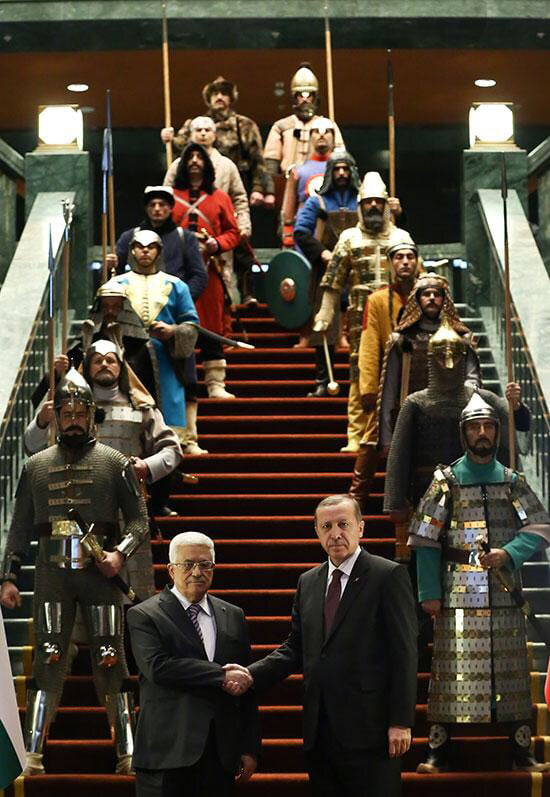
The Turkish project is assembled from two sources. The first is neo-Ottomanism: the reactivation of the imperial past as a matrix for regional policy, in which Turkey conceives of itself not as a nation-state but as the heir to a civilizational center. The second is the network of political Islam around the Muslim Brotherhood and the Turkey–Qatar axis — a supra-state identity in which Ankara takes on responsibility for the umma. Fused together, they yield the claim to “ride Islam” — leadership of the Sunni Islamic world.
And this claim has a geographic logic. Leadership of the Islamic world rests on the possession of holy sites: for Saudi Arabia these are Mecca and Medina on the Arabian Peninsula — Islam’s two foremost sanctuaries, which give the kingdom the standing of custodian. Turkey has no sanctuaries of that rank of its own. But there is one it can lay claim to in a pan-Islamist role — Jerusalem, Islam’s third holy site. In Ankara’s picture it is “the most important after Mecca and Medina,” and the contest for it is a way to wrest from the Saudis the title of custodian of Islam. This is precisely why the symbolic prize of Turkish leadership is Jerusalem.
That is why the Turkish presence concentrates not in Gaza, where Israel holds a hard military veto, but in East Jerusalem — through diplomacy, education, religion, the restoration of heritage. This is entry not by force but by presence.
What the mass survey showed
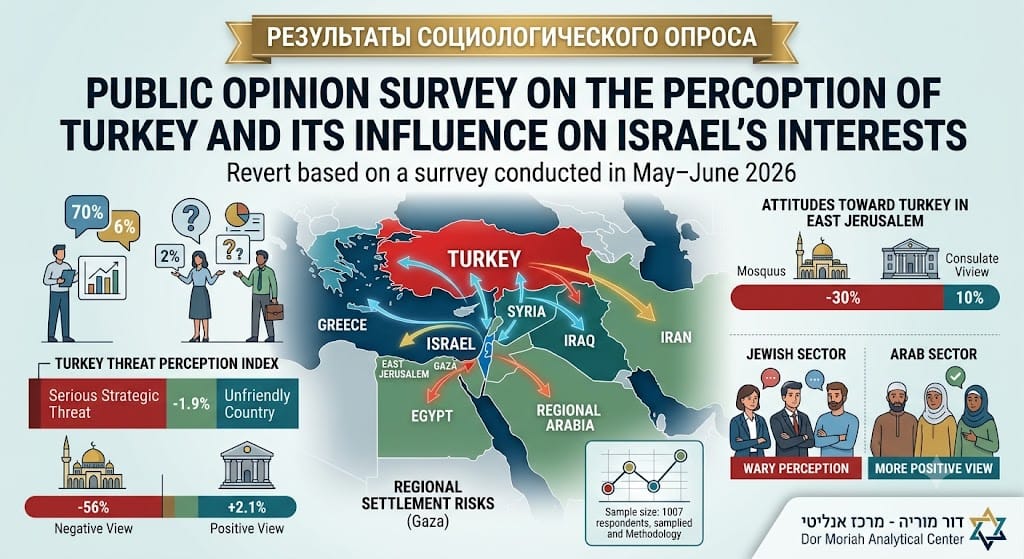
Israeli society reads this geography of threat accurately. The Dor Moriah mass survey (May–June 2026, 1,007 respondents, sampling error ±3.1%) shows that it is precisely East Jerusalem that draws the sharpest reaction.
Turkey’s diplomatic activity in the city is rated negatively by 69.9% of Jews — one of the harshest figures in the entire study. Turkish cultural, educational, and religious projects there are rejected by 63.5%. A majority (45.5% across the sample as a whole) holds that such activity may be permitted only under strict control, given the high risk of external ideological influence. This is no abstract anxiety: society understands that the battle is over the symbolic capital of Jerusalem, and reacts accordingly.
What the expert survey showed
The expert panel names this mechanism. In May 2026, Dor Moriah surveyed eleven specialists, from secular leftists to the religious right; the convergence of assessments across the ideological spectrum is the main result, turning private opinions into a structural picture.
The structural picture is this. The hierarchy of threats is drawn by the experts almost unanimously: first comes ideological and proxy patronage; last, the pan-Turkic military vector, which the panel considers overrated. The main threat, in the experts’ formula, is not tanks but networks. Turkish penetration is described as a “Trojan horse”: not direct intervention but the accumulation of political capital through humanitarian, educational, and religious functions — Diyanet, TIKA, TDV. Ankara does not help; it takes the field. And a prohibitive strategy loses here: it hands Turkey the image of a “blocked benefactor.” The working countermeasure is not a ban but an alternative, transparent, non-religious infrastructure.
The crucial point: the experts flagged a blind spot in Israeli analysis — Turkish secular cultural export, building long-term sympathy among Israel’s Arab citizens. And here the two studies meet. What the experts called a hypothesis, the mass survey measured. In the Arab sector the index of perception of Turkey is positive (+29.7): a favorable assessment prevails, while in the Jewish sector it is deeply negative (−49.5), with the perception of threat dominant. Arab respondents rate Turkish activity in East Jerusalem positively, and only 9.3% favor strict control over it, against 52.4% among Jews. The blind spot is not hypothetical — it is already on the radar, in the numbers.
The prohibition arrives on schedule
The panel’s warning about prohibition was tested within six weeks, and not by Ankara.
On July 14 the Jerusalem Center for Applied Policy published a policy paper by Ran Yishai, a retired ambassador who heads its research division: ten recommendations on the Turkish consulate in Jerusalem. Strip diplomatic privileges from staff not accredited to the State of Israel. Cancel their work visas. Restrict their movement inside the country. Remove immunity from their vehicles. Take away the reserved parking and the tax exemptions, and review the property-tax status of the consulate’s buildings. Audit the work of the Yunus Emre cultural center and of TIKA, and pursue the building-code violations alleged on their compounds. End the practice by which diplomats accredited to Israel simultaneously hold posts in a mission that operates with the Palestinian Authority. The paper offers Ankara one way out: move the embassy to Jerusalem, as Washington did in 2018, and close the consulate that serves Ramallah.
The document is careful and well-built. Its authors say plainly that the aim is not to shut the consulate but to change the terms on which it operates. It is also, item by item, the strategy the expert panel identified as the losing one — administrative denial of a service Turkey delivers to a population that wants it. Every canceled permit converts a Turkish project into a Turkish grievance and hands Ankara a constituency in East Jerusalem it did not have to organize. Israel is not short of legal instruments in its own capital. It is short of anything to put in the vacated space.
That is the asymmetry the panel was pointing at, and the JCAP paper illustrates it in reverse. Ten recommendations are about removing Turkey. None is about what a resident of Silwan or Beit Hanina gets instead — from whom, with what money, under whose name.
The Turkic bloc and the Baku test
The second pillar of the Turkish claim is Turkic solidarity, institutionalized in the Organization of Turkic States. Here, however, the expert panel cools the alarmism. The OTS is assessed as a 70–80% ceremonial platform with no binding-decision mechanisms; its real part is narrowly logistical. The ceiling on Turkish influence in the post-Soviet Turkic space is set not by Israeli counteraction but by the sovereign pragmatism of local elites and Ankara’s lack of the capital base to convert cultural closeness into dependence.
The firmest constant in the region, the experts said, is the Baku–Jerusalem bond: it holds on the Iran factor, and Turkey cannot replace Israel’s defense and intelligence cover for Azerbaijan.
The genocide episode tested that thesis in real time, and the result splits cleanly in two.
On hard security the panel was right. Azerbaijan did not touch the substance of the relationship. Oil through Ceyhan kept flowing, the intelligence arrangements against Iran kept running, the defense procurement kept going. Baku protested and did not pay for the protest. Sovereign pragmatism and the Iran factor held, exactly as forecast.
On the symbolic level the panel’s optimism was too broad. Baku did not merely register displeasure; it got the outcome it wanted. On July 16 the Knesset vote was dropped before the recess, and press accounts credit Turkish and Azerbaijani pressure. The bill has not been withdrawn — it now belongs to whatever coalition emerges after October 27. Israel raised a weapon against Turkish historical legitimacy, held it up for eighteen days, and put it away.
Read the two halves together and the boundary is drawn precisely. Ankara’s pull cannot move Baku on oil, arms, or Iran. It can move Jerusalem on a resolution. The pull works where the stakes are symbolic, and Israel discovered that symbolic stakes are where its own tolerance is thinnest.
Yerevan supplied the coda. Asked to comment, Prime Minister Pashinyan said Armenia saw no need to respond and had no interest in the genocide becoming a political instrument. The Armenian diaspora press in the United States was harsher, calling the Israeli move the use of a national tragedy as a scoring card. The party in whose name the moral act was performed declined to accept it as one. That is the clearest available evidence of what the recognition actually was: an instrument of demarcation with Ankara, priced and then withdrawn.
The election as a channel
One vector was outside the May surveys and is now inside the calendar. Israel votes on October 27, and Turkey is working the campaign.
Gabi Siboni of the Jerusalem Institute for Strategy and Security put it in one line this month: Turkey is attempting to operate inside Israel, including during the elections, through influence campaigns and activity in Jerusalem’s Holy Basin, funding and building mosques to challenge the Israeli presence. His colleague Kobi Michael, of INSS and the Misgav Institute, framed the objective the way the panel had: Turkey is not seeking war with Israel, it is seeking to isolate and weaken it.
This matters for the argument because of what the mass survey found earlier: on the risk of Turkish influence on Israeli domestic politics, respondents chose “low or none” over “high” by 48% to 37%. A society that calls Turkey a strategic threat sees little danger in its reaching inward. Between May and July the reach became a campaign variable, and the perception has not moved.
What Israel has yet to formulate
Put the four elements together — the Jerusalem bet, the Turkic bloc, the Baku test, the election channel — and the contour of the Turkish threat emerges, one that does not match the familiar picture. Israel is bracing for Turkey in Gaza, for Turkish soldiers, for a military presence. But Ankara’s real bet is on the symbolic center and on the loyalty of a population: East Jerusalem as the prize of Sunni leadership, and Israel’s Arab citizens as the field of long cultural influence.
This is a threat against which there is no military answer. You cannot strike at sympathy. You cannot sanction the restoration of a mosque. You cannot contain the pull of Turkey’s claim to leadership in the Islamic world — a pull that on symbolic questions moves even Baku, the ally the experts named the firmest constant in the region.
And Jerusalem has not settled on a register in which to answer. Its ministers call Erdogan a grotesque hybrid of Hitler and Sinwar and demand the consulate be shut. Its prime minister told foreign media on July 14 that Turkey is not an enemy state. Its cabinet armed a historical charge in June and its parliament put the charge back in storage in July. A think tank drafts ten ways to make Turkish work in the city harder and none to make Israeli work in the city more attractive.
The May studies by Dor Moriah and the summer that followed converge on a single conclusion. The Turkish threat aims not where Israel’s defenses are looking. It aims at Jerusalem as a symbol, at the umma as an audience, and at Israel’s Arab rear as a field. And the answer to it is not military but the one Israel has developed least of all: a long, patient, non-religious presence in its own symbolic and human space. That answer has yet to be formulated. Between June 28 and July 16, Israel demonstrated instead how quickly it can raise a symbol and how quickly it can put one down.
For the full survey: https://dor-moriah.org.il/en/turkiye-through-the-eyes-of-israelis/?v=4605f628f91d