
Right or Wrong, Labelling the Left
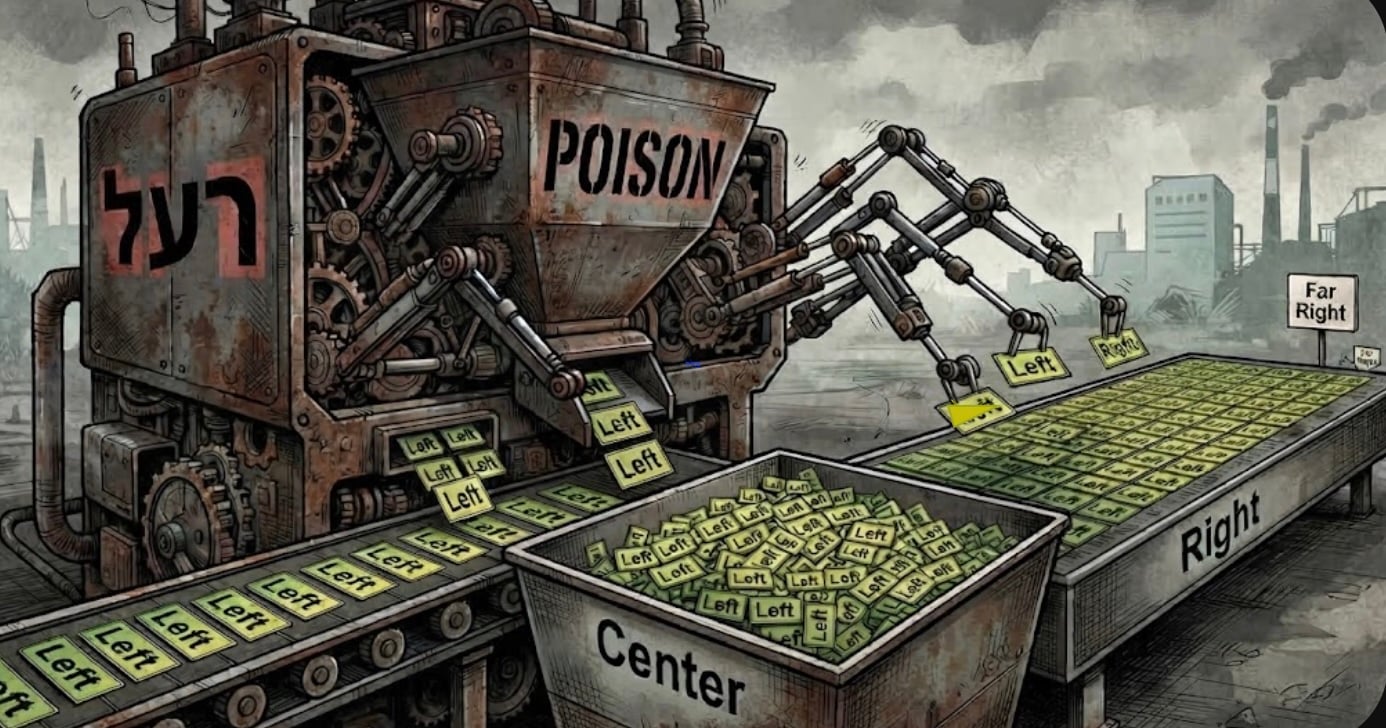
Just several years ago, Israelis politically identifying as center, objected to the right labeling them “left.” That center includes center leaning right to center leaning left. That right, filtering labels through the approval apparatus of the Netanyahu household, has an agenda. Their side, or you’re not right!
That apparatus, commonly called the poison machine enables PM Netanyahu and his government’s actions causing Israel’s isolation by former allies. The toxins infect relationships within Israeli families and diaspora Jewish families.
The center – including center leaning right – succumbs to the leftie label. They assure you they’re just not “that far left.” They wouldn’t vote Yair Golan, they’ll vote Gadi Eisenkot. Like his party name, Eisenkot is Yashar (straight), not left. Golan leads the Democrats party formed from the former Labor and Meretz parties. Both men had impressive military careers. Golan considered provocative, can unintentionally deter vacillating voters. His party amorphously articulates leftist positions, with “left” connotations accusing them of national betrayal.
Avigdor Lieberman, heading the Yisrael Beiteinu party, will likely join a coalition with Eisenkot, like Naftali Bennett, head of B’Yachad. Lieberman prefers a coalition without Democrats. Neither Bennett nor Lieberman are anything but right. They frequently reiterate that, responding to labeling emanating from the poison machine. By some scenarios, one of them, not Eisenkot, could be our next prime minister.
Left to right shifts respond to security events. Government spokespersons feed mainstream media – poison machine filters play a role in forming public perceptions of security.
Arab parties are considered by leftie Jewish voters, despite party marginalization by the “left” compelled to assert it will only form a coalition with Zionist parties, i.e., party lists with Jewish majorities.
Zionist parties, right to left, invariably include Arab and Druze representation on their lists. Politics negotiate interests. Minority members of Zionist parties prioritize certain benefits over discriminatory legislation (as in the case of the Nation State Law, 2018, omission of equality for minorities, as per Israel’s Declaration of Independence).
If labels position centrist parties in coalitions with Zionist parties only, the parties undermine democracy and equality specified in Israel’s Declaration of Independence. The Democrats would partner with Arab parties. Yashar only welcomes support from Arab parties for a coalition that will exclude them.
The previous government, with rotating Prime Ministers Bennett and Lapid historically included an Arab party, first courted by Netanyahu. Bennett says it’s different after October 7. Speculations Eizenkot will include an Arab party to ensure 61+ coalition members (from 120 Knesset members), are deemed unlikely even among those who would endorse it. “Not after October 7” is powerful.
Preparing Rosh Hashana dinner, a right-wing politician’s voice reached my kitchen from the television: Arab absence from public life. Accusatory.
My thoughts: Disregard for disproportionately high service in public health and medical professions. Disregarding government actions interfering with Arabs’ options in public life.
Pondering, recalling a radio interview last week with former Likud MK, Benny Begin. The current government, he said, seeks not to govern, but to control.
Thinking, what would currently validate Arab party inclusion in a coalition?
Foreseeable numbers of Knesset seats for the Democrats doesn’t bring Golan close to being prime minister, to determining the coalition partners. Eizenkot will likely have that role by the prevalent scenario. The Democrats will join his coalition.
I avoid confrontations with the left defined by the poison machine. An acquaintance at the gym told me last week she isn’t as leftist as my t-shirts suggest I am, but she’s left, she’ll vote Eizenkot. Listened, without setting her straight – Eisenkot is not left. In the scheme of things, I hope Eisenkot will be our next prime minister, with Golan’s influence stronger than Lieberman’s.
A friend proposed I vote Eizenkot to fortify his power with as many Knesset seats as possible, suggesting one less MK for the Democrats is inconsequential. I didn’t mention considering an Arab party. Admittedly, my calculations include the potential impact of my vote on a coalition.
My West Bank settler cousin won’t vote Likud nor for any party prepared to join a Netanyahu coalition, believing Netanyahu must take responsibility for October 7. That limits party choices on the right. The dilemma? Voting Lieberman or Bennett means voting for a left-labelled coalition.
Do other West Bank settlers share his dilemma? “No,” he responded, “That would require thinking, when it’s easier not to. If they disqualify the Likud, they’ll vote Ben-Gvir or Smotrich.” Right, or wrong.
Thinking. A lot depends on it.
Harriet Gimpel – September 13, 2026