Clarity for Leaders in Law, Policy, Finance, and Covenant
Rightness vs. Righteousness: America’s Idolatrous Warning for Jews
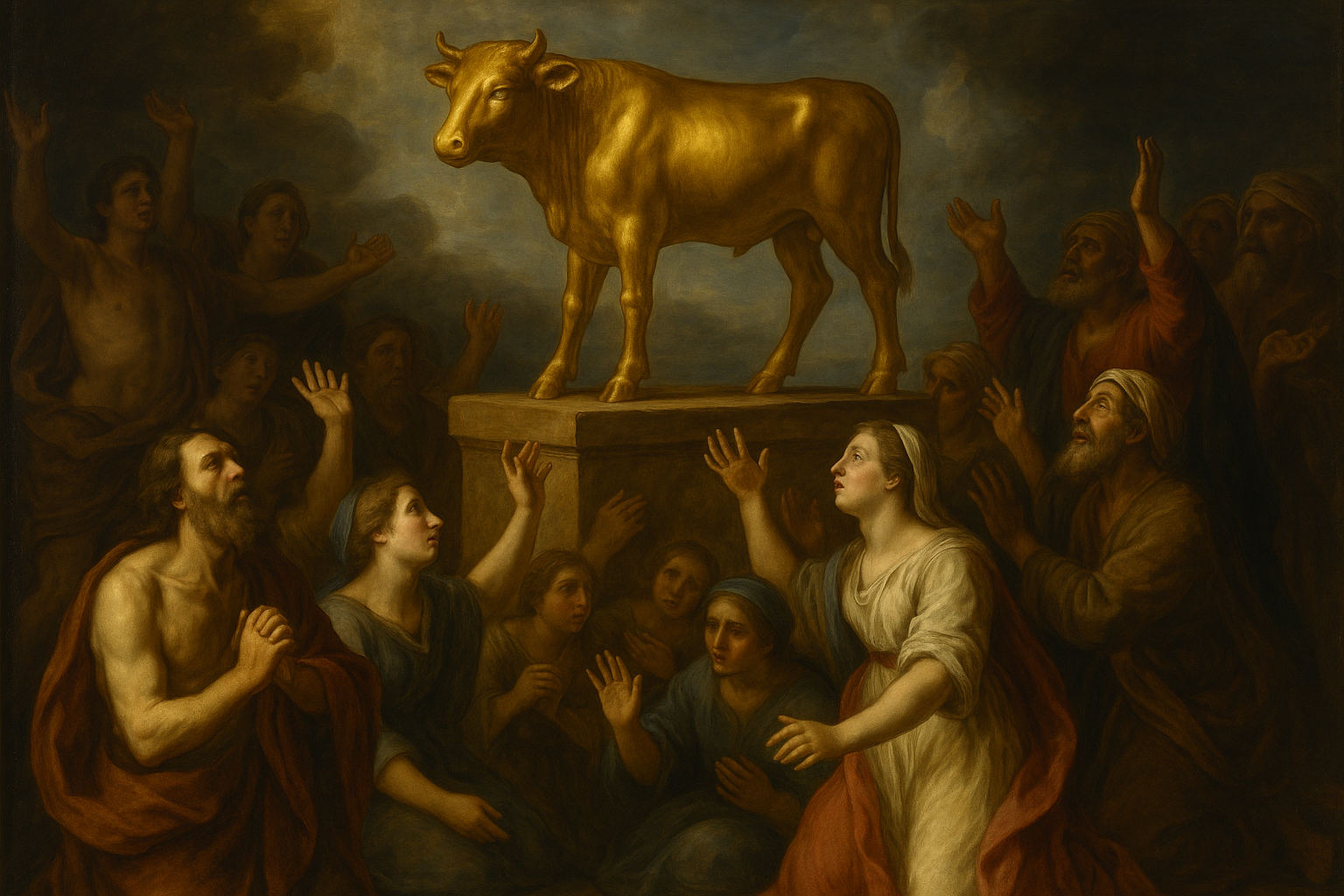
Image Source: The Sovereign Standard. The Golden Calf remains a timeless symbol of political idolatry, when human constructions are exalted above covenant with G-d.
From Heschel at Selma to Wiesel’s warning on silence, Jewish voices remind us that political theater is not a substitute for covenantal righteousness. America’s weaponization of faith and free speech is idolatry, and Jews cannot afford to ignore its danger.
_____________________________
From the vantage of Jewish tradition, America today is beset by a crisis deeper than partisanship, one of idolatry. In the Bible, idolatry is not only bowing before statues; it is elevating human constructions, party platforms, ideologies, and cultural myths above G-d’s truth. Prophets such as Isaiah, Jeremiah, and Amos condemned precisely this: when ethical covenant is traded for political correctness, when ritual or speech becomes a tool of power rather than a channel of duty. We are now living that prophetic warning.
The Democratic Party has, in recent years, been allowing outright antisemitism to persist in its ranks, excusing rhetoric that targets Israel and Jewish identity while rebelling against traditional moral norms in the name of progress. Meanwhile, the Republican Party increasingly proclaims that “America is a Christian nation”, not as a humble acknowledgment of faith but as a cultural identity and political claim. Yet what too often follows is the language, symbolism, and policy of white nationalism masquerading as “Christian heritage,” elevating race or cultural dominance above covenantal justice. From the Jewish perspective, this is not a political nuance. It is existential. When nationalism cloaks itself in religious vocabulary, it echoes the idolatries our ancestors warned against, human claims to ultimate authority over G-d’s law.
At the heart of this collapse lies the weaponization of the First Amendment. That great safeguard, freedom of religion and freedom of speech, was written to protect minority voices, unpopular ideas, and the faithful who dissent. It was never intended to be twisted into instruments of conformity or political grandstanding. Yet now, speech codes are invoked to silence Jewish and Zionist voices on campuses. On the other hand, conservative politicians and cultural figures deploy biblical verse in public squares not to foster holiness, repentance, or covenant, but to assert correctness and enforce ideological agreement. The distortion undermines both the law and the Constitution alike.
Charlie Kirk’s passing is a human tragedy and, symbolically, a reflection of how the heart of America continues to grow more corrupted by its own political theater. He lived and died claiming the First Amendment as sacred. He believed every voice, whether kind or harsh, should speak freely. He resisted tailoring dissent to partisanship. To see now the very First Amendment he defended being twisted into a tool of cancel culture, selective outrage, or enforced silence would grieve his memory deeply.
Yet what has followed since his death exposes America’s deeper crisis of political idolatry. Some voices have attempted to elevate him as a civil rights leader. That is political theater of the most dangerous kind. Civil rights in America were not about platforming influencers but about covenantal justice secured in blood. Martin Luther King Jr. and Rabbi Abraham Joshua Heschel marched at Selma not to score partisan victories, but to bind America back to its founding promise of liberty and justice for all. To place Kirk in that lineage, however well-intentioned, is to diminish the gravity of their sacrifices and to transform memory itself into an idol of convenience.
Since his death, antisemitism on the right has grown emboldened. Rhetoric that once was hushed behind euphemism now surfaces in plain view. Jewish students, Jewish voices, and Jewish institutions feel the shift not only in what is said, but in what is tolerated. For those who believe, as Judaism teaches, that the memory of a martyr or a speaker is intertwined with the moral quality of the society that survives them, the stakes are high.
We see policymakers occasionally offering beacons of principled clarity. Justice Neil Gorsuch in cases such as 303 Creative LLC v. Elenis (2023) reaffirmed that the First Amendment protects expressive freedom, even when state law presses speech to conform to ideas the speaker rejects. Senator Marco Rubio has recently framed visa restrictions on foreign officials alleged to censor Americans as necessary to protect free speech and American sovereignty, stating, “Free speech is essential to the American way of life – a birthright over which foreign governments have no authority.” Such voices are rare, but they serve as reminders that the political system is not irreparably lost if citizens demand fidelity to first principles.
Yet these voices are drowned by the roar of rightness: the demand to be “correct,” to have power, to win culture wars. Judaism warns against this: tzedek (justice, righteousness) demands humility to G-d’s command, concern for the stranger, and respect for the truth even when it costs. Rightness, self-righteousness, insists on tribal correctness, ideological purity, and the triumph of one’s narrative over all others.
For Jews, the lessons are sharpened by history. We know what happens when societies replace covenant with cults of personality, when speech is policed for conformity, when identity claims become demands of national identity. We have seen that antisemitism is often the first casualty when idolatry is allowed to flourish unchecked. As Rabbi Abraham Joshua Heschel once said, “Few are guilty, but all are responsible.” And Elie Wiesel, reflecting on the duty to resist silence, warned, “Neutrality helps the oppressor, never the victim. Silence encourages the tormentor, never the tormented.” Rabbi Jonathan Sacks likewise cautioned that “when politics is turned into a religion, when the nation, the race, or the state is worshipped, then politics itself becomes an idol and the result is always disaster.” Together, their words remind us that Jews cannot be passive when societies fall into idolatry. Responsibility, refusal to remain silent, and vigilance against political religion are sacred duties.
America must choose again between righteousness and rightness. The First Amendment must be treated not as a weapon of political maneuvering but as a sacred trust. Faith must be covenantal, not theatrical. Identity must not become an idol. The Jewish community does not seek dominance, but demands dignity. We do not demand that America worship our G-d, but that America keep its covenant: to justice, to free speech, and to the protection of the vulnerable.
If America cannot distinguish between rightness and righteousness, it will not long endure in moral legitimacy. For Jews, and for all who believe that covenant precedes politics, the choice is clear: to hold power, or hold truth. Righteousness preserves nations. Rightness wins elections. And that is our warning, our hope, and our prayer.
When I look around America now, I hear the words of Exodus: “When Joshua heard the noise of the people as they shouted, he said to Moses, ‘There is a cry of war in the camp.’ But he said, ‘It is not the sound of the tune of triumph, and it is not the sound of the tune of defeat; it is the sound of song that I hear’” (Exodus 32:17–18). The nation mistakes noise for righteousness, but heaven knows it is only the clamor of idolatry.
Related Topics
Related Posts