
Eyes everywhere
Rio police’s severe blow to narco-terrorists and the link with Hezbollah
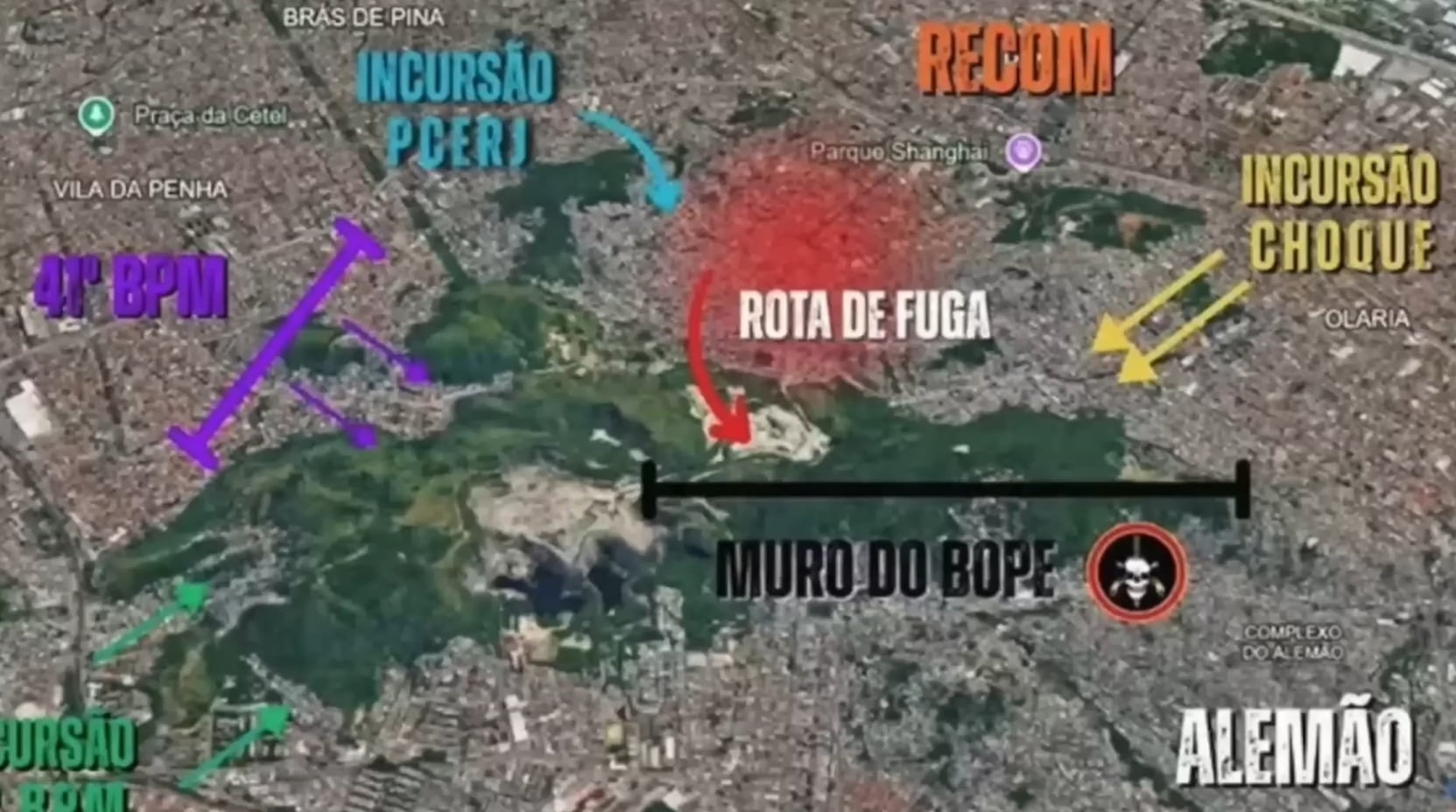
The BOPE wall blocking the narcos' escape (YouTube; screenshot from Cardinot channel; used in accordance with Clause 27a of the Copyright Law)
On Tuesday, October 28, 2025, over 2500 officers from the civil and military police of Rio de Janeiro launched a large-scale law enforcement operation targeting the narco-terrorist organization Comando Vermelho (Red Command) in the Penha and Alemão favelas.
Comando Vermelho is one of the largest Brazilian narco-terrorist organizations, formed in the early 1970s, in a prison alliance between common criminals and far-leftist terrorists.
The operation, code-named “Operação Contenção” (Operation Containment), led to 133 arrests and over 120 narcos killed in action. On the police side, 4 officers were killed and 13 were wounded.
While Comando Vermelho’s leader, Edgard Alves de Andrade “Doca”, managed to escape, other important members of the organization, such as Thiago do Nascimento Mendes, and Nicolas Fernandes Soares (Doca’s financial operator), were apprehended. Among the arrested narco-terrorists, at least 33 were from other Brazilian states such as Goias, Espiritu Santo, Amazonas, and Bahia. Among the large amount of weapons confiscated, many originated from the arsenals of the Peruvian, Argentine, Brazilian, and Venezuelan armies.
Without a doubt, “Operação Contenção” was the largest operation ever targeting the Comando Vermelho gang, with around 80% of its arsenal seized. It is interesting to notice how two days later, on October 30, the Paraguayan authorities blacklisted Comando Vermelho and the rival Primero Comando da Capital as terrorist organizations. The same measure was also taken by the Argentine government.
The BOPE’s “wall” tactic to avoid collateral damage
As explained by Gianpiero Spinelli, US DOD security and military contractor, Brazilian Law Enforcement Instructor, and author of the book “Caveira” (The Skull), the operation was not planned overnight, but it rather took a long and careful planning:
“It took over one year of meticulous investigation and deep intelligence collection. The phones of Comando Vermelho’s leaders were tapped and their movements carefully monitored. The police commanders were well aware that narcos were using the vegetation area between the favela complexes of Penha and Alemão as an escape corridor. The police therefore used it as an operational advantage to avoid collateral casualties among civilians as much as possible.”

Spinelli explained that, days before, the police leaked word within the affected favelas of an imminent operation, however, aimed at executing arrest warrants for specific individuals, which would be much slower, more general, and likely involve home searches. Such an operation would not be aimed at occupying and reclaiming territory held by drug traffickers and was therefore of limited concern for the narcos.
Consequently, the narco-terrorists were given plenty of time to collect the arsenal in their possession, the drugs, and flee towards the corridor in the wooded area that divides the favelas of Penha and Alemão.
Two days before the operation, the BOPE (the tactical unit of Rio de Janeiro’s military police) infiltrated the vegetation and formed a “wall”, deploying hundreds of heavily armed officers waiting for the arrival of the narco-terrorists fleeing the favela.
In the early morning of October 28, the Civil Police’s tactical unit (CORE) surrounded the complexes of Penha and Alemão to proceed with the alleged arrest-aimed operation, which would have required at least 4 hours, while the narco-terrorists were misled towards the wooded area.
Police drones filmed the criminals, fully armed and in camouflage, fleeing from the inhabited areas. As they reached the contact area and found BOPE waiting for them, they did not surrender, and that is where most of the casualties occurred.
This tactic was devised by Rio de Janeiro’s law enforcement to minimize collateral damage within residential areas. Had the clashes occurred within the favelas, the number of civilians would have been extremely high, as the drug traffickers would have fired on civilians, used them as shields, and then blamed the police, slowing down the operation. This modus operandi is virtually identical to that used by Hamas in Gaza to blame the IDF.
According to an AtlasIntel poll conducted the day following the operation, 87.6% of residents of the favelas in the city of Rio de Janeiro supported the operation, as reported by CNN Brazil.
On the contrary, various human rights organizations such as Anistia Internacional Brasil, Justiça Global, Redes da Maré and, indeed, the UN, have criticized the operation due to the number of deaths. No surprise.
Comando Verlemlho’s alliance with Hezbollah
A particularly interesting tactical aspect of the operation concerns the narco-terrorists’ use of drones loaded with explosives against the police. According to Spinelli, the expertise may have been provided to the Comando Vermelho by Hezbollah itself, which has been present and well-established in Brazil, particularly in the Triple Frontera region, for decades.
In Brazil, the Lebanese terror group maintains close relations with Comando Vermelho and Primero Comando da Capital, exchanging training for trade, as the group is known to be involved in illegal activities such as drug and arms trafficking, as well as money laundering, to finance its operations in the Middle East.
As a matter of fact, Hezbollah and Comando Vermelho share a lot in common, as they are both heavily involved in narco-activity respectively in Lebanon and Brazil; they both resort to terrorism and use civilians as human shields, while presenting themselves as providers of those services that cannot be provided by the government, even if according to the different contexts. In November 2023, Brazilian authorities disrupted a suspected Hezbollah cell planning attacks against Jewish and Israeli targets.
Related Topics