Solicitor & foreign policy adviser
Ritual equidistance: Tajani’s Gaza tightrope
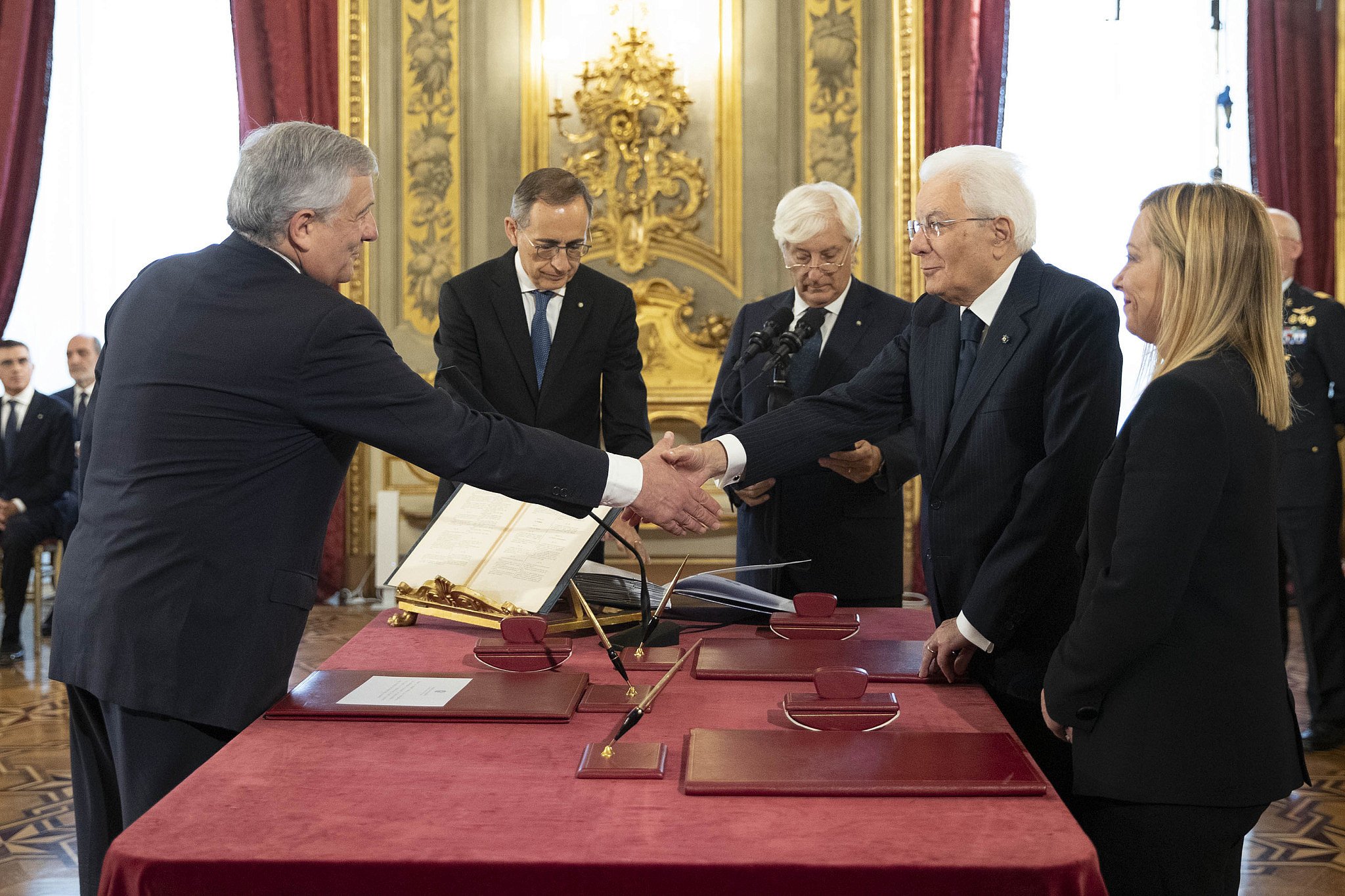
Antonio Tajani sworn in as Foreign Secretary (Photo: Quirinale.it on Wikipedia Commons)
It’s not easy to be Antonio Tajani. Imagine trying to sound resolute while walking a rhetorical tightrope, flanked on one side by Hamas apologists and on the other by your country’s fading Atlanticist instincts. Italy’s Foreign Secretary, a veteran of European diplomacy, rose before the Chamber of Deputies today to deliver the Ministerial’s Statement on Gaza to Parliament—a very long sigh, clothed in diplomatic formalities and studiously ambiguous moralism.
Tajani’s address was a “Comunicazione del Ministro degli Esteri alla Camera”—a formal policy statement to the Lower House to be repeated verbatim to the Upper House. These interventions are meant to inform Italy’s elected representatives about foreign policy positions. In practice, they often serve as miniature performances, tailored to pacify public opinion, nod to Brussels, and avoid offending anyone too important. In this case, the subject was Israel’s ongoing military operation against Hamas and Italy’s response to the humanitarian fallout. It could have been an opportunity to speak with clarity and conviction. Instead, it became yet another European lesson in artful evasion.
Tajani began by acknowledging Israel’s right to defend itself. A standard formula. But what followed was a cascade of equivocations. “The humanitarian situation in Gaza is dramatic,” he said, “and the number of civilian casualties is unacceptable.” No mention of how those casualties are the consequence of Hamas’s deliberate militarization of civilian infrastructure. No reminder that this war began on October 7, with the massacre, rape, and abduction of over 1,200 Israelis. Hostages were curiously absent from the statement, their captivity apparently less urgent than the Italian imperative to appear neutral.
Therein lies the rot. Neutrality, in the face of genocidal terrorism, is not wisdom; it is decadence masquerading as diplomacy. Tajani was careful not to explicitly condemn Israel, but he made his sympathies clear. Italy, he declared, supports “the Palestinian people,” not Hamas. A clever formulation—but one that studiously ignores that Hamas is the de facto government of Gaza and the entity firing rockets at Israeli cities. If you do not support the dismantling of Hamas, you are not helping the Palestinian people. You are helping their captors.
Tajani’s statement reveals more than he may have intended. He insisted that Israel must comply with international law, a principle no Israeli government has ever disavowed. But such exhortations are rarely applied in reverse. Where was the demand that Hamas release hostages immediately and unconditionally? Where was the recognition that Israel is confronting an enemy that uses hospitals as weapons depots and children as human shields?
This selective blindness is not new. Europe has a long tradition of responding to Israeli wars of necessity with performative concern. Gaza becomes the screen onto which the continent projects its post-colonial guilt and strategic confusion. In that sense, Tajani is less an innovator than a diligent steward of European orthodoxy: never too harsh on Hamas, never too warm toward Israel, and always available for solemn declarations of humanitarian anguish.
Of course, Italy is not Belgium. There are limits to how far it will stray from the Western consensus. Tajani confirmed Italy would not impose an arms embargo on Israel (unlike Spain) and that it would continue to coordinate with allies on defense matters. But these gestures are not enough. When European leaders speak about Gaza without identifying Hamas as the aggressor and obstacle to peace, they participate, however inadvertently, in the normalization of terror. They feed the false narrative that Israel’s actions are driven by vengeance rather than necessity.
Tajani said Italy supports a “two-state solution.” So do many Israelis—in theory. But Israelis are not being attacked by theory. They are being attacked by rockets, tunnels, and paragliders. A two-state solution is not a magic phrase that dissolves the reality of Hamas, Hezbollah, Houthis, and Iran. It is not a substitute for security guarantees or demilitarisation. To invoke it now, amid a war for survival, is to offer abstraction in place of solidarity.
At the heart of Tajani’s intervention is a familiar European pathology: the impulse to appear balanced even when reality is not. This is not diplomacy; it is the evasion of moral responsibility. The moral landscape of this war is not symmetrical. One side targets civilians and celebrates their deaths; the other warns civilians to evacuate and risks its soldiers to minimize harm. To treat both as flawed parties in a tragic conflict is not neutrality. It is incoherence.
A serious Italian foreign policy would speak plainly. It would affirm that Israel has a right, indeed, a duty, to destroy Hamas. It would support humanitarian relief, while insisting that aid not be siphoned off by a terrorist regime. It would remember the hostages. It would ask why no European country has proposed a post-Hamas administration for Gaza. And it would resist the temptation to hide behind platitudes.
In his closing remarks, Tajani said, “Italy is on the side of peace.” It sounds noble. But peace is not a side—it is the consequence of choices. And one choice, now urgent, is whether Europe will continue indulging its illusions, or finally speak the truth: that peace in Gaza begins with Hamas’s defeat, not Israel’s restraint.
Related Topics
Related Posts