The views expressed herein are solely mine.
Riyadh’s Last Stand Against the Brotherhood Bloc
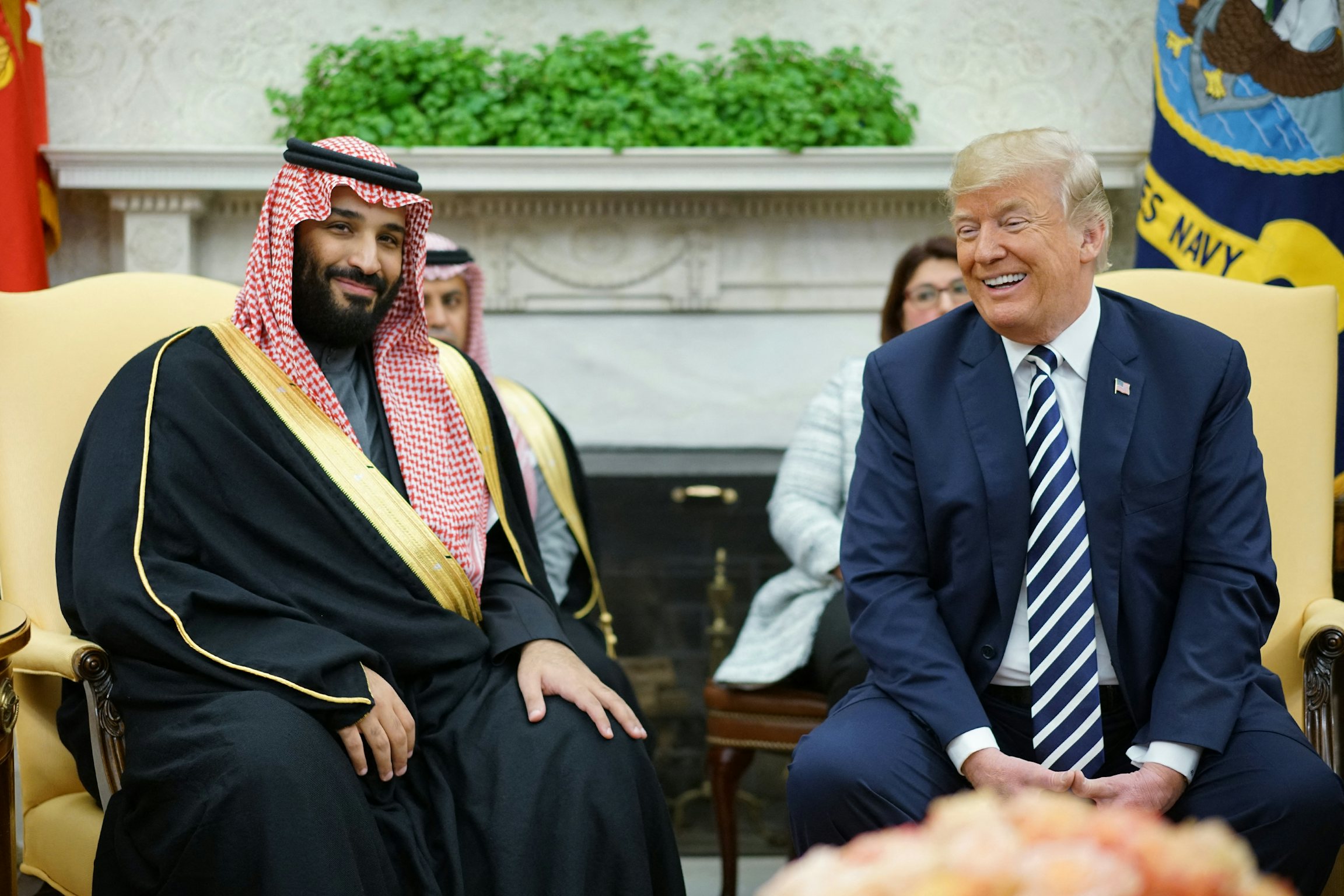
President Donald J. Trump in the Oval Office with Crown Prince Mohammed bin Salman in 2018. Credits: Mandel Ngan/AFP/Getty Images.
Something seismic is shifting in the sands of Arabia.
Saudi Arabia — once the uncontested heavyweight of the Sunni world — is scrambling to regain Washington’s favor after years of geopolitical gambling with China and Russia that yielded little more than polite shrugs.
As we saw at the Sharm el-Sheik summit — where Saudi Arabia, like the UAE, was notably absent — Riyadh’s nonappearance underscored its waning influence with Washington.
This is hardly the legacy King Salman envisioned when he elevated his son to crown prince, even placing another royal brother under house arrest to secure the succession.
In a dynasty of more than 15,000 princes, such moves were meant to guarantee Mohammed bin Salman’s (MBS) freedom to act decisively and effectively; yet the current erosion of Saudi clout is not the future the King bargained for.
However, this scenario could change soon.
According to The Financial Times, Riyadh is negotiating a defense pact with the United States modeled on the recent U.S.–Qatar agreement, which obligates Washington to view any attack on Doha as a threat to America itself. Certainly, this is a striking reversal: the Saudis, who once derided Qatar as an “upstart gas station,” now find themselves following its playbook.
The timing is no coincidence.
Donald Trump, in a fiery interview with Maria Bartiromo, declared that Saudi Arabia and other Arab states will “very soon” join the Abraham Accords — the same framework Iran tried to sabotage by unleashing Hamas on October 7th, 2023.
That massacre, pushed by Tehran, was never about Gaza; it was about killing the Saudi-Israeli peace path.
Yet Iran’s proxies are collapsing, its nuclear program has stalled, and its recent “nuclear revival” deal with Moscow looks more like desperation than dominance.
Meanwhile, Hamas has torched its credibility by executing Palestinians in the streets — proving to the West that it is not a liberation movement but an Islamist death cult funded by Qatar and blessed by Turkey’s Muslim Brotherhood network.
Doha, not MBS’s Riyadh, now sits in Washington’s good graces.
The State of Qatar has become the “preferred Sunni ally,” flush with cash, influence, and proximity to America’s power centers.
Today, it pours billions into U.S. universities and media, gifted Trump a $400 million jet, and will soon be training its pilots on U.S. soil.
Meanwhile, the Emir plays “middleman” with Iran, banker of Gaza, and gatekeeper to Hamas’s political bureau.
For Saudi Arabia, this is humiliation — watching a smaller rival wield both the Islamist card and the American one.
That is why the Saudi Kingdom is racing back into America’s arms and toward Israel’s open door.
A U.S. defense pact would guarantee survival. At the same time, normalization with Israel through the Abraham Accords would guarantee relevance, stability, and security.
Riyadh knows that only an Israeli–Saudi–American triangle can contain Iran, curb Turkey’s ambitions, and dismantle Qatar’s ideological monopoly in the Sunni world.
And MBS understands that in Washington’s new reality, oil no longer buys loyalty — cooperation does.
Thus, here lies the strategic masterstroke that could resurrect Riyadh’s authority.
The recently signed Saudi–Pakistani nuclear cooperation agreement — a quiet yet monumental understanding — effectively extends Islamabad’s deterrent umbrella to the Kingdom.
Combined with a prospective U.S.–Saudi defense pact, it places Riyadh under both an American and an Islamic shield.
If anchored by full entry into the Abraham Accords and discreet coordination with Israel, this structure would form the most formidable Sunni deterrent architecture in modern history.
Such a configuration would elevate Saudi Arabia beyond mere survival. Doubtlessly, it would transform the Kingdom into the central guarantor of Sunni security — the state that protects not only Mecca and Medina, but also the geopolitical dignity of Islam itself on its way to achieve “Saudi Vision 2030.”
In one stroke, MBS could restore Riyadh’s moral and strategic supremacy, outflanking the Qatari-Muslim Brotherhood alliance that sought to brand Saudi conservatism as obsolete.
While Qatar weaponized ideology, Saudi Arabia may weaponize legitimacy — fusing nuclear deterrence, Western partnership, and “Abrahamic diplomacy” into a triad securing both faith and future. Without a doubt, it would be the rebirth of a Saudi Arabia that commands respect through power, not sermons.
If Riyadh succeeds, it will not merely join the Abraham Accords — it will reclaim its title as the Arab world’s indispensable nation.
Fail, and it will watch Qatar, the ideological instigator of the 2011 Arab Spring, become America’s chosen “moderate.”
For the Saudis, this is not diplomacy. It is survival.
Related Topics
- Abraham Accords
- Arab Israelis
- Arab Spring
- China
- Gaza
- Gaza Border
- Gaza Disengagement
- Gaza Rocket Attacks
- Gaza Strip
- Hamas
- Iran
- Iran Nuclear Deal
- Islam
- Israel At War
- Israel-Iran Conflict
- Israel-Saudi Normalization
- Israel-US Relations
- Israeli Foreign Policy
- Jewish-Arab violence
- Muslim-Jewish Dialogue
- Natural Gas
- October 7 anniversary
- Pakistan
- Palestinian Statehood
- Palestinians
- Peace Builders
- Peace Process
- Peace to Prosperity
- Qatar
- Russia
- Saudi Arabia
- Terrorism
- The Arab World
- Trump Peace Plan
- Turkey
- US Politics
Related Posts