Romain Blandre & Jean-Pierre Stucki Interview | Alexandre Gilbert #347
Romain Blandre has been a history and geography teacher at a middle school in Mulhouse for 20 years. Since 2017 he has served as the relay teacher (professeur-relais) for the Strasbourg education authority (académie de Strasbourg) at the European Center of Deported Resistance Members at Struthof (Centre européen du Résistant déporté-Struthof). For the past years he has also been the academic correspondent for the Mémorial de la Shoah. As part of university research (University of Strasbourg), he is studying Holocaust-denial discourse and the many acts of vandalism targeting the Struthof camp.
Jean-Pierre Stucki is a French journalist, author and television producer, who became TF1’s Strasbourg correspondent in 1988 and a France Télévisions regional delegate in 2008. He was the first journalist to reach the 1992 Mont Sainte-Odile air disaster and co-wrote La Nuit du mensonge (1993) about it, as well as Sectes, des paradis totalitaires (2000). He has since directed and produced documentaries for France 3, including Fils de Suisses (2007) and Les Loups noirs d’Alsace, l’histoire falsifiée (2025).
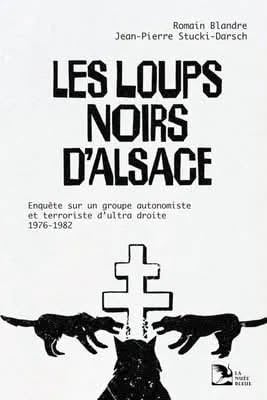
It took half a year for the defenders of the Loups noirs d’Alsace (Éditions La Nuée bleue) and the detractors of history and of historical science to take up their pens and criticize our book, co-written with Jean-Pierre Stucki.
Olivier Maulin takes on the task in Valeurs actuelles. We have had access to his writing, and it is clear that this gentleman either read the book badly or, rather, read it very “selectively” and erroneously.
In his “piece,” he denounces our lack of seriousness, claiming that we accuse the Loups noirs and their leader Pierre Rieffel of having committed the desecration of the Jewish cemetery in Quatzenheim. He also reproaches us for not mentioning that Rieffel turned down the Bastion social’s invitation. The author of these lines needs to reread our book and correct his article in light of what we actually wrote on these subjects.
Another reproach: that we accuse the Loups noirs of being neo-Nazis without any tangible proof. Here again, we invite him to reread the book objectively and to revisit the passages in which we demonstrate the links with the Wiking-Jugend and the Hoffmann Group, the meetings at the neo-Nazi gatherings in Schönau, the ties to Marcel Iffrig, the reproduction of texts by the Holocaust denier Robert Faurisson in their press organs, the ties to Pierre Zind, also a Holocaust denier, and the Haus der Heimat project, about which he says not a word.
When addressing the question of Holocaust denial, Maulin speaks of a mysterious pamphlet, supposedly nonexistent, written by Rieffel himself. Yet we publish extracts from it in which Rieffel explains that the Struthof gas chamber never existed and that the violence committed by the Nazis in this concentration camp never took place.
Olivier Maulin’s method is particularly dishonest. In this “review,” he paraphrases our book, retaining only what confirms his own ideas and discarding everything that runs counter to his ideology, without ever providing a single piece of scientific evidence for what he wants to demonstrate. In the end, he applies the strategies of the Holocaust deniers whom he shamelessly defends, while also praising a terrorist group that committed attacks in the region and planned to commit still more.
What shocked you most in Olivier Maulin’s critique?
Romain Blandre & Jean-Pierre Stucki: I wouldn’t say we were shocked. We were more dismayed by the weakness of this gentleman’s pseudo-argument and above all by his obvious inability to understand our research. We prove, with documents, that the Loups noirs d’Alsace (Black Wolves of Alsace) were genuine neo-Nazis who hated France. We demonstrate their links with racist and antisemitic German splinter groups, as well as their plans with the dangerous terrorists of the Hoffmann Group. Olivier Maulin sweeps all of this aside and hammers home a single “truth”: that we are liars.
Since the documentary aired on France Télévisions and the book was published, many people, especially in autonomist circles, keep defending the indefensible and denying the obvious. We know it is hard to admit our mistakes, but when they are this flagrant, it is more honorable to own them and revise our certainties than to keep defending dangerous neo-Nazis.
What exactly does your book say about the desecration of the Jewish cemetery in Quatzenheim?
RB & JPS: Here again, Olivier Maulin is wrong when he claims that we accuse the Loups noirs d’Alsace of committing this despicable crime. We never wrote that. We simply explain that whoever committed this desecration did not spray-paint the words “Loups noirs d’Alsace” for nothing. The perpetrators knew the antisemitic ideas of the Loups noirs and paid them a kind of tribute in that cemetery, defacing the graves with spray paint in the same colors the Loups noirs used to sign their attacks. This detail may seem trivial. In fact, it shows a thorough knowledge of the acts committed by the Alsatian terrorists of the 1970s and 80s, and it is a sign of recognition among “initiates.” This technique of discreet mutual recognition has a name: the dog whistle.
Which link with the Wiking-Jugend, Schönau or Marcel Iffrig do you find the most compelling?
RB & JPS: Everything we say on these subjects matters. The Loups noirs met, in part, at a neo-Nazi gathering held every year in Schönau, Germany, in honor of Alfred Dahl, an aviator killed by the French during the First World War. We know this because the Loups noirs themselves recount it. They even admit to having been frightened when numerous antifascists arrived to disrupt the gathering. And they were not there by chance, on a stroll through the Black Forest. Their presence was a political act.
The Wiking-Jugend were a throwback to the Hitler Youth. They were founded in 1951 by Heinrich Himmler’s daughter. We know that members of this group were in contact with the Loups noirs, and that these individuals’ handwritten signatures appear on a manifesto, a kind of pact between them to create an Alsatian branch of the WJ. As for Iffrig, he was the spiritual father of Pierre Rieffel. He was a doctor from Diemeringen who was repeatedly investigated for his racist and antisemitic remarks. At one point he ran the editorial board of an autonomist periodical, Elsa, to which he gave a neo-Nazi and Holocaust-denying slant, much to the dismay of its founders. The names of the Loups noirs appear on the journal’s editorial committee until the end of its publication, when its most radical articles were printed.
How did you find Rieffel’s pamphlet and establish that he was its author?
RB & JPS: The pamphlet is probably held in the Baden-Württemberg archives. We were not able to consult it, but large extracts appear in a report on the German far right written by those archives, and above all there are extracts and mentions by well-known Holocaust deniers such as Vincent Reynouard, who cites it several times and shows its cover in a video. Jürgen Graf, a Swiss Holocaust denier, mentions it in one of his bibliographies. I contacted Reynouard, who assured me he had owned the pamphlet but immediately complained that it was seized from him after his arrest. So a few copies must exist in France too.
It is a pamphlet titled “KZ-Struthof Legende und Wahrheit” (“Struthof Concentration Camp: Legend and Truth”), which denies the Nazi crimes committed at the Natzweiler camp and the existence of its gas chamber.
Why is the denial of the Struthof gas chamber so revealing of the group’s ideology?
RB & JPS: The further we followed the thread of their history, the more we realized that the Loups noirs were proclaiming false truths about their real motivations. Behind the cover of personal revenge and autonomism lay far less glorious motives: racism, antisemitism, hatred of France, neo-Nazism and Holocaust denial. After studying all the archives, and above all their own testimony, all of their acts can easily be reinterpreted. The attack on the Struthof: an attempt to destroy the evidence of Nazi crimes. The blowing up of the Turckheim column: a reenactment of Hitler’s dynamiting of it during the annexation in 1940. The two attacks on the Staufen Cross: a desire to target the Resistance fighters, whom the Loups noirs, incidentally, call “collabos.” A fine historical inversion, of the kind Holocaust deniers practice so well.
How did the Holocaust denial of Faurisson and Pierre Zind spread through these Alsatian networks?
RB & JPS: This is THE question that has intrigued us since our discoveries. At a time when means of communication were neither as developed nor as instantaneous as they are today, how do we find texts by Faurisson in the pages of newspapers run by the Loups noirs? The first lead is Iffrig, who must have been in contact with them. The second is Pierre Zind, who taught at the same university as Faurisson. Zind sat on the jury that awarded a “très bien” to Henri Roques’s Holocaust-denying thesis in Nantes in 1985. He is also the one who came in person to show his support at the trial of the Loups noirs. You don’t choose your family, but you do choose your friends…
In any case, this is the question we are working on right now, along with the place of the Loups noirs d’Alsace within the Nouvelle Droite movement, which seems to have brought this whole small world together.
What is the Haus der Heimat project, and why do you consider it important?
RB & JPS: Haus der Heimat is the title of a secret pamphlet written by Marcel Iffrig in 1980. It is also the project that brought together the Loups noirs and their accomplices from the Wiking-Jugend and the Hoffmann Group. The pamphlet contains a manifesto signed by all the members gathered in July 1980, setting out a project of re-education and of bringing together, on a single territory, all the Germanic peoples scattered across the world and divided by Christianity. The aim was to gather this population, supposedly made pure again, on the land of the ancestors around pagan values. Concretely, this meant buying a plot of land and building the “House of the Homeland,” which would offer cultural products (books, records) and a program of fraternal mutual aid. Sports training was also to be offered. To our knowledge, the project was never completed, although we are sometimes told of a plot of land being purchased in the Villé valley with a “cabin.”
What do you say to those who portray the Loups noirs as mere regionalist activists?
RB & JPS: That they are simply wrong. It is neither serious nor irreparable, but they are wrong, and we advise them to read our book.
What do you think of Marie Dumora’s film La Ligne bleue?
RB & JPS: I had the good fortune to work alongside Marie Dumora, who commissioned me to produce the educational dossier that accompanies the film. That allowed me to see it several times. It is a unique film that shows the camp’s reverse shot. For the first, and surely the last, time it gives a voice to witnesses who saw what happened in and near the camp. Some of them even lived alongside the SS or went to school with their children. It is a wonderful and very sensitive film.
Did you offer Olivier Maulin a right of reply or a debate?
RB & JPS: No, we have no contact with him. We identified the newspaper in our replies on social media, so perhaps he will hear about what we say in response. In the end, it matters little. We are honest in our research, and that is the main thing. However, it does raise questions about the reliability of certain editorial boards that give their authors carte blanche and publish without verifying either the accuracy of the articles’ content or the sources used by their contributors. That is rather worrying, especially in the world we live in today.