Solicitor & foreign policy adviser
Rome’s red carpet for a convicted terrorist
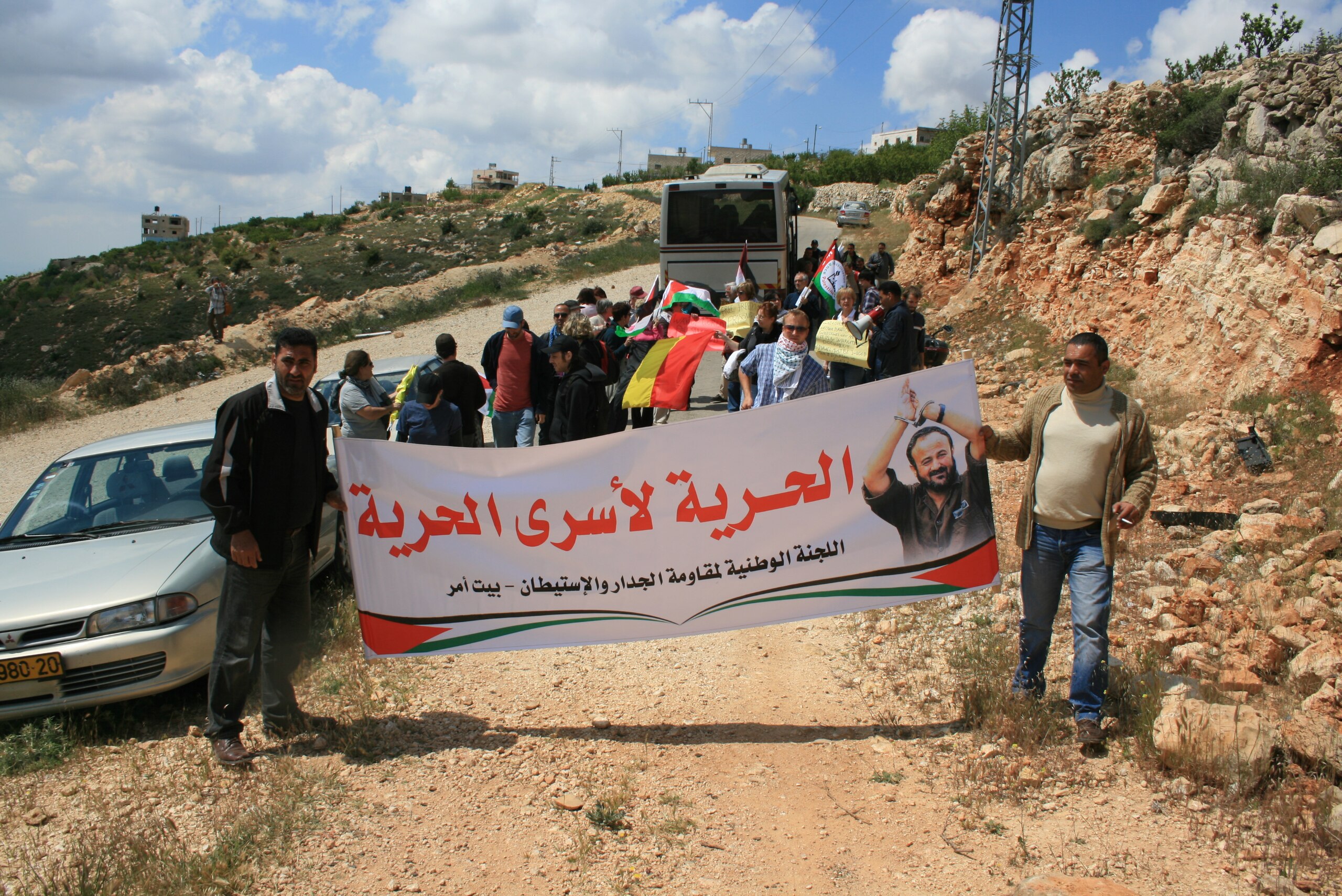
A banner in support of Marwan Barghouti at Beit Ummar (Photo by y טל קינג - Wikipedia Commons)
The headline practically wrote itself: in a stunt that could only flatter the credulous, a clutch of left-wing Italian politicians offered a reception in Parliament for Fadwa Barghouti, the wife and legal representative of Marwan Barghouti, the West Bank figure convicted in Israel of directing and organizing terrorist attacks against civilians during the second Intifada and currently serving multiple life sentences. What was billed by her hosts as a parliamentary audience in Rome was in substance a photo opportunity that validated the political ambitions of a man whom even many Palestinians associate with senseless violence.
The gathering read like a who’s who of anti-Zionism. Elly Schlein, leader of Italy’s Partito Democratico (PD), posed for the cameras alongside Giuseppe Conte, the former prime minister and head of the anti-establishment Movimento 5 Stelle (M5S), while Angelo Bonelli and Nicola Fratoianni — figures from smaller far-left factions — stood dutifully in tow. They jointly declared “full support” for Barghouti’s campaign for release and amplified comparisons to Nelson Mandela.
What followed was a familiar exercise in narrative inversion. Mandela was no saint, and a ruthless political operator, but his struggle aimed at dismantling a system, not sanctifying the murder of civilians. Barghouti’s legacy, by contrast, is inseparable from attacks that deliberately targeted them. History can hold complexity without confusing the two.
Fadwa Barghouti’s appearance was presented as a plea for justice, and she indeed spoke of her husband’s incarceration conditions. As with any political prisoner, questions about humane treatment deserve scrutiny. But the optics of elected Italian figures offering an audience that implicitly confers legitimacy on a convicted terrorist betray a deeper misjudgment. It is a misjudgment that carries consequences, not least in undermining Italy’s position in debates over Middle East peace and counter-terrorism cooperation.
While Schlein has sought to cultivate a progressive image that embraces human rights causes globally, her decision to embrace Barghouti’s cause exposes what has become her signature shallowness. Italy’s foreign-policy record on the Middle East has oscillated between mainstream European diplomacy and episodic gestures that satisfy activist constituencies at home. This event falls into the latter category: it plays well on social media, but it sends a message abroad that Italian left-wing elites are willing to blur the line between advocacy and endorsement of individuals whose past actions included command responsibility for violence. The diplomatic repercussions are predictable and already being felt in protests from the Israeli embassy in Rome.
Conte’s presence adds an additional layer of irony. Once an anti-establishment firebrand, he now finds himself performing the rituals of establishment politics — uneasy alliances and moral equivalences — with a straight face. It must be said that embracing Barghouti’s representation as a human-rights case without acknowledging the substance of his convictions is the sort of selective framing that would be risible if it were not so serious.
Supporters of the meeting argue that the West must engage all parties to advance peace. This is a familiar refrain. Yet throughout history, nominal engagement that ignores violent histories and ongoing threats has rarely produced stable outcomes. If anything, rewarding violent actors with diplomatic recognition, even symbolic, weakens the prospects for moderation. Ambassador Jonathan Peled, understandably, chastised the meeting, seeing in it an attempt to rewrite the narrative around Barghouti’s convictions.
The Italian left-wing’s choices matter. When leaders calibrate their foreign-policy gestures to win applause rather than to advance coherent, principled positions, they weaken their own credibility. There is a pattern in European politics of elevating grievances without context, of adopting slogans that flatter a sense of moral superiority but evade hard truths. This meeting captured all of that: a spectacle camouflaged as substance.
Contrary to what was suggested by those in the room in Rome, Barghouti’s name does not stand for unified Palestinian leadership ready to negotiate peace, but for a factional figure whose popular appeal is rooted at least in part in a violent chapter. Italians inclined to support human rights exports should press their leaders to differentiate between advocating for humane treatment of detainees and valorizing individuals whose record includes directing violence against civilians.
Critics who insist that opposing gestures like this equals ignoring Palestinian suffering miss the point. One can, and should, recognize the plight of civilians across the region without romanticizing the careers of those who embraced tactics that targeted non-combatants. Indeed, conflating those two hurt’s both causes: it trivializes real grievances and it undermines the legitimacy of peaceful avenues for change.
If Italian politicians believe their gesture advanced peace, they should revisit both history and strategy. Peace is facilitated not by theatrical gestures that blur moral lines but by policies that insist on accountability, protection of civilians, and clear repudiation of terror as a tool. Words matter; the figures who wield them should measure their impact.
A parlor trick dressed as diplomacy offers fleeting applause. True leadership requires confronting uncomfortable truths, not reclassifying convicted violence as misunderstood virtue.
The sharpest cut in all of this may be the simplest: history remembers those who sought peace, but it rarely forgives those who, in its name, sanitize terror.
Related Topics