
NAnews - Nikk.Agency Israel News
Russia Fought Nuclear Pressure on Syria. Now It Is Doing the Same on Iran
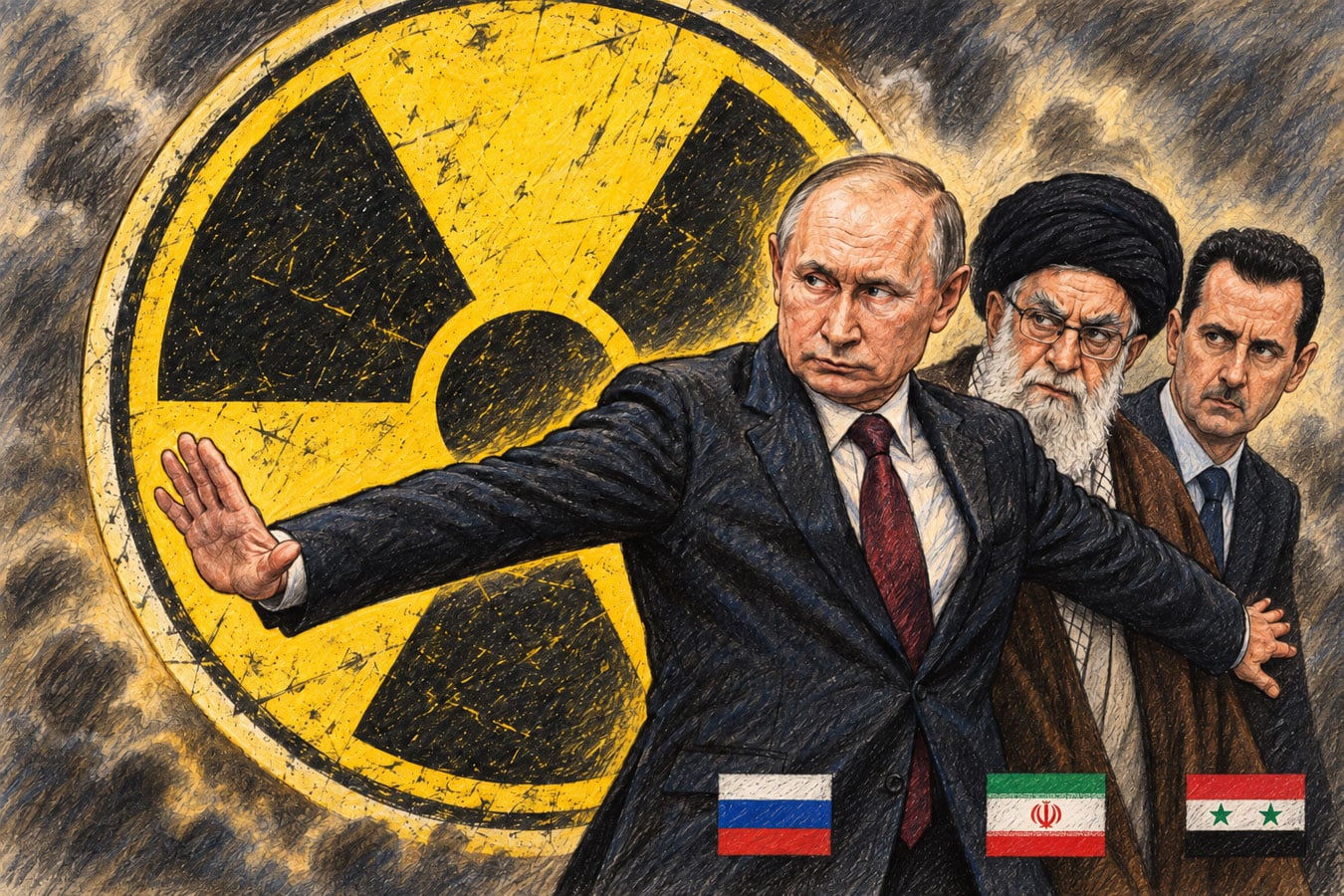
Russia Fought Nuclear Pressure on Syria. Now It Is Doing the Same on Iran. The image was created using AI.
In September 2026, the IAEA finally resolved the Assad-era Syrian nuclear case while escalating its dispute with Iran. Russia had opposed international pressure in both files at crucial stages. The Syrian case now offers a rare chance to see what inspectors found when they eventually gained the access they had been seeking for years.
There is a very specific reason to return to a Syrian nuclear reactor destroyed by Israel nineteen years ago.
On September 1, the International Atomic Energy Agency circulated two reports that produced an unusual contrast. In Syria, the agency said it had finally resolved the outstanding questions surrounding secret nuclear activities under Bashar al-Assad. In Iran, it said there had been no comparable progress: inspectors still lacked the access needed to verify nuclear material after earlier U.S. and Israeli strikes, a situation the agency described as a proliferation concern.
Eight days later, the contrast became even sharper. On September 9, the IAEA Board of Governors formally drew a line under Syria’s old safeguards non-compliance case after the new authorities provided information and access that helped resolve the remaining questions. On the same day, the Board reported Iran to the UN Security Council for the first time in twenty years. Russia and China opposed the Iran resolution; the Syria resolution passed by consensus.
Then, on September 17, Russia and China vetoed a Security Council resolution that would have extended the mandate of independent experts monitoring sanctions on Iran. Moscow and Beijing argued that the sanctions architecture itself was illegitimate and that the dispute should be addressed diplomatically.
All of this is happening during the war that began on February 28 with renewed U.S.-Israeli strikes on Iran. Preventing Iran from acquiring a nuclear weapon remains one of the stated objectives of the campaign, while Tehran continues to deny that it is seeking one.
That is why the Syrian story suddenly matters again.
At NAnews, we have been following the overlapping Israeli, Syrian, Iranian and Russian dimensions of this story. But the Syrian case is particularly useful because, unlike the Iranian one, it has now reached something close to an investigative conclusion.
The question is not whether Syria and Iran are identical cases. They are not.
The question is what inspectors eventually found in Syria after years in which Russia argued against escalating — and later against even continuing — international scrutiny.
What exactly was Al-Kibar?
The facility Israel destroyed in September 2007 was in Syria’s eastern Deir ez-Zor region, near the Euphrates River. It was not near the Golan Heights and not directly on Israel’s border.
What mattered to Israel was not the distance but the technology.
The IAEA later concluded that the destroyed structure was, with very high probability, a nuclear reactor that Syria should have declared. Information available to the agency indicated a gas-cooled, graphite-moderated design that had been built with North Korean assistance and was not configured to produce electricity. The IAEA also received information about three additional Syrian locations functionally related to the project.
The technology was similar to the North Korean reactor line associated with Yongbyon.
Such a reactor can use natural uranium as fuel. During operation, plutonium forms inside irradiated fuel. If that fuel is later chemically reprocessed, the plutonium can potentially be separated.
That does not make a reactor a nuclear bomb.
A weapons program would require additional infrastructure, processing and a political decision to produce a weapon. Rafael Grossi has been careful on precisely this point: the Syrian reactor presented a serious proliferation risk, but the IAEA cannot determine from the technical evidence whether Assad had actually decided to build a bomb.
How did Israel know what Syria was building?
Israel did not discover a completed reactor overnight.
According to material later released by the IDF, Israeli intelligence had been tracking unusual Syrian nuclear activity for several years. By late 2004, Military Intelligence and Mossad had information that foreign specialists were assisting a nuclear project. In January 2006, analysts obtained the first substantial indication that a nuclear facility was being built; in April, intelligence identified a suspicious site.
The decisive breakthrough came in early March 2007.
Mossad obtained photographs taken inside the facility. Some showed North Korean officials at the site. The images gave Israel the evidence it had lacked and supported the assessment that Syria was constructing a plutonium-producing reactor with North Korean assistance.
There are different published accounts of exactly how those photographs were obtained. Some describe an operation involving the computer of Ibrahim Othman, head of the Syrian Atomic Energy Commission. Not every detail of that intelligence story has been officially confirmed, so the safest conclusion is narrower: Israel obtained internal photographs, and those images were central to the final assessment.
The IDF estimated that the reactor could become operational by the end of 2007. Israel therefore faced a timing problem: once nuclear fuel was introduced and the reactor operated, striking it could create a radiological hazard.
On the night of September 5-6, Israeli aircraft destroyed the facility.
Israel did not officially acknowledge the operation until 2018.
Syria already knew how IAEA safeguards worked
There is an important detail that is often missing from the story.
Assad’s Syria was not outside the international nuclear system.
The country had an officially declared small research reactor near Damascus. Its nuclear material was known to the IAEA and subject to safeguards and inspections. Syria also had other declared research activities.
So the problem at Deir ez-Zor was not that Damascus did not understand how declaration and inspection worked.
Syria knew.
One reactor was declared and inspected.
The other was not.
That distinction is central to understanding why the IAEA eventually treated Deir ez-Zor as a safeguards violation rather than merely a dispute over intelligence assessments.
What did the IAEA actually find after the Israeli strike?
The investigation was difficult almost from the beginning because Syria rapidly altered the site.
By the end of October 2007, large-scale clearing and levelling had removed or obscured much of the destroyed building.
Still, in June 2008, Syria did allow IAEA inspectors to visit Deir ez-Zor.
This is worth stressing because the simplified version — “Assad never let the inspectors in” — is inaccurate.
On June 23, Syria gave inspectors unrestricted access to the buildings then present on the site as a transparency measure. Inspectors took environmental samples. Damascus continued to insist that the destroyed structure had been a non-nuclear military installation, but it did not provide the documentation the agency requested to support that explanation.
Then the laboratory results arrived.
The samples contained particles of uranium that had undergone chemical processing.
Syria suggested that the uranium might have originated in the Israeli munitions used to destroy the building. The IAEA investigated that possibility and did not find it convincing enough to resolve the issue.
The agency then wanted to go further.
It asked for construction records, procurement information, explanations concerning equipment and water systems, and access to the three other locations thought to be functionally related to Deir ez-Zor.
That was where the investigation stalled.
The IAEA had not inspected the whole system and then simply refused to believe Syria.
It had found a physical nuclear trace and could not obtain all the access and information it considered necessary to reconstruct the rest.
Where does Russia enter the story?
Not, on the public evidence, in building the reactor.
There is no IAEA finding that Russia helped construct Al-Kibar, and the available documents do not establish how much Moscow knew about the project before Israel destroyed it.
Russia’s documented role begins later.
In 2011, after examining the site’s configuration, environmental samples, satellite images, cooling arrangements and other information, the IAEA concluded that the destroyed building was very likely a nuclear reactor that should have been declared.
The Board of Governors found Syria in non-compliance and reported the case to the UN Security Council.
Russia and China voted against.
Then came 2014.
Three years after the Board’s finding, key questions remained unresolved. Yet Russia pushed to have Syria’s past nuclear activities removed from the agenda of future IAEA Board meetings. Western members opposed the proposal because they wanted pressure on Damascus to cooperate with the still-stalled investigation.
The Russian initiative failed.
The significant point in retrospect is not that Moscow necessarily knew what inspectors would later find. There is no evidence for that conclusion.
It is that Russia was arguing for reducing international attention before the investigation had produced a complete picture.
Was Iran part of the Syrian nuclear project?
Iran was one of Assad’s closest strategic allies, so theories about an Iranian role appeared early.
Some analysts and former officials speculated about Iranian financing, possible Iranian interest in future plutonium production, or a broader Syrian-North Korean-Iranian arrangement.
Those theories should not be confused with established IAEA findings.
The agency has not concluded that Iran financed Al-Kibar, helped build it or was supposed to receive nuclear material produced there.
The roles are clearer if kept separate.
North Korean technological assistance is strongly documented.
Syria was responsible for the undeclared nuclear program.
Iran was Assad’s strategic ally, with possible participation discussed but not established to the same evidentiary standard.
Russia’s documented role came through diplomacy after the reactor had been exposed.
That is already enough to make the case relevant without turning it into a four-country conspiracy.
How did the investigation restart?
The next phase began before Assad fell.
In March 2024, Grossi visited Damascus and agreed with Assad’s government on a new process to clarify unresolved questions. In late June, Syria allowed the IAEA to visit two of the three locations associated with Deir ez-Zor and take environmental samples; it later allowed access to the third.
This matters because the transition was gradual.
The accurate version is not “Assad blocked everything and the new government opened everything.”
Some cooperation resumed under Assad.
But after his fall in December 2024, the process accelerated considerably.
By 2025, analysis of new samples had again produced evidence of anthropogenic uranium at one of the associated sites. The new Syrian authorities said they could not explain its origin and gave the agency further access.
Assad himself was meanwhile in Russia. After reaching the Russian Hmeimim airbase during the collapse of his government, he was evacuated to Russia and granted asylum.
That fact would later intersect with another Syrian question: the future of Hmeimim itself.
Who led inspectors to the 73 tons of uranium?
This is perhaps the most important part of the new evidence.
The uranium was not found under the ruins of Al-Kibar.
On July 17, 2026, Syria’s post-Assad authorities themselves informed the IAEA that they had identified nuclear material at a location that had never previously been declared. Damascus invited the agency to inspect it.
The exact location has not been publicly identified.
It should not simply be described as Deir ez-Zor, nor automatically treated as one of the three sites the IAEA had been investigating since 2008.
When inspectors arrived, they found a substantial nuclear-material inventory.
The IAEA ultimately verified approximately 73 metric tons of natural uranium metal, of which about 55 tons were in the form of fuel rods. The remaining material consisted largely of uranium scrap and waste from fuel manufacturing.
The significance of that figure is not simply its size.
It showed that Syria had gone well beyond possessing raw uranium. Fuel had actually been manufactured for the reactor.
The material is now under IAEA containment, surveillance and safeguards.
A fuller chronology of how inspectors moved from the first 2008 samples to the 2026 fuel stockpile is available in the original Russian-language NAnews investigation.
What did the Syrian program look like by the end?
The new evidence allowed the IAEA to reconstruct a much broader system.
There was an almost completed reactor at Deir ez-Zor.
There was fuel manufactured in Syria.
There was a fuel-fabrication facility.
There was a storage location containing tens of tons of natural uranium metal, much of it already in fuel form.
And the wider investigation identified activity associated with planned reprocessing.
Inspectors also returned to Deir ez-Zor during 2026. Excavation exposed cooling infrastructure consistent with a nuclear reactor, adding another physical element to an assessment the agency had made years earlier.
That is a much more substantial picture than the original image of one mysterious building in the desert.
It still does not prove that Assad had ordered the construction of a nuclear weapon.
The IAEA can establish what infrastructure existed and what it could have done.
It cannot reconstruct a political decision that may or may not have been taken inside the regime.
Why was the old Syrian case closed only now?
Because the IAEA finally had enough access and information to resolve the specific safeguards questions that had remained open.
On September 9, the Board welcomed Syria’s transparency and cooperation and ended the country’s old non-compliance status. The resolution passed by consensus.
That does not mean the IAEA has stopped inspecting Syria.
The newly identified uranium remains under safeguards, and ordinary verification continues.
What ended was the old Assad-era non-compliance case.
The sequence matters:
- Israel destroyed the reactor.
- Inspectors found uranium.
- The IAEA requested access and explanations.
- The investigation remained incomplete for years.
- Further sites were eventually inspected.
- More uranium evidence appeared.
- The new government disclosed another location.
- A large stock of reactor fuel was physically verified.
- Only then was the old case closed.
Why does that matter for Iran now?
Syria and Iran are technically different cases.
Iran has a large declared nuclear program, uranium-enrichment facilities, a long safeguards history and disputes that do not map neatly onto Al-Kibar.
So the Syrian evidence does not prove anything automatically about Fordow, Natanz or Iran’s intentions.
What can be compared is Russia’s diplomatic approach.
In the Syrian case, Moscow opposed escalation while the investigation remained incomplete and later tried to remove the issue from the IAEA Board’s continuing agenda.
In the Iranian case, Russia opposed the September 9 resolution reporting Iran to the Security Council. Eight days later, Moscow and Beijing vetoed the extension of independent UN sanctions monitoring.
That does not prove that Russia is concealing an Iranian weapons program.
It does provide a historical test for the argument that international pressure is excessive before inspectors have obtained the access and explanations they are seeking.
In Syria, the missing answers eventually turned out to involve reactor infrastructure, fuel production and tens of tons of nuclear material.
What is changing at Russia’s Syrian bases?
There is a second Syrian development unfolding at the same time.
While Damascus resolves the nuclear legacy of Assad, it is also renegotiating the military legacy of his relationship with Moscow.
Under the August 2026 agreement, civilian facilities connected to Russia’s presence are to move under Syrian control, while the military bases at Tartous and Hmeimim are to operate as joint training centers. Russian forces remain.
Then, on September 7, a convoy of four Russian vessels delivered supplies to Tartous and Hmeimim — the first such resupply mission after the agreement.
So Russia is not leaving Syria.
What has changed is the question of authority.
- Who approves Russian naval arrivals?
- Who controls cargo?
- Who authorizes flights?
- What military equipment can remain?
- And can Damascus alter the conditions under which the facilities operate?
Hmeimim also carries an obvious symbolic weight: it was the Russian base through which Assad left the country before receiving asylum in Russia.
Moscow is now negotiating the future of that same military presence with the authorities who replaced him.
What should Israel watch now?
For Israel, the most useful part of the Syrian story is not retrospective satisfaction over the 2007 strike.
It is the set of practical tests that follow.
The first is nuclear: whether the IAEA retains reliable access to the roughly 73 tons of uranium, whether the inventory remains fully accounted for, and whether any movement of the material stays under international monitoring.
The second is military: what Russian capabilities actually remain at Tartous and Hmeimim, and who has authority over their use.
The third concerns deconfliction. If Israel operates in or around Syrian airspace, channels intended to prevent unintended encounters with Russian forces still matter.
And the fourth is Iran’s regional network. Post-Assad Syria will be judged in Israel partly by whether it can prevent the reconstruction of weapons-smuggling routes to Hezbollah and other Iranian-backed armed groups.
There is also a Ukrainian dimension, though the analogy should remain narrow. Zaporizhzhia is a civilian nuclear power plant in wartime, not a clandestine reactor. The common principle is simply that international verification depends on access.
The lesson is access
The Syrian case does not prove that every Russian argument about Iran is wrong.
It does not prove that Iran is repeating Assad’s program.
And it does not prove that Russia knew what Syria had hidden.
What it does provide is an unusually complete example of how a nuclear dispute looks before and after inspectors gain the access they need.
In 2014, Russia argued that Syria’s nuclear file no longer deserved continued attention at the IAEA Board.
Twelve years later, inspectors had identified a wider fuel infrastructure and physically accounted for roughly 73 tons of uranium.
That difference is the reason the Syrian story matters in 2026.
Nuclear questions are not resolved because one government — or its allies — believes enough questions have been asked.
They are resolved when inspectors can verify the answers.
Related Topics
Related Posts