NAnews - Nikk.Agency Israel News
Russia Is Losing Its Syrian Leverage – and the Threat to Israel Is Fading
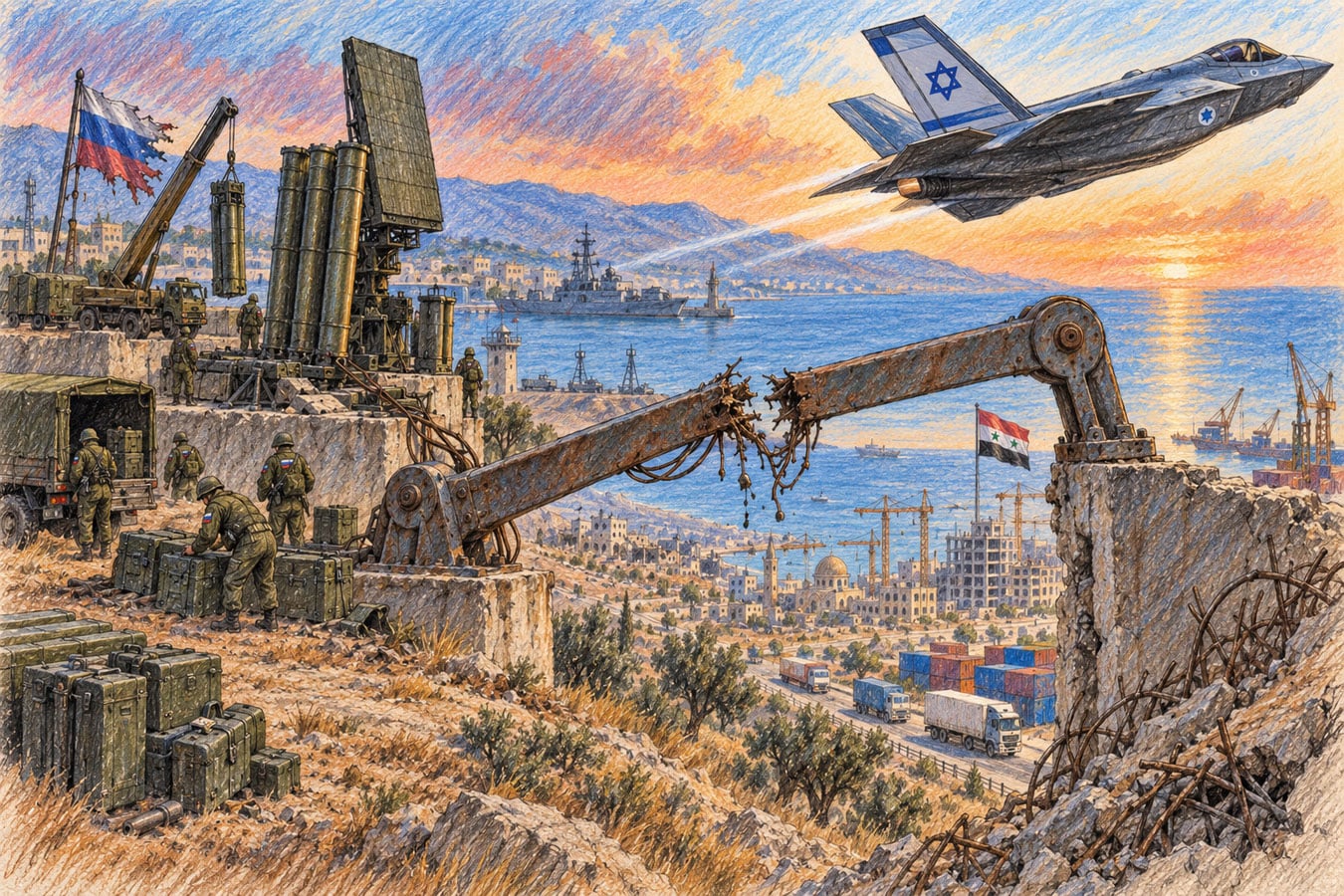
Russia Is Losing Its Syrian Leverage - and the Threat to Israel Is Fading. The image was created using AI.
On August 9, 2026, Syria and Russia reached an agreement that may matter to Israel far more than the simple question of whether Russian soldiers remain on Syrian soil.
After roughly 18 months of negotiations, Damascus and Moscow agreed that civilian facilities at Hmeimim and Tartus would return to Syrian state management, while Russian military sites are to be transformed into joint training centers. The transition is supposed to take no more than three months.
Russia is not being expelled from Syria. But that is not the most important point.
What matters for Israel is that Moscow is gradually losing the autonomous military infrastructure, political dependency and freedom of action that once allowed it to use Syria as leverage over Israeli security.
Russia once had a real military lever over Israel
For years, the Israeli Air Force operated against Iranian entrenchment, Hezbollah weapons transfers and other threats inside a Syrian theater crowded with Russian aircraft, radars and air-defense systems.
Moscow usually did not try to stop Israeli strikes. But it possessed the capability to make them more dangerous.
That became clear in May 2022, when a Russian-operated S-300 battery fired missiles at Israeli aircraft after an IAF strike near Masyaf. Then-defense minister Benny Gantz later confirmed the incident and described it as a one-off event. The Israeli aircraft had already left the area and were not hit.
The military result was limited. The political meaning was not.
Russia had demonstrated that a deterioration in relations with Israel could, at least under certain circumstances, acquire an operational dimension.
That was one reason Jerusalem maintained a deconfliction mechanism with Moscow. Israel could continue striking Iranian and Hezbollah-linked targets, but every operation had to take into account Russian forces operating in the same airspace.
Russian military police also established observation posts close to the Golan Heights. For Israel, Russia was therefore not an abstract great power stationed somewhere on the Mediterranean. It had soldiers, radars and military infrastructure close to one of Israel’s most sensitive borders.
Assad’s fall removed Moscow’s political foundation
The collapse of Bashar al-Assad’s regime in December 2024 changed this balance first at the political level.
Russia had intervened directly in Syria in 2015 and helped Assad survive at a moment when his regime appeared close to military defeat. For nearly a decade, Moscow operated not merely as a foreign military presence but as one of the principal guarantors of the Syrian government itself.
That gave Russia far more than access to bases.
It gave Moscow political priority in Damascus.
Once Assad fell, the relationship was reversed. Russia suddenly had to negotiate with a new Syrian leadership over privileges that had previously appeared permanent.
NAnews has already examined how this transition changed Moscow’s position in Tartus and Hmeimim. Russia managed to remain in Syria, but remaining is no longer the same as controlling.
Israel then destroyed most of Assad’s air defenses
The political collapse was followed by a dramatic military change.
After Assad’s fall, Israel launched a broad campaign against the former Syrian military’s strategic weapons, fearing that advanced systems could fall into hostile hands.
According to the IDF, the Israeli Air Force destroyed 86 percent of the former regime’s air-defense system — 107 air-defense components and 47 radars. Among the systems destroyed were large numbers of Russian-made Pantsir-S1 and Buk platforms.
That figure needs to be read carefully.
It refers to the air defenses of Assad’s former Syrian army. It does not mean Israel destroyed all Russian air-defense systems protecting Russian facilities.
Still, the strategic effect was significant.
Russia lost both the government that had depended on it and much of the surrounding Syrian military infrastructure that had helped make its presence relevant to Israeli operational planning.
The mechanism of pressure was already becoming weaker.
Tartus and Hmeimim are now changing status
The August 2026 agreement goes further.
Civilian infrastructure, including Hmeimim Airport and the fourth commercial berth at Tartus, is supposed to return to Syrian administration. Russian military facilities are to be converted into joint Syrian-Russian training centers.
For Israel, this distinction matters.
An autonomous foreign military base gives its owner considerable freedom to store weapons, operate aircraft, maintain logistics and conduct military activity according to its own command structure.
A joint training center should work differently.
It implies Syrian authority, negotiated functions and a more limited degree of Russian autonomy.
Whether that happens in practice is still unknown. The final balance will depend on what Russia actually retains: air-defense systems, aircraft, weapons storage, command authority, logistics and the ability to operate without Syrian approval.
The memorandum changes the legal framework. The hardware and chain of command will determine the real security effect.
The handover has already begun on the ground
The transition is not only theoretical.
In August, civilian cargo resumed using the Tartus berth previously employed by Russian forces. Russian military personnel were also observed vacating some buildings and moving equipment to nearby military facilities.
That does not amount to a Russian withdrawal.
Part of the contingent is expected to remain.
But Israel now has concrete indicators it can monitor: who controls the air-defense systems, who authorizes their use, whether Russian aircraft can still operate independently and whether Moscow retains separate military logistics.
Those details will show whether Russian military autonomy has genuinely been reduced.
That autonomy — not the Russian flag itself — was the real source of leverage.
This is what Moscow is losing
Under Assad, Russia could connect diplomacy with military risk.
A political dispute with Israel over Ukraine, Iran or another issue took place against the background of Russian forces operating beside the airspace where Israeli pilots carried out sensitive missions.
The 2022 S-300 incident proved that the connection was not purely theoretical.
Today, several pillars of that system are disappearing at once.
Assad is gone. Most of his air-defense network is gone. Civilian infrastructure is returning to Syrian control. Russian bases are being placed under a new framework.
Moscow can still pressure Israel through diplomacy, propaganda or international institutions.
But its ability to use Syria as an independent military lever against Israel is shrinking.
That is the central change.
The Israeli paradox: Jerusalem did not necessarily want Russia gone
There is an important contradiction.
After Assad’s fall, Israel did not necessarily want every Russian soldier to leave Syria.
In February 2025, Reuters reported that Israel had urged Washington to support the continued presence of Russian bases. According to the report, Israeli officials saw a weakened Russian presence as a possible counterweight to Turkey and to the new Syrian leadership backed by Ankara.
The logic is understandable.
Israel’s concern is not simply which foreign power is weaker. The real question is who controls military space immediately north of the Golan Heights.
A weaker Russia may give the IAF greater freedom. But a complete Russian vacuum becomes dangerous if another power fills it with a stronger military presence.
Today, the most obvious candidate is Turkey.
Turkey is moving into the space Russia once dominated
The new Syrian authorities are developing much closer military relations with Ankara.
In May 2026, Syrian personnel participated in Turkey’s EFES-2026 multinational military exercise. The Syrian contingent itself was limited, but the political message was larger: post-Assad Syria is being integrated into a military environment in which Turkey plays a central external role.
NAnews examined this separately in its report on Syria’s participation in EFES-2026.
For Israel, this produces a new version of an old problem.
What happens if Russian radars and air-defense systems disappear from Syria, only to be replaced by Turkish radars, drones, air defenses or military personnel?
The nationality changes.
The operational problem may not.
That is why Israeli-Turkish channels aimed at preventing military incidents in Syria matter so much. They resemble, in principle, the practical deconfliction arrangements Israel once needed with Russia.
Assad’s fall also exposed the limits of Russian guarantees
Russia spent years presenting itself as a power that protects its partners.
In Syria, Moscow committed aircraft, personnel, money and political capital to preserving Assad’s rule.
Yet when the decisive collapse came in December 2024, Russia did not save him.
This does not mean the war in Ukraine was the sole cause. Syria had its own internal dynamics, military failures and political fractures.
But the wider resource problem is difficult to ignore.
Russia is simultaneously fighting a major war in Europe that consumes ammunition, aircraft, air defenses, manpower and enormous financial resources.
Its ability to sustain several distant military theaters at the same level is not unlimited.
Armenia had already reached a related conclusion. In 2023, Prime Minister Nikol Pashinyan described his country’s overwhelming dependence on Russia in security matters as a strategic mistake and pointed out that Moscow itself needed weapons and ammunition for the war in Ukraine.
Israel’s circumstances are entirely different.
The useful lesson is narrower: Russian security commitments should be judged not by rhetoric but by Moscow’s actual capabilities and interests at the moment those commitments are tested.
Moscow may try to replace military control with economic influence
Russia is unlikely to abandon Syria simply because its military position is weaker.
Economic dependence offers another route.
In 2026, reports emerged about plans for a Russian commercial logistics hub in Tartus that could handle grain, wheat, metals and other cargo. Syrian port officials disputed claims that such a project had already been finalized.
It would therefore be wrong to describe the hub as an accomplished fact.
But the strategic logic is clear.
Postwar Syria needs food, fuel, reconstruction, logistics and functioning ports. If Russia can no longer dominate Damascus primarily through military agreements, commercial dependence may preserve part of its political influence.
For Israel, the relevant question is where commerce ends and security begins.
Warehouses, ports, fuel networks and transport infrastructure can all acquire dual-use value.
Syria now has alternatives
Moscow is also negotiating from a weaker position because Syria has other potential partners.
In July 2025, DP World of the United Arab Emirates signed a 30-year agreement to develop Tartus Port with planned investment of $800 million.
That matters because competition creates choice.
A Syrian government able to attract investment from the UAE, Gulf states, Turkey and others has less reason to grant one external power exceptional military and economic privileges.
The same shift can be seen in regional infrastructure plans.
Turkey and Saudi Arabia have discussed a railway connection through Syria and Jordan that could eventually carry passengers, freight, oil and gas toward Europe.
If such projects materialize, Syrian infrastructure becomes valuable because several states need it functioning commercially — not because one foreign military needs an exclusive base.
For Israel, a more connected Syrian economy could support stability.
But there is a trade-off: growing Turkish economic involvement also strengthens Ankara’s influence immediately north of Israel.
Russia is losing more than a Syrian foothold
Tartus and Hmeimim were also important for Russian operations beyond Syria.
They provided Moscow with a Mediterranean logistics platform that helped support deployments toward Africa and other theaters.
If those facilities become dependent on Syrian approval or operate under narrower agreements, Russian movements become more expensive and politically constrained.
Russia can find alternatives.
But a base you control is fundamentally different from a facility you are merely permitted to use.
The broader Russian military network becomes less flexible.
For Israel, that means Moscow has fewer regional instruments available to connect the Syrian arena with its larger confrontation with the West.
The human cost should not be forgotten
Russia’s Syrian military presence also has a history.
Human Rights Watch documented Syrian-Russian attacks during the 2019-2020 Idlib offensive that struck hospitals, schools, markets and other civilian infrastructure. The organization reported hundreds of civilian casualties in the incidents it examined and mass displacement during the wider campaign.
Reducing Russia’s role will not automatically return refugees to their homes.
Syria still needs housing, jobs, infrastructure and security.
But the collapse of the Assad-Russia military system removes one structure through which overwhelming external airpower was used to preserve the previous political order.
There is also a legal dimension. In February 2026, the UN’s International, Impartial and Independent Mechanism conducted its first evidence-collection operation inside Syria.
Access to detention sites, archives and witnesses will be an important test of whether the country is genuinely moving away from the old system of external protection and impunity.
The biggest unknown is hidden in the phrase “joint training center”
For Israel, perhaps the most important unresolved issue is what these new Russian-Syrian facilities actually become.
“Joint training center” sounds less threatening than “Russian military base.”
But names do not determine capability.
Who commands the site? Which weapons remain? Will Russia retain advanced air defenses? Can Russian aircraft operate independently? Which Syrian units will train there? Will every armed formation involved be under an accountable state chain of command?
There is currently no independent evidence that such centers are intended to train forces for attacks against Israel or against the current Syrian authorities.
That scenario should not be presented as fact.
But the answers to these questions will determine whether Russia has genuinely lost military autonomy or has merely renamed it.
Israel will judge the new Syria at the border
Ultimately, the real test will not be a diplomatic ceremony in Damascus.
It will be what happens along the Golan Heights and on the weapons routes running through Syria.
Israel will want to see that Iranian military infrastructure does not return, weapons smuggling is disrupted, armed groups remain under control and Syrian territory is not rebuilt into a platform for attacks against Israeli communities.
Internal Syrian stability therefore matters just as much as Russian troop numbers.
A weak central government could generate serious threats even if every Russian soldier disappeared.
At the same time, Israel and Syria are now exploring security channels that would have been difficult to imagine under Assad.
NAnews has previously examined the possibility of an Israeli liaison presence in Damascus under American auspices.
That development points to another important change.
Under Assad, Russia was almost impossible to bypass when Israel needed to manage military risks inside Syria.
Today, direct contacts, American mediation and regional arrangements are gradually making Moscow less indispensable.
Russia remains in Syria. Its old leverage does not.
It would be premature to declare the Russian threat gone.
Russian personnel remain. The final structure of the joint facilities is still unclear. Moscow retains political and economic interests and may preserve part of its military capability.
But the system that once made Russia particularly relevant to Israeli security has already been fundamentally weakened.
Assad is gone.
Most of his air defenses are gone.
Civilian infrastructure is returning to Syrian control.
Tartus and Hmeimim are operating under a new framework.
Damascus has alternative partners.
And Israel increasingly has security channels that do not depend on Moscow.
That is why the Russian threat to Israel from the Syrian theater is fading.
The real issue was never simply whether Russians were present.
It was whether Moscow possessed enough autonomous military power in Syria to restrict Israeli operations, increase the danger to Israeli aircraft or turn Israel’s northern security into political bargaining material.
That capability is eroding.
The next challenge may be just as difficult.
A shrinking Russian role creates more room for Turkey, the new Syrian security establishment and, if Damascus loses control, potentially Iran or Iran-linked armed groups.
Israel therefore has little reason to celebrate a vacuum.
Its real opportunity is harder and more important: to help shape a Syrian environment in which no foreign power can once again acquire the kind of independent military leverage that Russia possessed under Bashar al-Assad.
For Israel, that would be the strategic gain — not replacing one external patron with another, but making security on the northern border less dependent on decisions taken in Moscow, Ankara, Tehran or any other distant capital.
Related Topics