Russian-American-Israeli Palestinian. Palestine is Israel.
Russia Is the Outskirts of Ukraine
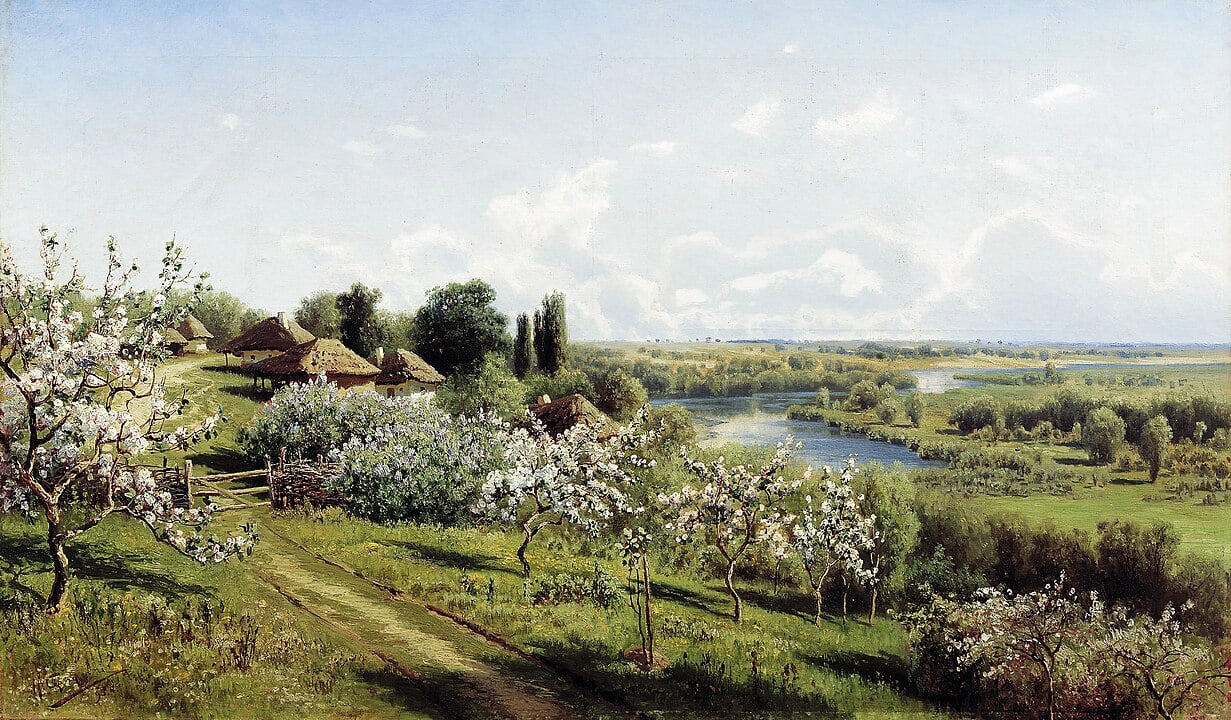
Painting “Apple Trees in Blossom. In Little Russia,” artist Nikolai Sergeyev, 1895. Public domain.
Note: This article is a translation of my Russian-language piece «Россия — это окраина Украины» (“Russia Is the Outskirts of Ukraine”), originally written on December 15, 2025. I postponed translating it because it relies heavily on Russian- and Ukrainian-specific linguistic nuances, semantic layers, and wordplay that are difficult to render naturally in English. This version attempts to preserve not only the meaning of the original text, but also its underlying linguistic logic.
Debunking Ukrainophobic Myths
One of the most persistent Ukrophobic (Ukrainophobic) myths promoted by Russia sounds like this:
«Украина — это окраина России»
“Ukraine is the outskirts of Russia.”
It is repeated with self-satisfied confidence, as if it were an established fact. As “proof,” two arguments are presented:
- the word Ukraina supposedly derives from the Russian word okraina (“outskirts”);
- Malorossiya (“Little Russia” — a geographical and historical term used to describe Ukraine) is interpreted as “small Russia,” something secondary, whereas Velikorossiya (“Great Russia”) is seen as the “real,” the “main” Russia.
At first glance, the scheme seems logical. But only until we look into history and language — there, where these myths fall apart literally at the seams.
Little and Great: everything is the opposite
Let us begin with the terms Little Rus’ and Great Rus’. In modern consciousness, the words “little” and “great” are automatically read as “small” and “big,” “secondary” and “main.” But in medieval Byzantine and church tradition, this meant something entirely different.
- “Little” is the original, root, historical territory.
- “Great” is the expanded, colonized, peripheral one.
Examples are easy to find even today:
- Little Moscow — the historical center.
- Greater Moscow — the agglomeration with suburbs.
- Greater Tel Aviv — not “more important,” but simply broader.
- Greater London, Greater Boston — the same logic.
By this same model:
- Little Russia is the historical core of Rus’, the territory of the Kyiv, Chernihiv, Pereyaslav lands.
- Great Russia is the later periphery, the developed, settled north-eastern lands centered around Moscow.
In other words, if we translate this into modern language without ideological distortions, we get a paradoxically simple formula:
«Россия — это окраина Украины»
“Russia is the outskirts of Ukraine.”
What the word “Ukraine” actually means
Now — to the main myth: that Ukraina comes from the word okraina (“outskirts”).
This is a linguistic manipulation.
In East Slavic languages, the word krai means:
- land,
- country,
- territory.
Compare:
- рідний край (ridnyi krai) — native land
- у наших краях (u nashykh kraiakh) — in our lands
- у чужому краю (u chuzhomu kraiu) — in a foreign land
The particle “u” in Old East Slavic and Old Ukrainian often performed a pointing function, close to a definite article.
Thus:
Ukraine = u-krai-na = this land, one’s own country, native land.
This is not “the outskirts of something,” but a self-sufficient name of a country.
A curious parallel — Hebrew:
- Eretz — land, country, land-region
- Eretz Israel — Land of Israel
- Ha-aretz — “this land,” one of the commonly used names of Israel
In fact:
Ukraine, in meaning, is “Ha-aretz,” not “outskirts.”
The difference is only that in Hebrew Ha-aretz is a conversational and symbolic name, whereas Ukraine became the official name of a state.
Ukrainian as “a person of the land”
In the Ukrainian language, one of the synonyms of the word zemlyak (fellow countryman) is krayanin — literally “a person of the land or region.”
That is:
- Ukrainian (ukrainets / ukrayanin) — is a compatriot,
but not an abstract one, rather a person precisely of this land.
The same principle:
- in Hebrew: בן הארץ (ben ha-aretz) — “son of the land”
- in English: countryman — “a person of the country”
Language here is more honest than any ideology.
How Muscovy became “Russia”
If Rus’ is historical Ukraine, a question arises:
how did it happen that Muscovy suddenly became Russia?
The answer is well known to historians.
1. The name
The word Russia is the Greek form of the word Rus’ (Ῥωσία), used in Byzantine church texts in reference to Kyivan Rus’.
The Muscovite principality did not call itself Rus’ until the 15th–16th centuries. It was:
- Muscovy (Moscovia),
- the land of Zalesye,
- the north-eastern outskirts of historical Rus’ (modern Ukraine).
2. Appropriation of identity
After the fall of Kyiv and the weakening of the southern lands, Moscow:
- appropriated the church and written tradition of Rus’,
- declared itself the “gatherer of Russian lands,”
- gradually substituted center and periphery.
Under Peter I, the process was закреплён (fixed/solidified) officially:
The Tsardom of Muscovy was renamed the Russian Empire — with a borrowed name and a rewritten history.
Who “Russified” the outskirts of Rus’
The princes of Rus’ — Vladimir the Great, Yaroslav the Wise, Yuri Dolgorukiy and their descendants — ruled also in the north-east.
It was precisely from Kyiv that:
- Christianization spread,
- writing,
- law,
- the language of written tradition.
Local Finno-Ugric tribes gradually adopted:
- the faith,
- the culture,
- the name Rus’ — as a political and cultural identity.
There was no distinction between rus’, ruskiy, rusin at that time.
The soft sign in the word rus’kiy (руський) is a later orthographic fixation,
not a sign of some special “ancientness” or separate identity.
From Great Russia to the “Russian people”
Until the 20th century, the population of the empire was officially called:
- Great Russians (Velikorossy),
- Little Russians (Malorossy),
- Belarusians.
At the same time, these names did not designate separate ethnic peoples, but only indicated inhabitants of certain regions.
Thus, modern Russians are inhabitants of Great Russia, the historical periphery, and Ukrainians are heirs of Little Russia, the historical core of Rus’.
The concepts “Russian people,” “Ukrainian people,” and “Belarusian people” took final shape in the Soviet era. Russians, Ukrainians, and Belarusians were formally recognized as separate peoples, but at the same time the idea of a “triune Russian people” was cultivated — an ideological construction intended to strengthen centralized power and impose an artificial sense of unity, especially actively promoted after World War II.
The party “United Russia” — is it “Triune Russia”?
The party “United Russia” was created in 2001 through the merger of several pro-government associations. For most people, its name symbolized the striving for internal unity of Russia itself. But if one looks deeper, it is not excluded that the original design was imperial.
The name “United Russia” could imply the idea of the “triune Russian people” —
the unification of Russia, Ukraine, and Belarus at minimum. By that time, there already existed, even if formally, the “Union State of Russia and Belarus,” and the party became in practice an instrument of power, similar to how the Communist Party of the Soviet Union (CPSU) controlled the USSR.
If this is true, then many subsequent events that we observe today could have been laid down in advance in the political strategy of “United Russia,” which makes the party’s name not simply a symbol of unity within the country, but a possible marker of broader ambitions.
Substitution of peoples and fabrication of identities
The modern Russian authorities virtuously use the experience of the Muscovite and Soviet eras in creating “peoples” for a political task:
- “the people of Crimea,”
- “the people of Donbas,”
- “the Donetsk People’s Republic (DPR),”
- “the Luhansk People’s Republic (LPR),”
- “Russian-speakers as a separate nation.”
This is not ethnography — this is technology.
The same method — in the Middle East
By the same scheme, a myth was created about the “Palestinian people” as a separate ancient nation, detached from Arab history, and a myth about “Palestine,” detached from the Land of Israel.
Historically, Palestine is:
- a Greek, Roman, and later administrative name,
- applied to Judea and Eretz Israel.
The politicization of “Palestinian identity” in its modern form took shape only in the second half of the 20th century — through international structures, UN rhetoric, terrorist organizations, and active support of the Soviet bloc under the direct supervision of the KGB of the USSR.
The method is the same:
- to separate the name from its historical bearer,
- to declare the bearer a “newcomer,”
- to replace real history with a constructed narrative.
Just as the world accepted as a given that Velikorossiya (“Great Russia”) is Russia, and the Finno-Ugric tribes on its territory became “indigenous Russians,” modern falsifiers of history hope that Palestine will be accepted as a replacement for Israel, and Arab clans from Eretz Israel — as “indigenous Palestinians.”
Conclusion
History does not like straightforward slogans — but it also does not tolerate substitution of concepts.
- Rus’ is historical Ukraine.
- Little Russia is not “lesser,” but original Rus’.
- Great Russia is the expanded periphery.
- Russia is a stolen, appropriated name.
- Ukraine is not an outskirts, but a native land.
- Palestine is Israel (Eretz Israel).
Everything else is a question not of science, but of propaganda.
—
See Also
Related Topics
Related Posts