The views expressed herein are solely mine.
Salamanca Was Right—Israel Proved It
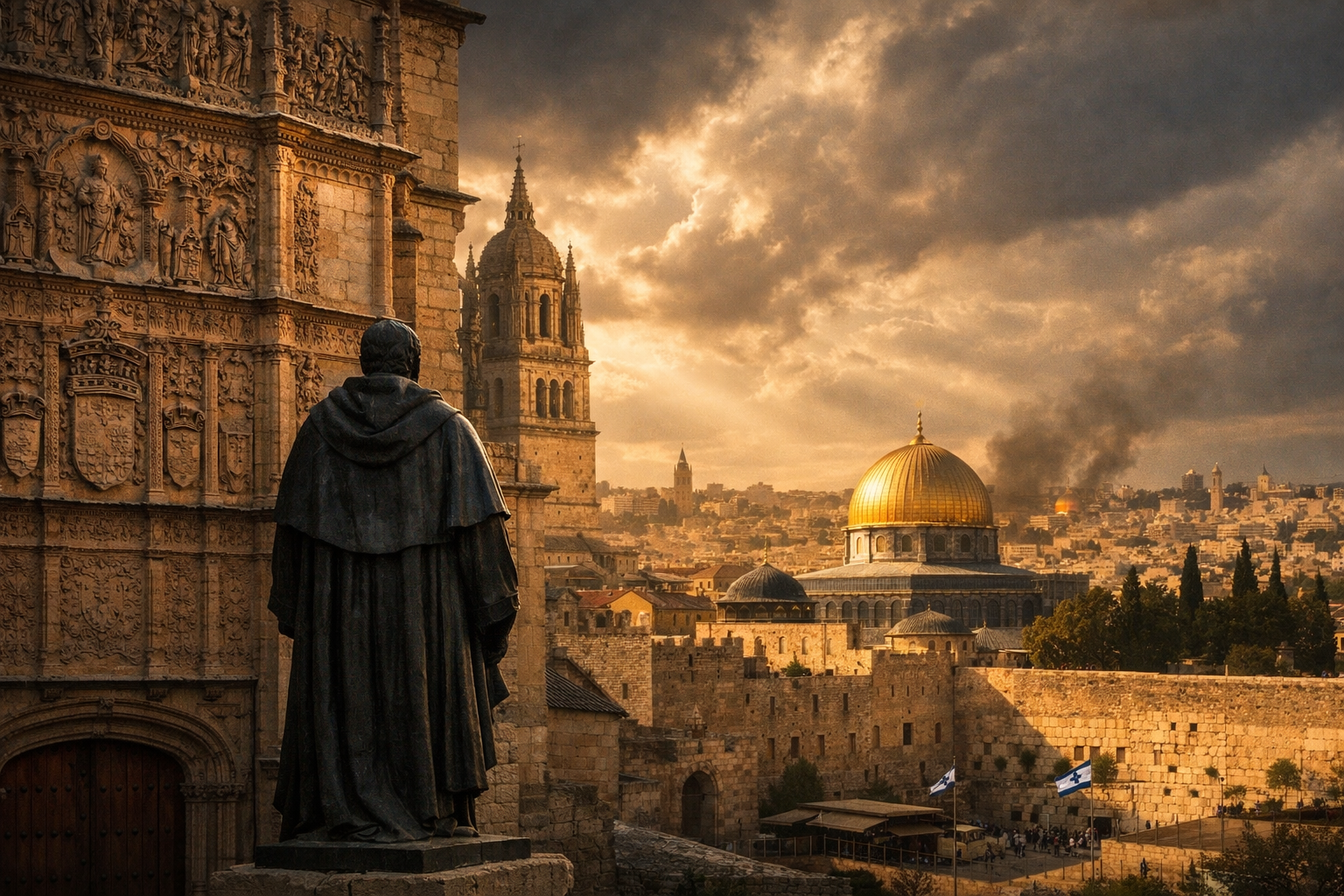
Credits: AI-Generated.
Israel’s claim to sovereignty is often debated through the language of twentieth-century diplomacy, mandates, and international law, yet its deeper intellectual logic is far older.
Long before Zionism, and long before the modern state system, the Spanish thinkers of the “Escuela de Salamanca” articulated a theory of political authority that maps strikingly onto Israel’s modern experience: sovereignty derives from the community, legitimacy is conditioned by justice and security, and political power exists to preserve collective survival.
Salamanca’s central move was to break decisively with absolutism. Figures such as Francisco de Vitoria and Francisco Suárez argued that political authority does not descend mystically from rulers but ascends from the people themselves. A polity, in their view, is morally before its governors. When rulers fail to protect the community or violate its fundamental rights, their legitimacy erodes. This was not revolutionary rhetoric but a systematic attempt to bind power to responsibility.
That logic is directly relevant to Israel. The Jewish state did not emerge as a theoretical project imposed from above, but as a collective act of political reconstitution by a people whose security had collapsed catastrophically. In Salamanca’s terms, Israel represents a community reclaiming the right to self-government because no external authority could or would fulfill the primary obligation of protection. Sovereignty, here, is not ideological ambition; it is remedial necessity.
Salamanca also insisted that self-defense is a natural right of political communities. Vitoria’s treatment of just war emphasized that force becomes legitimate when it preserves the conditions for collective life. This framework illuminates Israel’s security doctrine far better than postwar liberal abstractions. Israeli military action is routinely judged as if legitimacy were independent of existential threat, yet Salamanca would have rejected that separation. A state that cannot defend itself forfeits not only security but political existence.
Crucially, Salamanca’s thought undermines the claim that Israel’s legitimacy depends primarily on international recognition. Suárez held that political authority originates in the people even before formal legal acknowledgment. Recognition may regularize sovereignty, but it does not create it. Applied to Israel, this means that UN resolutions or diplomatic processes are secondary to the foundational act of collective self-assertion that restored Jewish political agency.
What makes this connection uncomfortable is that it exposes a contradiction in contemporary discourse. The same moral vocabulary used to defend popular sovereignty and resistance to tyranny elsewhere is often suspended when applied to Israel. Salamanca offers no such exemption. Its principles are universal: communities may govern themselves, defend themselves, and refuse domination when survival is at stake.
Seen through this lens, Israel is not an anomaly in the international system but a case study in classical political realism rooted in early modern moral theory. The distance between sixteenth-century Salamanca and twenty-first-century Jerusalem is shorter than critics admit. Both rest on the same premise: sovereignty is not granted by external approval but earned through the responsibility to secure the life of a people.
Related Topics