
Sanctions and Cryptocurrency: Exploring what Isolation could mean for Israel
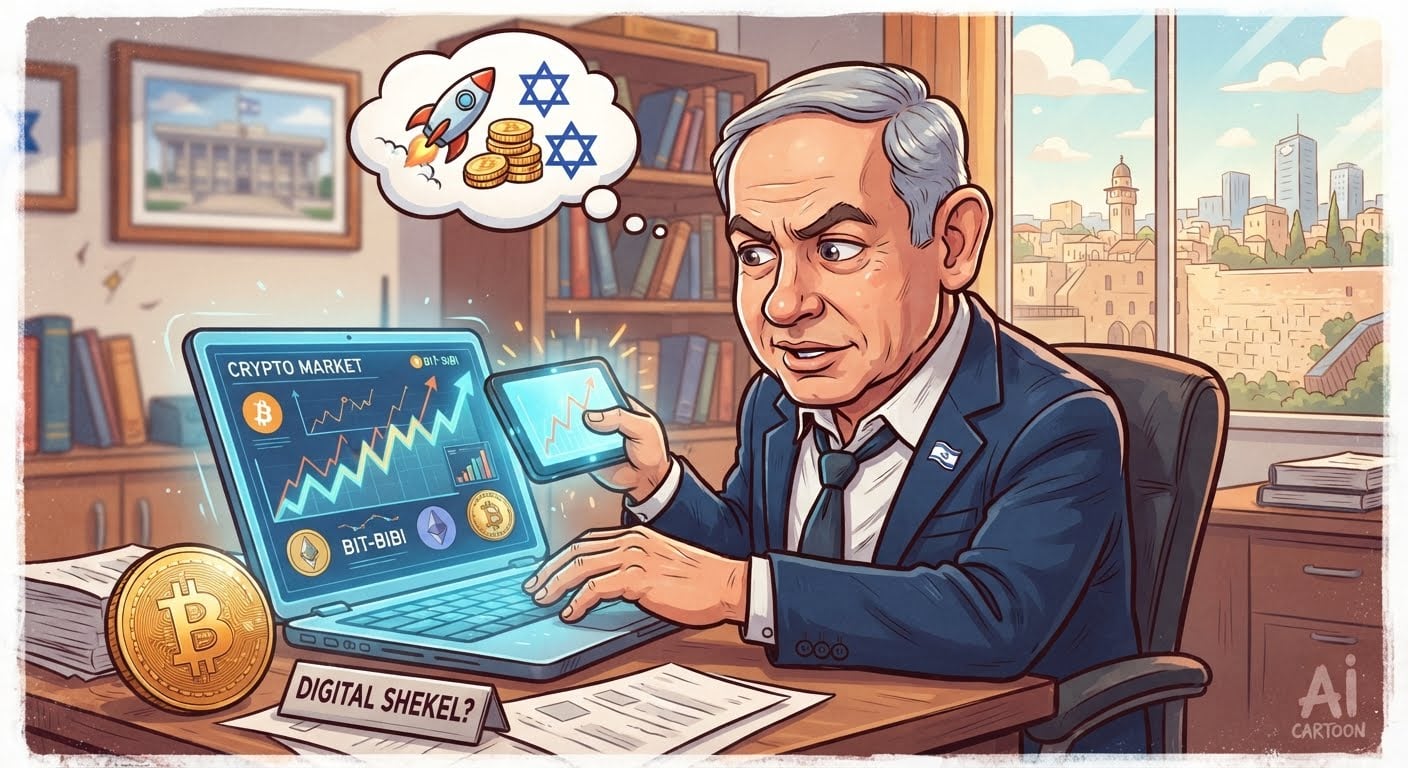
PM Netanyahu explores cryptocurrency to address a future Israel under sanctions (freely sourced from Google AI)
This is not an article about who to vote for. Rather, it is intended to clarify the implications of Prime Minister Netanyahu’s ‘cryptocurrency’ remarks from motzei Shabbat (Saturday night).
In the foreign policy debates ahead of Israel’s forthcoming elections, there seem to be four common misunderstandings.
First misunderstanding: The main effect of Israel’s weakening strategic relationship with the US means that the so-called ‘aid’ will soon come to an end.
Second misunderstanding: The United Nations is merely a ‘talking shop’ whose activities have little impact on Israel.
Third misunderstanding: Coming international actions against Israel would likely entail targeted financial sanctions.
Fourth misunderstanding: The only existential security threat facing Israel today comes from Iran and its nukes.
Ahead of the election, it was pertinent for Prime Minister Netanyahu to provide further information on these matters to the electorate.
His message came on the back of his earlier comments in mid-September 2025, where he heralded a vision of an isolated Israel building a so-called ‘super sparta’ economy. This was a reference to the ancient Greek city state of Sparta which economically isolated itself in order to promote military discipline, social cohesion and moral integrity.
On motzei Shabbat, the prime minister outlined his thinking for how this ‘super sparta Israel’ could deal with its isolation, the main thrust being the possible use of cryptocurrency and blockchain technologies.
What could this future hold in store for Israel?
It may be pertinent at this point to provide some analysis on this thinking, in particular to address these four misunderstandings.
Firstly, the most important consequence of Israel’s weakened strategic relationship with the US would not be the end of the ‘aid’ but rather, the end of the US veto at the UN Security Council against anti-Israel resolutions.
Let’s imagine, the date is 20th January 2029. President Vance / Newsom / Ocasio-Cortez / Sanders / Mamdani (delete as applicable) is sworn into office as the Trump Administration leaves DC.
Any of these outcomes would likely lead to the end of the US veto.
Under a Vance Administration, the US may prefer to abstain. When another UN Security Council member – let’s say an Algeria or an Ireland – introduces an anti-Israel resolution, key conservative influencers, the likes of Tucker Carlson, would be vocally arguing (wrongly in my view) that use of the US veto would be in Israel’s, not America’s interest. (Unfortunately, Republicans increasingly dislike Israel too – a recent poll showed that 57% of Republicans aged 18-49 hold an unfavorable view of Israel). In this context, Vance – known to be lukewarm (at best) to Israel and Netanyahu – would likely prefer using up his scarce political capital on the domestic issues known to be more central to his priorities, rather than fighting about this.
Under a Democratic Administration, it is not only the likes of Ocasio-Cortez, Sanders or Mamdani that Israel should worry about. Even under a moderate/traditional Democrat president – someone like Gavin Newsom – the US may also prefer to abstain or even vote in favour of an anti-Israel UN Security Council Resolution. While hotly debated, Democratic research holds that a key factor why Kamala Harris lost the presidency was the Biden Administration’s pro-Israel stance after October 7th. Recent polls show that 60-70% of Democrat voters favour, not just the end of US ‘aid’, but also an arms embargo and sanctions on Israel. The logic of democracy means any candidate which seeks the Democratic Party ticket would need to take a hard line against Israel, and may need to stick with that hard line to retain party support in Congress.
So to the second misunderstanding. Some may consider the UN to be a ‘talking shop’ which doesn’t have any power. This isn’t correct.
Until now, Israel has faced negative reports from UN rapporteurs and agencies, or General Assembly resolutions. These are not binding.
However, UN Security Council Resolutions are binding. And they bind not only those countries that vote for them but, under Article 25 of the UN Charter they bind every member state of the United Nations, which is in effect every country in the world.
Five countries have the right to veto a UN Security Council Resolution and prevent it from becoming binding – China, France, Russia, the UK and the US. Until now, with minimal exceptions, the US has vetoed anti-Israel UN Security Resolutions, preventing them from becoming binding more than 50 times since 1972. By contrast, none of China, France, Russia or the UK have used their veto on an anti-Israel resolution.
Irrespective of whether the US abstains from an anti-Israel resolution under a President Vance or Newsom, or votes in favour of it under a President Sanders, Ocasio-Cortez or Mamdani, the effect would be the same: the UN Security Council Resolution passes and becomes binding.
Based on precedent, what could a UN Security Council Resolution entail?
So to the third misunderstanding. A UN Security Council Resolution may not only entail targeted financial sanctions of the kind that the prime minister has in mind.
Rather they could involve:
1. The global recognition of a Palestinian State based on the pre-1967 green line demarcation
2. Sanctions against key Israeli sectors and organisations that are said to be ‘impeding the formation’ of a Palestinian State
3. A global arms embargo, enforced by blockade, to ‘protect the Palestinian population’ and to ‘end Israel’s occupation’
4. Embargo of other strategic goods and services said to support Israel’s military effort – for example, oil and gas, metals and minerals
5. Authorising the use of force to ‘liberate Palestine’, similar to the 1990 effort to liberate Kuwait
Sounds hysterical? Beyond belief?
That’s only because Israel has become so accustomed to the US veto it’s hard to imagine a reality without it.
And it’s clear, even with the US veto assured, many countries have been lining up to introduce these kind of resolutions with gusto. Let’s not be deluded – even some of Israel’s closest allies often vote for them.
(UN Watch has a helpful application that tracks every country’s UN voting position on Israel. Who could think of an ally closer to Israel than Czechia, for example? Per UN Watch, it voted against Israel in 98 of 181 anti-Israel resolutions since 2015, or 64%. Argentina? 137 times, or 76%. India? 159 times, or 88%.)
So then to the fourth misunderstanding, that the only existential security threat facing Israel comes from Iran.
I understood through his message, the prime minister wants us to believe the country is well-prepared for isolation; that the damage to Israel can be contained; and that – for whatever political motivation you may choose – the isolation will be “worth it”.
Maybe.
But here are some considerations to take into account:
Israeli experts are saying that sanctions would cause a significant loss of jobs as industry sharply contracts; prices could steeply escalate, multiplying the cost of living crisis many times over; a shortage of basic goods may occur as Israel would lack the hard currency to fund imports; and government revenues and defense expenditures could fall as key earners such as hi-tech migrate offshore.
And even if cryptocurrency may help in some way to counteract some of these sanctions – experts are skeptical – can cryptocurrency break an arms embargo enforced by blockade?
Contemplate this. More than 70% of Israel’s oil supply comes via Turkey. Think for a moment about the probable reason why this oil still flows. (Hint: it may rhyme with ‘grump’)
So, even if Israel can somehow switch by January 2029 to produce all the weapons it needs at home, would that help if Israel’s supply of the raw materials needed to manufacture those weapons, and the fuel needed to power them, are cut off?
In conclusion, again, this is not intended to sway anyone’s vote. Rather it is intended so that when Israelis vote, they vote with open eyes.
A country in Israel’s position cannot avoid hard choices. The threats from Iran are real. The constant effort by the likes of Hamas and Hezbollah to regroup is real, their motivations to destroy Israel remain undiminished. Antisemitism, the hatred of Jewish people, and the denial of our history and rights are growing worldwide. The pathway towards sustainable coexistence with the Palestinian people continues to be elusive. The internal challenges and the historic grievances deepen, while baseless hatred is stoked by those who should know better.
Judaism defines clearly what is expected of Jewish leaders. Tenakh never shies away from criticism when even the greatest of our leaders fall short – Moshe Rabbeinu himself did not enter the Land. Whatever our religion or religiosity and whatever our political perspective, we must distinguish between what are the hard choices an Israeli leader cannot avoid, and what are the free choices and unforced errors whose consequences our history shows we may have to live with for centuries or millennia.
May the Lord bless these elections, forgive our sins, save our people as You have in every generation, and inspire Israeli voters to vote and Israeli leaders to lead with wisdom, integrity, compassion and a spirit of unity and peace.
Related Topics