This Way Up: Spiritual Means to Psychological Ends
Seasons of the Soul: Jewish Time through Chinese Eyes
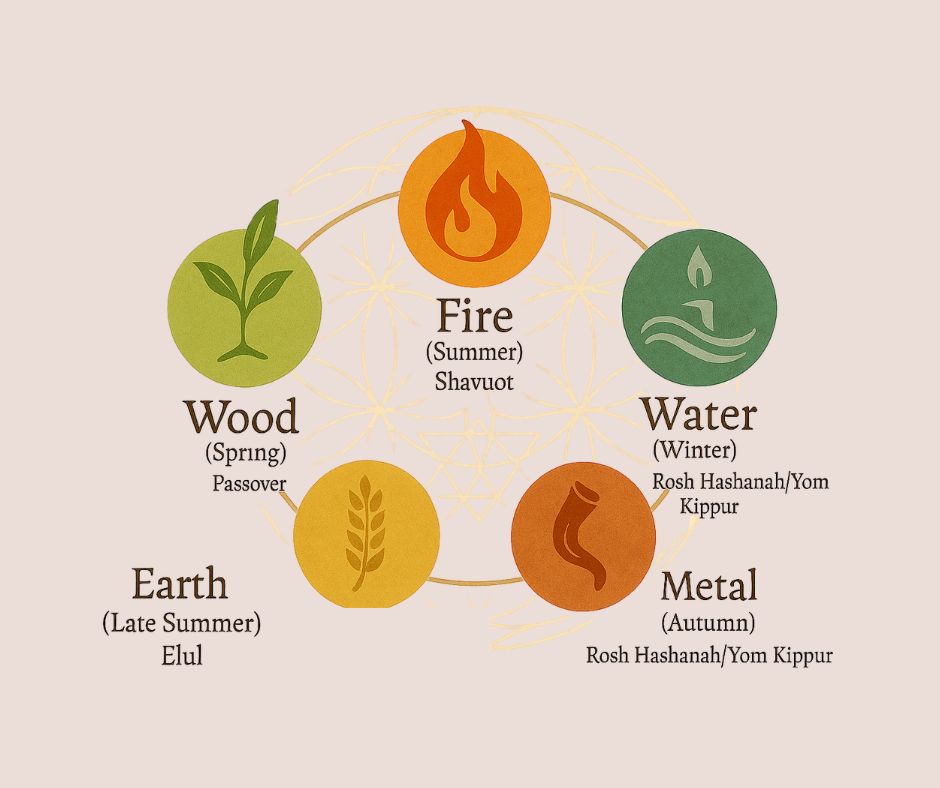
Illustration generated with ChatGPT (OpenAI, 2025).
In an increasingly interconnected world, the ancient wisdom of different cultures is finding new ways to converse. One such fruitful dialogue arises when we look at the Jewish holiday calendar through the lens of the Chinese Five Element Theory, a system that organizes the world and human nature according to five fundamental energies: Wood, Fire, Earth, Metal, and Water.
These elements correspond to the seasons, emotions, virtues, and processes of change. Intriguingly, when we align the Jewish cycle of holidays with the Five Elements, we begin to see powerful parallels that deepen our understanding of both systems—and perhaps, our shared humanity.
Wood – Spring and Liberation: Passover
Wood is the energy of spring. It is the force of growth, renewal, vision, and determination. In Chinese medicine, Wood governs the liver and is associated with the emotion of anger, both in its destructive form, and as the righteous fuel for change.
Enter Pesach, the festival of liberation. Occurring in the spring, Passover is the story of breaking free from Mitzrayim (Egypt), a Hebrew word that also means “narrow places.” This is Wood energy in action: pushing through constriction, fueled by vision and hope. Moses, the liberator with a fiery sense of justice, mirrors the Wood archetype—the trailblazer who sees a better future and acts with courage.
This is a season not just of external freedom but of the inner movement toward purpose. Just as Wood must grow toward the light, the Exodus reminds us that we are meant to expand beyond our perceived limitations.
Fire – Summer and Revelation: Shavuot
Fire is the energy of connection, passion, joy, and communication. It governs the heart and is associated with the emotion of joy and the virtue of sincerity. It is the most expressive of the elements.
Shavuot, the festival of the giving of the Torah at Mount Sinai, occurs at the peak of this energy. It is a celebration of Divine-human connection, of revelation, and of love. In the mystical tradition, this is often likened to a wedding between G-d and the people of Israel. The fire of Sinai, the burning desire to receive wisdom, and the overflowing joy of union are all hallmarks of the Fire element.
Just as fire sparks warmth and intimacy, Shavuot invites us into communion—with G-d, with each other, and with truth, itself.
Earth – Late Summer and Integration: Tu B’Av, Elul
Earth represents nourishment, grounding, and transformation. It governs the spleen and is tied to the emotion of worry and the virtue of compassion. Earth is the transition point, the center, the season of ripening and reflection.
The Jewish calendar’s late summer holidays, such as Tisha B’Av, a day of calamity, and Tu B’Av, the day of love, and the month of Elul, a time of introspection before the High Holy Days, embody Earth’s contemplative quality. Elul is a time to digest the year’s experiences, to begin turning inward, and to repair what is out of balance.
In Earth we find the compassionate invitation to return—to center ourselves, to ask forgiveness, and to mend relationships. Earth is the soil where teshuvah (return/repentance) is planted.
Metal – Autumn and Judgment: Rosh Hashanah, Yom Kippur
Metal is the element of clarity, refinement, grief, and letting go. It governs the lungs and large intestine—systems of intake and release. It is the energy of discernment and sacred judgment.
Rosh Hashanah and Yom Kippur fall squarely in the Metal season. This is the time of Divine review, when life and death are weighed in the balance. The shofar’s cry pierces like Metal: sharp, clean, and penetrating. It calls us to purify, to refine, to return to essence.
Yom Kippur, in particular, is a day of atonement and release. Like Metal cutting away that which no longer serves, we fast, confess, and let go of illusion. It is the sacred pruning that makes new growth possible.
Metal invites us into dignity, honesty, and awe—a time to measure the soul and align with higher truth.
Water – Winter and Dreaming: Hanukkah, Tu B’Shvat (and Beyond)
Water is the element of stillness, depth, fear, and wisdom. It governs the kidneys and the will. Water corresponds to winter—a season of darkness, gestation, and hidden potential.
Hanukkah, the Festival of Lights, shines in the heart of winter. Its story of endurance, faith, and hidden strength reflects Water’s deep resilience. The miracle of the oil, which burned beyond expectation, is Water’s lesson: that which appears limited may hold unmeasurable reserves of power.
Tu B’Shvat, the New Year for Trees, falls at the end of the Water season or, depending on the year, at the beginning of the Wood season. It celebrates the sap beginning to rise, reminding us that beneath the frozen surface, life is preparing to bloom. Water teaches us to trust the unseen—to root deeply and wait.
Two Ancient Wisdoms, One Conversation
When we overlay the Jewish calendar with the Five Element cycle, we see not only a rhythm of external time but an internal map of spiritual evolution. Each season, each holiday, carries a message that corresponds to a phase of personal and communal growth.
This is not coincidence. Both Judaism and Chinese medicine recognize the human being as a microcosm of the cosmos. Both systems honor cycles, seasons, and the interplay of opposing forces. Both insist that transformation is possible with the help of ritual.
By viewing Jewish tradition through the lens of Five Element Theory, we gain a fresh language to describe its depths. And in doing so, we open a door to deeper collaboration between two ancient peoples who have long prized wisdom, balance, and the elevation of the human spirit.
In a fractured world, this kind of cultural listening is a form of healing. As we reimagine sacred time across traditions, we may just discover a universal calendar etched in the stars . . . and in the soul.
Related Posts