
Middle East Analyst
Securing Democracy in the Post‑Labor AI Age: Update
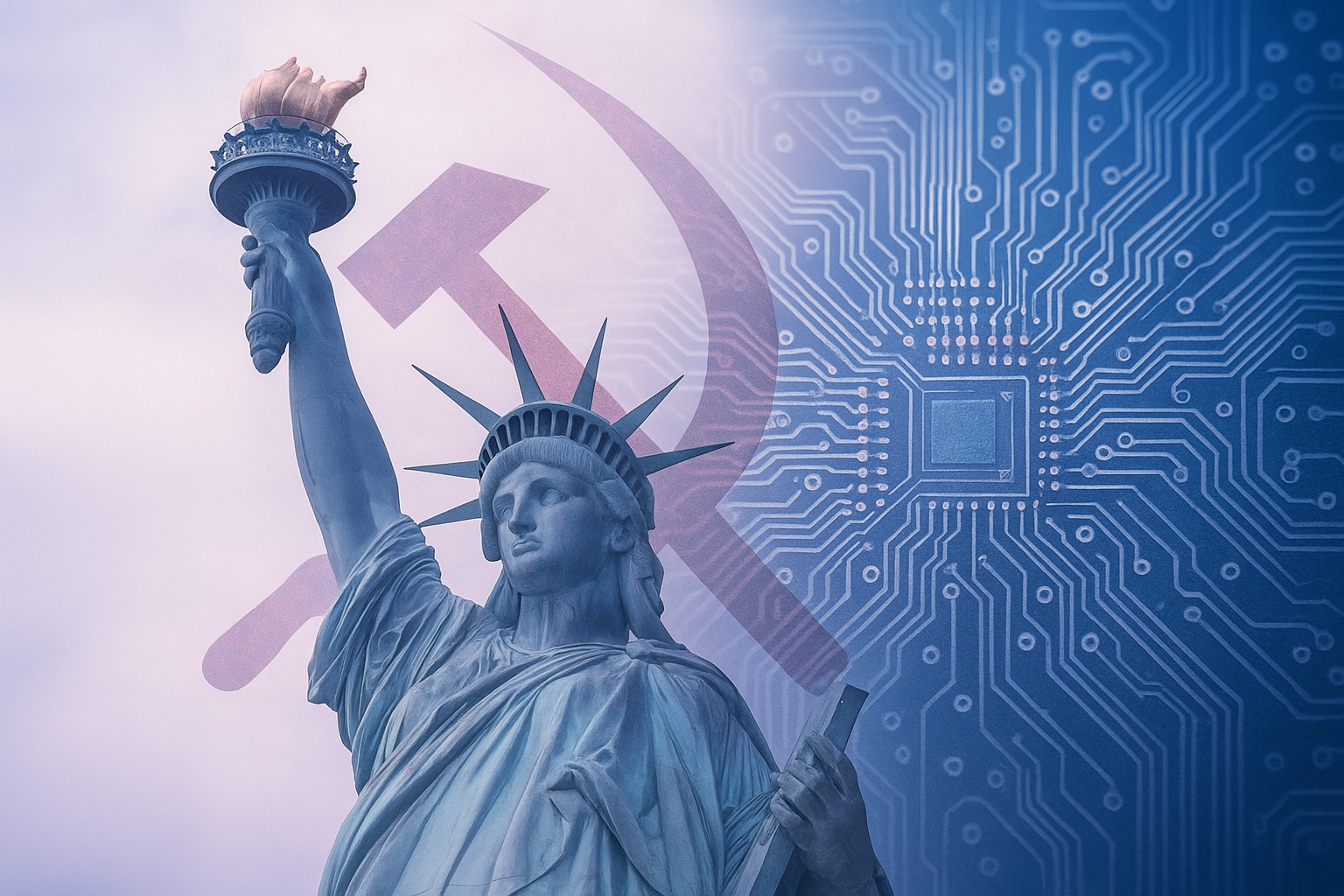
by author (AI)
Hybrid governance: A blueprint for democratic reinvention amid automation and inequality.
The political moment we are living is not an accident of rhetoric or a sudden conversion of public opinion. It is the visible activation of structural forces that have been building for years. The rapid diffusion of advanced artificial intelligence has not merely introduced new tools into markets and militaries; it has altered the economic foundations of citizenship, the distribution of power within societies, and the implicit bargains that sustain democratic legitimacy. The essay I published in December 2025, Securing Democracy in the Post‑Labor Age, anticipated this transformation. What we are now witnessing is the transition from diagnosis to response: public anxiety has crystallized into political demand, institutions are scrambling to reassert control, and the language of governance is being rewritten in real time. This essay articulates why the only viable path forward is a hybrid political economy—a system that integrates human judgment and democratic legitimacy with AI capability and market dynamism.
The Structural Crisis
At the heart of the crisis is a simple structural mismatch. For two centuries modern democracies have anchored political membership and economic inclusion to labor. Work provided income, social identity, and a predictable pathway into civic life. Automation and AI are dissolving that anchor. Tasks once reliably performed by human labor are now subject to algorithmic substitution at scale. The result is not merely job churn; it is a reconfiguration of scarcity and bargaining power. Capital that controls the most powerful models captures outsized returns. Networks and platforms concentrate market access. Wealth accumulates in fewer hands while the social mechanisms that translated productivity into broad-based prosperity weaken.
This economic reordering produces political consequences. When large swaths of the electorate experience declining purchasing power, stagnant mobility, and a sense that institutions no longer protect their interests, legitimacy erodes. The grievance is not ideological in the classical sense; it is existential. Voters do not primarily ask whether a policy is liberal or conservative. They ask whether the system still works for them. In this environment, AI becomes a symbol and a mechanism of extraction. It is both the engine of new wealth and the visible instrument through which that wealth is consolidated. That fusion of technology and inequality is what turns a technical debate into a sovereign political issue.
Political Responses and Institutional Strain
Political systems respond to structural crises in two predictable ways: first, by attempting to reassert control through new institutions and rhetoric; second, by improvising policy that signals action even when the underlying problems require deeper structural change. The recent flurry of executive initiatives, the creation of an Autonomous Warfare Command, and the appointment of an AI Czar are manifestations of the first impulse. These moves are understandable. Governments must demonstrate capacity and command in the face of perceived threats to national security and economic stability.
Yet the reactive nature of these responses carries risks. Centralization without clear democratic guardrails can entrench power rather than distribute it. Militarizing AI governance reframes social and economic questions as security problems, which narrows the policy toolkit and privileges secrecy over deliberation. Rhetoric that demonizes dissenting constituencies deepens polarization and undermines the possibility of broad consensus. The political system is therefore caught between two imperatives: it must act decisively to stabilize markets and reassure citizens, and it must do so in ways that preserve democratic accountability and economic competitiveness.
The Hybrid State Model
The hybrid state is not a slogan; it is a design problem. It requires rethinking the relationship between markets, the state, and non‑human agents of production. In practical terms, a hybrid model rests on three interlocking pillars: democratic governance of values and constraints, regulated markets that preserve incentives for innovation, and institutional mechanisms that distribute the gains of automation.
Democratic governance means that humans retain authority over the normative questions AI cannot adjudicate: what counts as public goods, how risk is shared, and which tradeoffs are acceptable. This authority must be exercised through transparent institutions that can translate public values into enforceable constraints on AI deployment. Regulated markets mean accepting that firms must be profitable to sustain investment and competitiveness, but that profitability will be bounded by rules designed to prevent monopolistic capture and extreme extraction. Mechanisms for distribution can take many forms—universal basic income, wage subsidies, public employment programs, or targeted social insurance—but they must be designed to preserve dignity, maintain incentives for skill formation, and avoid creating counterproductive dependencies.
Crucially, the hybrid state treats AI as a partner in governance rather than a replacement for it. AI systems can enhance policy design, optimize logistics, and model complex tradeoffs, but they operate within human‑set constraints and under democratic oversight. This arrangement preserves the epistemic advantages of algorithmic analysis while ensuring that moral and political judgments remain accountable to citizens.
International Constraints and Treaty Architecture
Domestic reinvention cannot succeed in isolation. AI’s economic and military dimensions are inherently transnational. Unilateral attempts to slow development will be undermined by competitive pressures. Militarily, the diffusion of autonomous capabilities raises escalation risks that no single state can manage alone. Economically, capital flows and global supply chains mean that regulatory arbitrage is a real threat.
Therefore, a credible hybrid strategy requires international treaty architecture. Such agreements would not freeze innovation; they would set shared red lines, verification mechanisms, and norms for responsible deployment. Treaties can create common standards for safety, labor transition frameworks, and rules to limit the concentration of critical AI infrastructure. Negotiating these agreements will be difficult, but the alternative is a fragmented landscape in which states pursue short‑term advantage at the expense of systemic stability. The December 2025 essay argued that treaty formation is both necessary and politically feasible if framed as a mutual insurance problem rather than a zero‑sum contest. The present moment makes that argument more urgent.
Conclusion
The political upheaval we are witnessing is the activation of a structural transformation that has been long in the making. AI did not become a top voter concern by accident; it became the lens through which voters interpret affordability, opportunity, and fairness. The institutional responses we see—centralization, militarization, and symbolic gestures—are predictable reactions to a system under stress. They are not sufficient.
What is required is a deliberate reinvention of democratic governance for a post‑labor AI world. The hybrid state is a pragmatic synthesis: it preserves market dynamism and national competitiveness while embedding AI within a framework of democratic values, distributional safeguards, and international cooperation. The essay from December 2025 laid out this diagnosis and prescription. Today, as public opinion and political action converge, that framework moves from theory to policy imperative.
Reinvention will be contested, messy, and incremental. It will demand new institutions, new social contracts, and new international bargains. It will also require political leadership that can translate structural analysis into policies that stabilize livelihoods without sacrificing innovation. The alternative is a prolonged legitimacy crisis in which populist pressures and geopolitical competition drive outcomes that are worse for both democracy and prosperity. The choice before us is not between unregulated markets and unyielding socialist state control. It is between a hybrid that integrates human judgment and AI capability under democratic norms, and a future in which neither human dignity nor technological promise is fully realized.
Related Topics
Related Posts