
Writing on Jewish life, relationships, trauma, and resilience
‘Security First’ Peace Plan Offers Path Forward
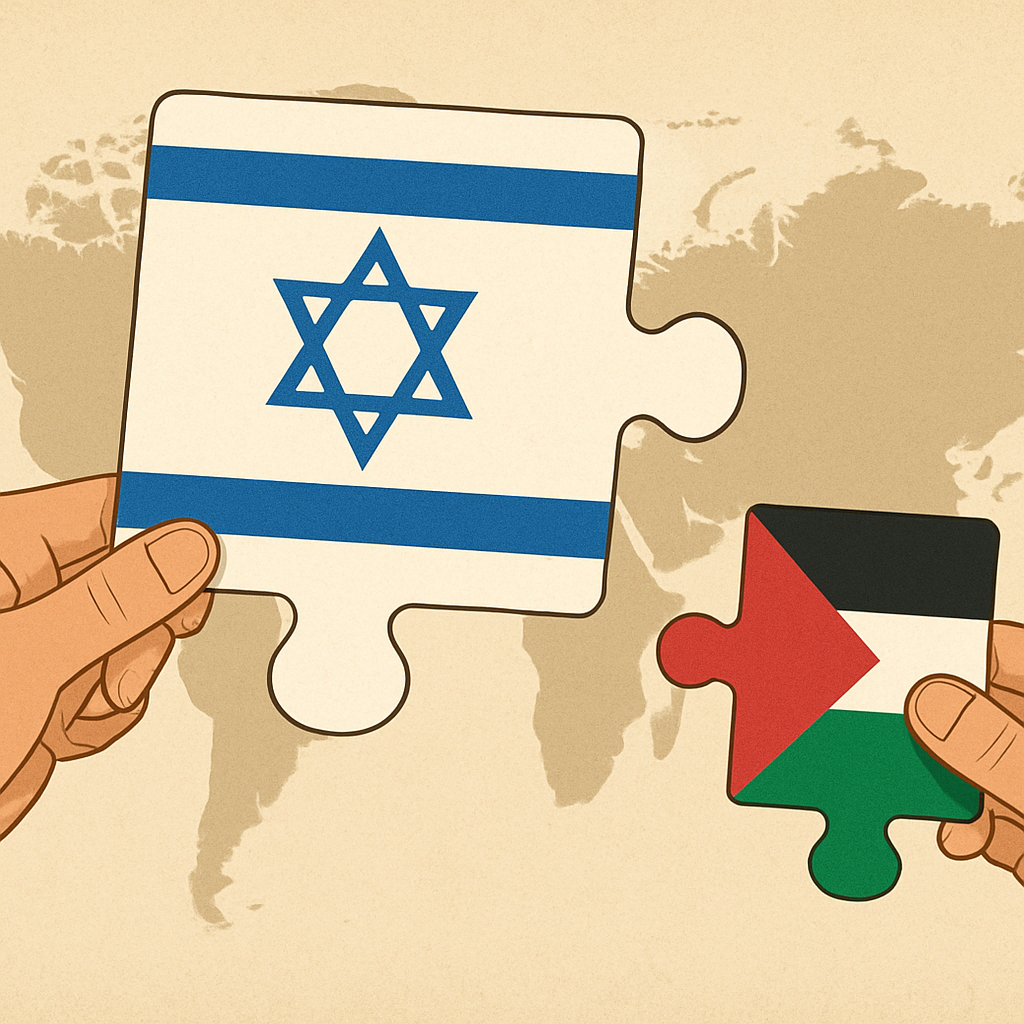
Illustrative: Image created by the author.
When Israeli Prime Minister Benjamin Netanyahu recently sat down with U.S. President Donald Trump, he presented a vision for Israeli-Palestinian relations that many dismissed outright: a Palestinian entity with broad self-governance, but under continued Israeli control of security.
To some, this looks like yet another delay tactic—another excuse to deny full Palestinian sovereignty. But history suggests something more complex and potentially more hopeful: a path that, while imperfect, has guided dozens of nations from conflict to self-rule.
A Familiar Framework in Global History
Netanyahu’s proposal may feel controversial, but it’s hardly without precedent. In fact, separating internal governance from external defense has been a pragmatic solution throughout modern history—particularly during times of instability or transition.
After World Wars I and II, much of the world was divided into mandates and trust territories administered by foreign powers under the League of Nations and the United Nations. Places like Palestine, Syria, Lebanon, and Tanganyika were expected to develop their institutions under the military protection of colonial powers until they could stand on their own. Sovereignty wasn’t granted in full—it was earned over time.
During the Cold War, client states aligned with either the United States or the Soviet Union often operated under similar arrangements. Internal governance was allowed—sometimes encouraged—but military decisions were often made in distant capitals. In many cases, this uneasy balance provided enough stability to prevent collapse.
The pattern didn’t end there. In the post-colonial era, countries like Monaco and Andorra entrusted national defense to France and Spain, respectively. France maintains defense pacts with numerous African nations to this day. These aren’t perfect analogies—but they reflect a common principle: sovereignty can evolve in stages, especially when security is at stake.
Even within the United States, examples abound. Puerto Rico, acquired in 1898, enjoys democratic self-governance, but lacks control over its defense and foreign policy. Over a century later, the integration process remains incomplete—a reminder that democratic autonomy and national security can remain in tension for generations.
Today, similar arrangements persist in places like Palau, Micronesia, and the Marshall Islands, where local populations elect their own leaders but defer to the United States for defense and international diplomacy. Kosovo, which declared independence in 2008, still relies on NATO for security. Bosnia and Herzegovina’s peace depends on EUFOR troops maintaining order.
These aren’t examples of full freedom—but neither are they evidence of failure. They show that in volatile environments, conditional sovereignty—with protections for all involved—can be a realistic way forward.
Beyond Idealism: A Case for Realistic Peace
To be clear, Netanyahu’s plan is not a final destination. It doesn’t promise full independence for Palestinians in the near term, and that will continue to anger critics. But maybe we’ve been looking for the perfect peace agreement when what we really need is a functional peace process—one grounded in current realities, not idealized endgames.
Critics argue, with reason, that a peace plan without full Palestinian sovereignty fails to deliver justice. But justice is also about protecting lives, reducing suffering, and building structures that allow trust to grow. For too long, each side has been paralyzed by all-or-nothing expectations. Maybe it’s time to consider the power of incremental steps.
A self-governing Palestinian authority under Israeli security oversight is far from utopian. But for people who are exhausted by incitement, conflict, and broken promises, it may offer something more tangible: stability, dignity, and the chance to build.
What Matters Now: Intent and Execution
The question is no longer whether Israel will retain security control for the near future—it clearly will. The real question is how that responsibility is exercised: Is it a tool of suppression or a bridge to cooperation?
If Israel wants this plan to be taken seriously by its own citizens, let alone the international community, it must demonstrate that this is not a strategy for indefinite occupation. That means taking concrete steps to empower Palestinian civil society, encourage responsible leadership, and lay the groundwork for eventual independence—however distant it may be.
And for the global community, it’s time to abandon the reflexive rejection of anything less than full statehood. As history has shown again and again, sovereignty is rarely born in a moment—it’s cultivated, sometimes painfully, over time.
A Cautious Hope
Netanyahu’s proposal will not solve the conflict. But neither should it be dismissed outright. It offers a practical, historically grounded framework for progress—a path that’s worked in other places, under other flags, with other people.
What remains to be seen is whether courageous leadership—on both sides—can make this transitional model something more than just another pause between rounds of violence. Peace may not be perfect, but it can still be possible.
Related Topics
Related Posts