CFO | Empower Society for Good I Author
Seeing the Good Society We Are Called to Build
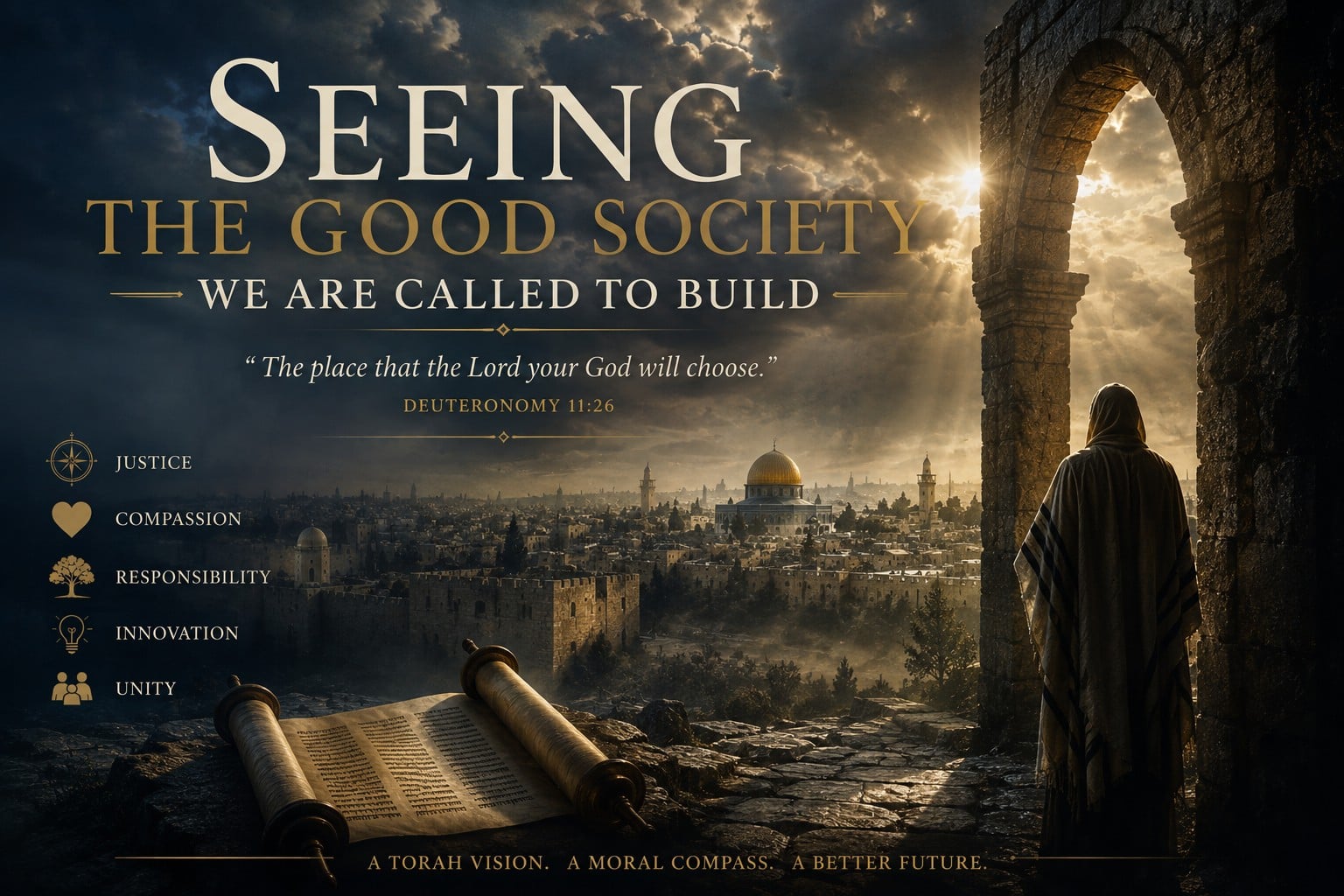
“See, I set before you today a blessing and a curse.”
(Deuteronomy 11:26)
This week’s parsha begins with one remarkable word:
Re’eh—See.
Not simply hear. Not merely believe. See.
See reality clearly. See the consequences of our choices. See the society we are building.
Judaism is a faith of visibility. The covenant is not hidden behind mystery or reserved for a spiritual elite. It is meant to be seen—in our laws, our leadership, our economy and the way we treat one another. The Torah is not only about personal faith; it is a blueprint for building a society whose values are visible.
As I reflected on these words, I could not help thinking about Israel today.
For almost three years, Israel has lived under the shadow of war. We have endured terrorism, missile attacks, disrupted trade routes, international boycotts and relentless diplomatic pressure. Yet despite everything, Israel’s exports reached a record $164 billion. Israeli innovation continues to transform medicine, agriculture, cybersecurity, artificial intelligence and defence. Our economy has demonstrated extraordinary resilience under conditions that would have overwhelmed many nations.
The blessing is visible.
Yet so too is the curse.
Israel is increasingly portrayed as one of the world’s great moral offenders. Our innovations are welcomed, our intelligence is sought and our medical discoveries save lives across the globe, while the nation that produces them is too often condemned. How can one nation be both so blessed and so cursed?
Perhaps that is exactly what Moses asks us to see.
Blessing and curse often exist side by side. The real question is not whether we experience both, but what we choose to do with the blessings entrusted to us.
Immediately after presenting the blessing and the curse, Moses commands Israel to eradicate idolatry from the land. To modern ears, this language can sound distant. But idolatry is more than the worship of carved statues. It is the elevation of false values above human life.
On Oct. 7, the world witnessed a modern form of idolatry. We saw murder celebrated as heroism, kidnapping turned into spectacle and hatred elevated above human dignity. Whenever a society glorifies death instead of life, destruction instead of creation and terror instead of peace, it has created idols every bit as dangerous as those condemned by the Torah.
Israel’s struggle is therefore not simply about borders. It is a struggle between two visions of civilisation: one that seeks to protect life and build society, and one that glorifies destruction. A Good Society cannot lose the moral clarity to distinguish between them.
The parsha then introduces one of the Torah’s most intriguing phrases:
“The place that the Lord your God will choose.”
The phrase appears repeatedly, yet Moses never names Jerusalem.
Why the mystery?
Perhaps because Jerusalem is more than a city. Before it becomes a location, it must become an idea.
Jerusalem would become the spiritual and moral centre of Jewish national life—the place where worship, justice, learning and collective responsibility converged. Yet its significance would never be limited to the Jewish people. Over time, Jerusalem also became sacred to Christianity and Islam. Today, billions of people look towards this small city as the place where heaven and earth meet.
That is why Jerusalem has always mattered far beyond its size. The struggle over Jerusalem is not simply about territory or sovereignty. It is about which values will radiate from the city that three great monotheistic faiths hold sacred.
Through the lens of Re’eh, Jerusalem is not simply a destination. It is the visible heart of a Good Society. Every civilisation needs such a centre—not merely a political capital or economic powerhouse, but a moral compass that reminds its people that power must be restrained by justice, prosperity by responsibility and freedom by covenant.
The parsha then makes what seems an unexpected transition—from Jerusalem to the laws of kosher animals. Yet the connection is profound. The Torah is teaching that values cannot remain confined to places of worship. They must become visible in everyday life.
How we eat matters. How we consume matters. How we treat animals matters.
A Good Society is built not only through great ideals but through daily habits. Even appetite must be guided by ethics. Today, Israel has become a leader in agricultural innovation and food technology, reminding us that innovation itself should serve life, reduce suffering and improve the human condition.
Perhaps that is the deeper meaning of Re’eh.
See—and understand that you will also be seen.
The Torah is not simply teaching us how to establish a Jewish state. It is teaching us how to build a Good Society.
A society where blessing is measured not only by prosperity but by purpose. Where power is restrained by justice, innovation serves humanity and freedom is guided by responsibility.
That is why “the place that God will choose” matters so deeply.
Jerusalem was never intended to be merely Israel’s capital. It became the heart of Jewish national life and, over time, a city sacred to the three great monotheistic faiths. For billions of people it represents the meeting place of heaven and earth.
The question has never been only who governs Jerusalem.
The deeper question is what values flow from it.
Today, instead of being recognised as a light unto the nations, Israel is too often portrayed by many as a stain upon them. Yet perception does not determine purpose.
Our task is not simply to defend ourselves or our reputation. It is to continue building the society that Moses envisioned—a society where justice is visible, compassion is practised, innovation serves humanity and moral responsibility guides national life.
The return of the Jewish people to our ancestral homeland was never the end of the story.
It was the beginning of the harder task.
To build in Jerusalem a Good Society that once again becomes a light unto the nations.
Questions to Ponder
- What blessings has Israel been given today, and how are we using them to build the kind of society the Torah envisions?
- What forms of modern idolatry—whether the glorification of violence, power, wealth or ideology—threaten our own moral clarity?
- Why does the Torah repeatedly speak of “the place that the Lord your God will choose” without naming Jerusalem? What does that mystery teach us about the city’s purpose?
- If Jerusalem is where heaven and earth are meant to meet, what values should flow from it to Israel and to the wider world?
- Does a nation’s greatness lie primarily in its economic success and military strength, or in the moral character of the society it builds?
- How can we ensure that innovation—in food, technology, medicine and artificial intelligence—serves human dignity rather than simply economic growth?
- In an age of instant judgement and social media, are we seeing reality clearly, or only the narratives we are encouraged to see?
- If the Torah is a blueprint for a Good Society, what practical changes can each of us make so that justice, compassion and responsibility become more visible in our daily lives?
- What would it mean for Jerusalem to become not only the capital of Israel, but once again a moral centre that inspires humanity?
- If the world is watching Israel so closely, how can we ensure that what it sees reflects our covenantal mission rather than merely our political struggles?
Related Topics
Related Posts