Exploring Memory, War, and Survival
Seven Passports for a Journey That Never Happened
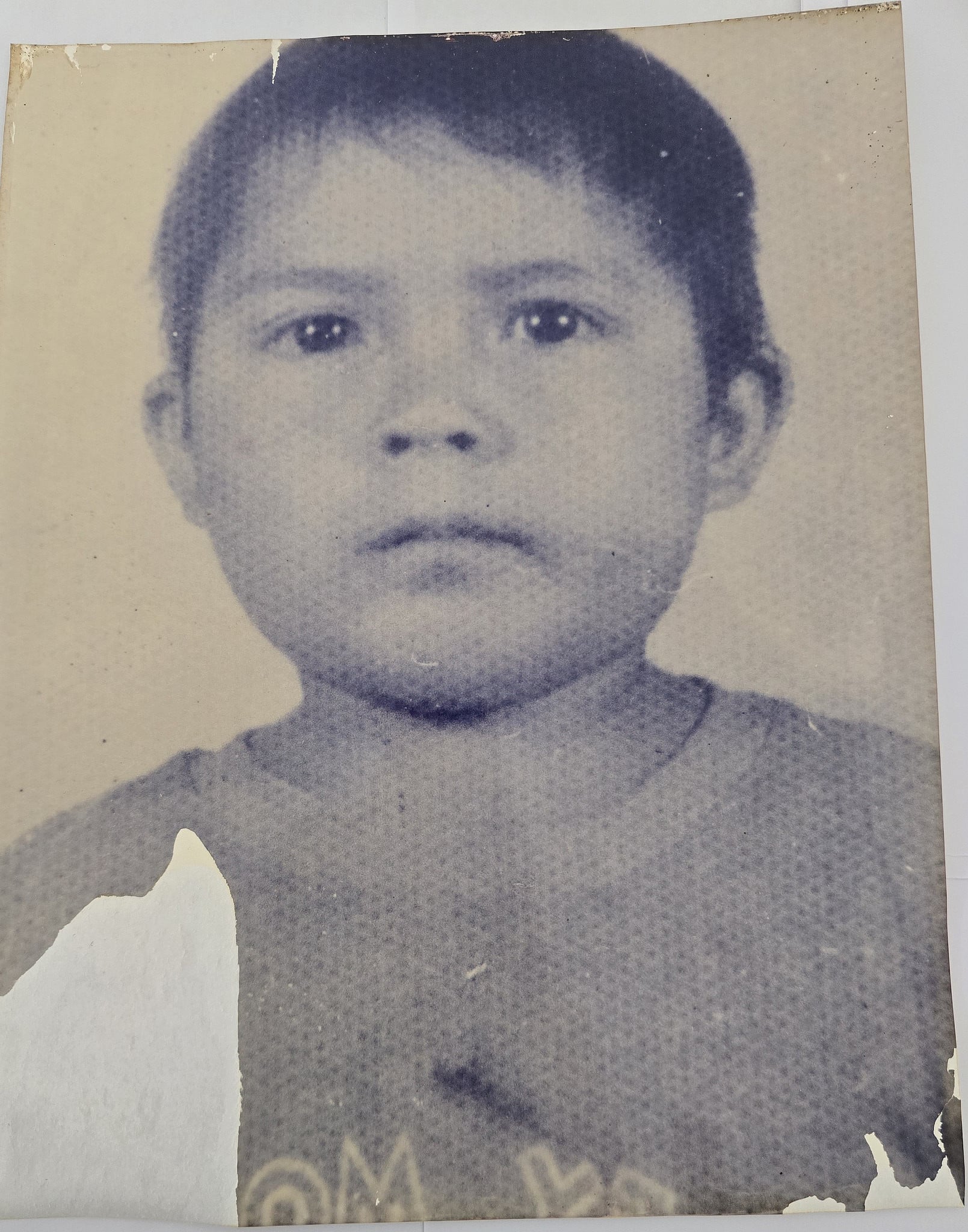
Walter Estever Gonzalez at approximately four or five years old in El Salvador. This surviving copy comes from a photograph taken for a passport intended for a family journey to Mexico that never took place. (Courtesy of the author)
There is a photograph of me from when I was four or five years old. I am wearing a Mickey Mouse shirt and looking directly at the camera with the seriousness children sometimes have when adults tell them not to move. The photograph has survived in imperfect form. The copy I have with me now is damaged by time, its edges worn and parts of the image missing.
But the photograph was not taken simply to remember what I looked like as a child. It was taken for a passport. And that passport was meant for a journey that never happened.
I do not remember the conversation that began it. I was too young. What I know comes from the story my family told afterward.
My mother’s aunt, Carmen, had a daughter and a son who had moved to Veracruz, Mexico. When I was very young, they returned to El Salvador for a visit. They told my mother that if she obtained passports for herself and her six children, they would help us reach Veracruz.
From there, another possibility existed.
My father had left our family, and my mother had been told that he was living in Houston, Texas. If we could reach Veracruz, perhaps we could eventually continue north. Years later, after I came to the United States, we learned that what my mother had been told was true: my father had indeed lived in Houston for a considerable time before eventually moving to Long Island.
But my mother could not have known that then. She had only a possibility. And six children.
We were living in El Salvador during a civil war. Leaving the country was not a simple decision, and for a woman with limited resources, obtaining seven passports was no small expense. Still, my mother found the money.
I remember being taken with my family to San Miguel, where the passport arrangements were made. I remember the photographs being taken. I do not remember the name of the office or agency. Memory preserved the experience but discarded the bureaucracy.
Seven passports were eventually ready: one for my mother, six for her children.
And then the two people who had promised to help us reach Veracruz disappeared. There was no journey. There was no explanation. There was only silence.
In 1985, a devastating earthquake struck Mexico, causing catastrophic destruction in Mexico City. From our small corner of El Salvador, Mexico seemed much smaller than it really was. We knew Carmen’s children had been living in Veracruz, not Mexico City, but geography offered little reassurance when no one knew where they were.
For years, the family wondered whether they might have died. Carmen did not stop looking.
She was a deeply religious woman, and whenever traveling preachers came through San Jorge, she would show them photographs of her children. Had they seen them? Had they heard their names? Did they know anything?
The answer was always no.
I think about that differently now than I did as a child. A child understands disappearance as absence. Someone was here, and then that person was not. An adult understands what absence does to the people who remain.
Carmen had no grave to visit. She had no death certificate that could tell her to stop waiting. She had no certainty that allowed grief to become something with boundaries. She simply did not know where her children were.
And she lived with that uncertainty for years.
Then, around 1999, something extraordinary happened. They came back. Carmen’s daughter and son returned to El Salvador alive.
They had not died in the earthquake, as the family had once feared. They had been alive all those years. What remained in the family story was their return, not an explanation for the years they had been gone.
Carmen had spent years searching for them. Not long after their return, she died.
For a long time, I thought that was where the story ended. It wasn’t.
By then, my own life had taken me far from the journey imagined when that passport photograph was taken. I eventually came to the United States and lived on Long Island.
In 2001, I met Claudia online. She was from Veracruz. We had never met in person, and I had never been to Mexico.
In June 2002, I traveled to Veracruz for her university graduation. It was my first trip to Mexico and the first time Claudia and I saw each other face to face.
I could not have known it as a child, but I had finally reached the destination for which my mother had once obtained that passport—only by an entirely different path, and for an entirely different reason.
Claudia and I continued our relationship across the years and the distance. By the time we married in April 2007, we already had a house and a business in Veracruz. On November 30, 2009, I moved there, and Veracruz became my home for the next decade.
The destination imagined for my childhood had not merely returned to my life. It had become home.
There was another strange coincidence.
When I met Claudia, I mentioned my maternal surname, Ticas. Unlike Gonzalez, Ticas was a name I had rarely encountered outside my own family. Claudia surprised me by saying that she already knew it. Before we met, she had lived near people in Veracruz who also carried the surname Ticas. They had operated a business in the center of the city.
I immediately thought of Carmen’s children. Ticas was their surname too, and the detail about the business resembled what my family remembered being told years earlier.
By the time I first arrived in Veracruz in June 2002, those neighbors were already gone. The people Claudia knew did not know where they had gone.
I never tried to find them.
I could not prove that they were Carmen’s children, and I had no desire to turn a coincidence into certainty. But after all those years, it was difficult not to wonder.
Carmen had died in San Jorge on December 30, 1999, about two and a half years before I first set foot in Veracruz. The people I had known only through an old family story were strangers to me. Later, there were even rumors that Carmen’s children might be living on Long Island. Again, I did not look for them.
Perhaps that sounds strange. After all, so much of this story is about people searching for other people. But I had seen what their absence had done to Carmen. I had no desire to turn them into something they had never been in my own life.
What remained important to me was Carmen herself. Years later, I transformed her waiting into a poem called “The Last Visit.”
I did not write her biography. Memory became fiction. Carmen became a woman named Doña Lidia. Her daughter and son became two absent sons. The photographs she had carried from person to person became candles lit at dusk. And the real return of two living children became something deliberately uncertain—a knock at a door that might belong to memory, longing, death, or something beyond all three.
The poem was eventually published in Nassau County Voices in Verse 2026. The name under which I published it, W. E. Ticas, carries that same maternal surname—the name I use in my writing in honor of my mother.
Writing the poem made me understand something I had not understood when I was a child. For years, I thought this family story was about two people who disappeared.
It wasn’t.
It was about the person who waited.
Perhaps that is why the old photograph matters to me now.
The passport for which that photograph was taken is still in Veracruz. What I have with me today is a surviving copy of the photograph: a little boy in a Mickey Mouse shirt, staring into a camera without understanding what the adults around him were trying to make possible.
My mother had paid for seven passports with the hope that they might give her and her children a way out of a country at war.
The journey never happened.
Years later, by a route no one in my family could have imagined when that photograph was taken, I reached the United States.
And later still, I reached Veracruz.
I first went there to meet the woman I would eventually marry. Years later, Veracruz became my home for a decade. The destination that had once existed in my childhood on the other side of seven passports became part of my adult life.
But Carmen did not live to know that part of the story.
When I look at the photograph now, I no longer see only the journey my family never made. I see my mother trying to create a possibility for six children. I see seven passports waiting for a departure that never came. I see Carmen carrying photographs of her own children and asking strangers whether they had seen them. And I see how little a child understands about the people who are waiting around him.
The photograph survived.
The passport survived.
The journey did not.
But somehow, after all these years, the destination did.
Related Topics