
Israeli-American Jewish medical anthropologist, and peace advocate
Sexy Soldiers, Ignored Warnings: How Gender-Bias Fueled Oct. 7th Massacre
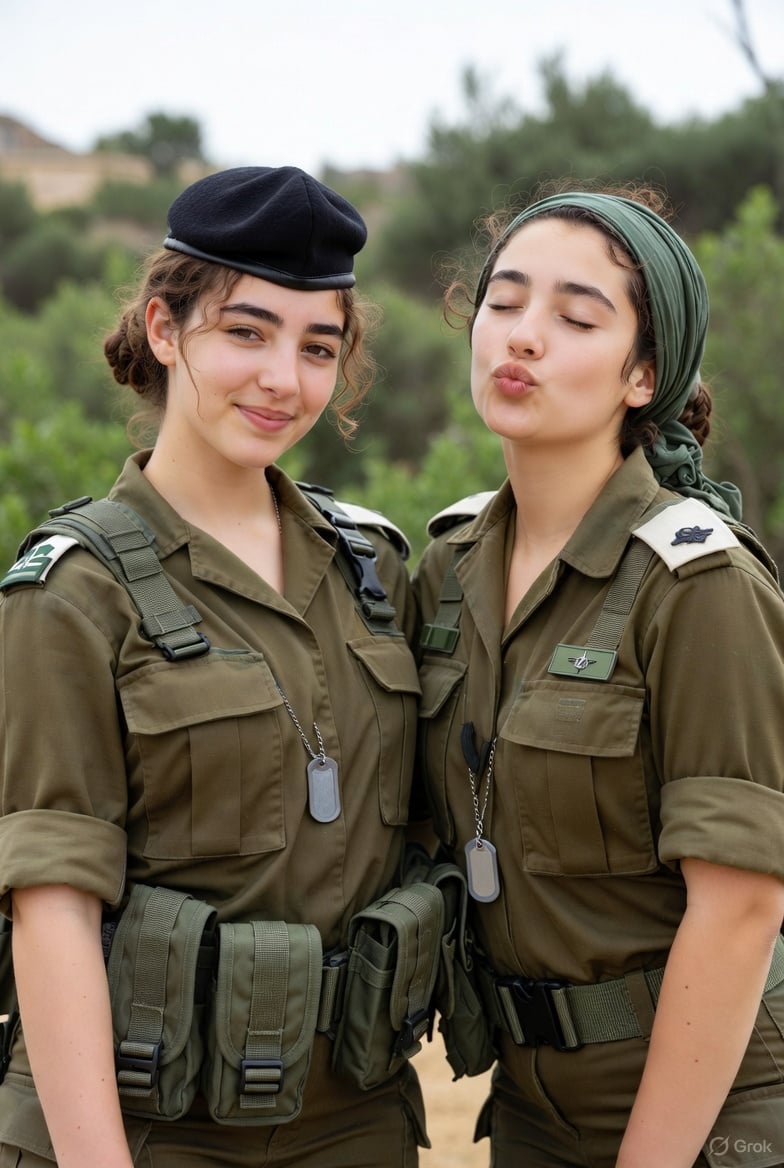
Image Created by Grok
In the pre-dawn haze of October 7, 2023, the young women of Nahal Oz—Israel’s “eyes on the border”—watched their worst fears unfold. Stationed at the Gaza frontier as part of IDF Unit 414, these all-female surveillance soldiers, known as tatzpitaniyot or lookouts, monitored Hamas activity through cameras and sensors.
Those women were the first line of defense Israel had at its border with Gaza, and yet, their urgent warnings of impending disaster were dismissed by male superiors as overreactions.
On that fateful day, Hamas militants breached the base, killing 15 of these women and abducting seven (one, Ori Megidish, was rescued by an IDF raid after 23 days; five more were released in January 2025, during the ceasefire deal after over 470 days in captivity. And one – Noa Marciano – executed in Gaza, her body recovered in February 2024), exposing a glaring vulnerability: sexism is a major Israeli national security threat.
Two years on, as Israel grapples with ongoing Gaza operations and internal reckonings, the story of these “Women on the Wall” demands we confront how gender bias, rooted in religious teachings and military culture, nearly unraveled the nation’s defenses.
The mood in the Nahal Oz unit before the attacks was a toxic brew of vigilance and frustration. These soldiers, mostly 18- to 20-year-olds fresh from high school, endured grueling 12-hour shifts in dimly lit rooms, scanning for anomalies across three miles of border. They spotted Hamas rehearsals: mock kibbutz raids, bulldozers practicing fence breaches, and unusual patrols disguised as “farmers.” Reports were filed meticulously—one on October 5 flagged “abnormal” activity—but senior commanders, predominantly male, waved them off as routine or “girls’ intuition.”
The atmosphere was tense; water shortages, faulty cameras, and endless shifts compounded the dread. Yet the sisterhood that made up unit 414 sustained them: shared meals, dance routines, and WhatsApp chats fostering unbreakable bonds. As one anonymous lookout told Haaretz, “We felt like we were screaming into a void.”
Israel’s post-Abraham Accords complacency contrasted sharply with their proactive alarm, highlighting how undervaluing female perspectives amplified the infamous “conceptzia” hubris. Sexual harassment plagued the unit, mirroring a broader IDF crisis that eroded trust and morale. Female soldiers faced unwanted advances, leering, and a culture where complaints were often mishandled. In 2021, 33% reported harassment, with only half filing due to fear of retaliation; outcomes were dismal, with fewer than 50% receiving proper attention. At Nahal Oz, survivors described an environment where they were “girls in a man’s war,” with harassment as pervasive as the Gaza dust. This toxicity wasn’t incidental—it silenced alarms. A 2025 Just Security analysis labeled it “chauvinism endangering lives,” noting how sidelining women undermines citizen trust.
Women comprise 34% of IDF personnel and 20% of combat roles, yet promotion barriers persist, with male leaders viewing them as support rather than strategists. IDF Chief of Staff Herzi Halevi’s 2025 apology acknowledged the dismissals as a “failure,” but skirted the issue of gender dynamics.
Individual stories humanize this tragedy, transforming statistics into searing indictments. Take Shai Ashram, 19, an outgoing dancer whose berets adorned her room. Killed in the command center inferno, she warned her father of gunfire in her last call: “Terrorists in the base… It’s going to be a huge event.” Shahaf Nissani, also 19, texted her mother in July about a “nerve-wracking” incursion, predicting war; she was among the first to fall. Roni Eshel, sharp-eyed at 19, briefed her dad on fence glitches, only to be burned alive in hiding.
Among the abducted, Liri Albag, 19, a motorsports fan with a “FAITH” tattoo, texted her family amid gunfire: “We were shot at—I wasn’t hit. Mom, pray.” Released in January 2025, her story echoes resilience amid horror. Noa Marciano, 19, a devout observer who flagged suspicious patrols, was executed in Gaza; her body was recovered in February 2024.
Survivors like Roni Lifshitz, 20, discharged post-trauma, lamented: “We were the lowest—our word? Less professional.” These women weren’t just monitors; they were daughters dreaming of travel, music, and justice, armed with 18 months of elite training in pattern recognition and intel analysis. Yet their expertise was invalidated, not for inaccuracy, but for their youth and gender.
Persistent Sexism in the IDF Existed Long Before October 7th
The betrayal ran deeper: Specific commanders in the chain—men who embodied the IDF’s patriarchal blind spots—bear names and legacies now etched in probes. Capt. Shir Eilat, the unit’s female commander, relayed breach alerts at 6:30 a.m. on October 7, only to perish in the flames while awaiting backup.
Her superior, Lt. Col. Ofir Avram of Unit 414, aggregated the women’s pre-attack reports on Hamas drills but couldn’t override the “fantasy” dismissals from higher brass; he faced no sanctions, even earning a promotion in 2024.
At the base, Lt. Col. Tomer Greenberg of the Golani 13th Battalion implemented partial “dawn readiness” but downplayed anomalies as routine; he died heroically in Gaza later that year, posthumously honored yet critiqued for leaving posts vulnerable.
Maj. Shilo Har-Even, his company commander, arrived with reinforcements at 7:41 a.m. but was killed blocking abductions—too late, per survivors. Higher up, Brig. Gen. Yossi Sariel of Unit 8200 dismissed intel as improbable, resigning in September 2024 amid censure but no deeper probe.
Maj. Gen. Aharon Haliva, Military Intelligence head, championed the “Hamas deterred” myth, resigning in April 2024 and being dismissed from reserves in November 2025 by Chief Zamir. Maj. Gen. Yaron Finkelman, Southern Command chief, failed to alert the base despite Shin Bet tips; he too resigned in January 2025 and was dismissed last month.
These men—veterans of past wars—weren’t charged criminally as of December 2025, but Zamir’s sanctions wave signals a reckoning, though families decry it as insufficient without a full state commission.
Long-standing Gender Bias Remains a Security Threat Propped Up by Religious Leadership
This dismissal ties into deeper religious legacies perpetuating women as unreliable witnesses. Israel’s Haredi leadership, influential in coalitions, draws on Talmudic texts such as Tractate Shabbat 30a and Yevamot 39b to disqualify women’s testimony, citing Deuteronomy’s masculine phrasing. Maimonides codified this in Yad, Edut 9:1, labeling women “incompetent” due to perceived “levity.” Written in 200-500 CE, when women lacked education (literacy ~10% male-only), these rules reflected seclusion and domestic roles. Today, Israeli women dominate academia—60% of higher education students, per the OECD 2022. A very different world than the one that the Rabbinical scholars of the Talmud could have envisioned.
Nahal Oz’s trained eyes outstrip ancient standards, yet bias lingers: A 2023 rabbinic statement post-October 7 downplayed female survivors’ accounts as “biased by trauma.”Media exacerbates this, portraying female soldiers as “toys in fatigues”—ponytailed pin-ups in Maxim spreads—and on social platforms like TikTok and YouTube, where hypersexualized videos of women dancing suggestively in uniform rack up millions of views.
Sexism isn’t a side issue; it’s a national security threat.
Influencers like Natalia Fadeev, a reservist known as “Gun Waifu,” blend pro-IDF propaganda with thirst traps, pouting and gyrating in combat gear to hits like Megan Thee Stallion’s, amassing over a million followers. The official IDF TikTok account amplifies this, featuring choreographed dances by attractive recruits that mimic assault training but devolve into seductive routines—lip-syncing Dua Lipa or marching to electronic beats—drawing criticism for trivializing conflict while inviting predatory comments from derogatory slurs (“whores”) to explicit fantasies.
This digital objectification, part of the long-standing “Combat Cuties” phenomenon, doesn’t empower; it endangers, fueling harassment like non-consensual filming reported in one-third of cases and normalizing a gaze that sees sentinels as spectacles, eroding respect for their testimony. It invites exploitation, from Hamas catfishing ops to internal breaches, turning defenders into distractions. Sexism isn’t a side issue; it’s a national security threat.
The State Comptroller’s 2024 report linked gender undervaluation to intel lapses, with female reports deprioritized 40% more often. A 2025 Weizmann Institute study showed that equitable units detect threats 25% better.
The UN’s Women, Peace, and Security agenda, adopted by Israel in 2014, frames bias as destabilizing, yet implementation falters amid rising harassment (18% up in 2024). If women’s testimony is doubted, why station them as sentinels? This hypocrisy created the “perfect storm” for October 7. Addressing this requires accountability at a national scale—transforming sexism from cultural echo to doctrinal enemy, ensuring no breach repeats.
Start with IDF mandates: Expand the 2024 “Zero Tolerance” harassment protocol into a “Gender Equity Security Doctrine,” requiring annual bias audits in intel units, with non-compliance barring promotions (as piloted in 2025 Ground Forces reforms).
Demand Knesset action: Amend the Women’s Equal Rights Law (1951) via a 2026 bill—sponsored by the Women’s Rights Caucus—to embed UNSCR 1325 metrics into IDF budgeting, tying 10% of defense funds to gender parity in command roles.
Two years after October 7, the ghosts of Nahal Oz still stand watch. Fifteen young women were murdered, seven were dragged into hell, their warnings were dismissed as “girls’ intuition,” their expertise belittled, their TikTok dances weaponized into proof that they were decorations rather than defenders.
The result was not just tragedy; it was the deadliest intelligence failure in Israel’s history, paid for in blood because too many commanders could not bring themselves to take female soldiers seriously.
Sexism is not a cultural quirk. It is a national security threat with a body count. Until the IDF, the rabbinate, and the country itself stop treating women’s testimony as second-class, until promotions, intelligence briefs, and life-or-death decisions are stripped of gender bias, the wall will remain porous and the next October 7 wound will never fully close. The Women on the Wall saw Hamas coming. The least we can do is finally start seeing them.
Related Topics
Related Posts