Seyag LaTorah, Lo Magen Sheker
סְיָג לַתּוֹרָה, לֹא מָגֵן שֶׁקֶר
Seyag LaTorah, Lo Magen Sheker
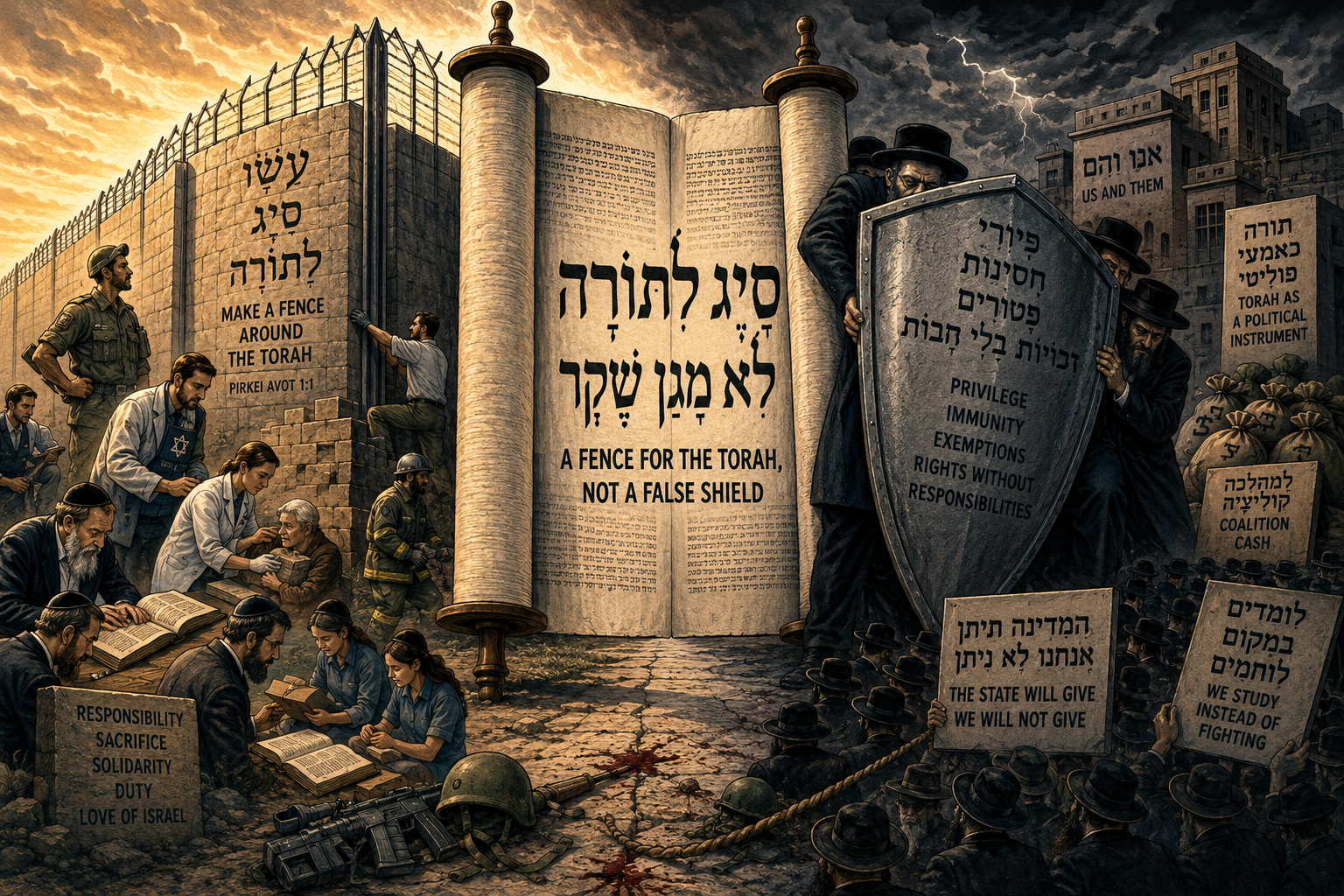
A Fence for the Torah, Not a False Shield
Torah is not a private shield against the burden of the people. A true fence around Torah protects the sacred not from responsibility, but from political corruption.
The Torah was not given so that one group could say to the rest of Israel: others will fight, serve, bury their sons, carry trauma in their bodies and silence in their homes, pay the price of history and live under the permanent pressure of fear, while we convert our absence into a superior form of presence. That is not holiness. It is the abuse of holiness. And it must be named without politeness, because polite language has too often served as the upholstery of moral cowardice.
Pirkei Avot begins its moral architecture with the severe instruction: asu seyag laTorah — make a fence around the Torah. Yet a fence is not a hiding place. It is not a private wall around privilege, nor a political bunker from which one group may receive the protection of the state while refusing the weight of the state. A fence around Torah exists to protect the sacred from distortion, desecration and careless use. It exists because what is sacred cannot be handled as campaign material, coalition property, budgetary leverage or rhetorical ammunition.
This distinction now matters with almost unbearable force. When Torah is invoked to deepen responsibility, it remains Torah. When Torah is invoked to avoid responsibility, it becomes a false shield, a magen sheker. The most dangerous political lies rarely arrive in the language of crude cynicism. They arrive wrapped in reverence, quotation, inherited authority and moral certainty. They do not say openly: we want privilege, immunity and exemption. They say: we defend Torah. Precisely there the corruption begins, because a holy vocabulary can become the most efficient disguise for an unholy asymmetry.
A Jewish state cannot survive as both a shared protection system and a private estate of exemptions. It cannot demand blood from some and declarations from others. It cannot send one part of society to the front while another part transforms non-participation into a publicly funded virtue. It cannot speak of national unity while institutionalizing an unequal distribution of fear, risk, grief and duty.
Not everyone must serve with a weapon. A serious state may recognize different forms of service: military, civil, medical, educational, emergency, social and communal. But the essential question is whether every community living under the protection of the state accepts a real, disciplined and measurable responsibility for the survival of the whole. Without that, the word “people” becomes theater.
The real divide is not between religious and secular Jews. That distinction is too easy, too vulgar and too useful for politicians. The real divide is between Torah as obligation and Torah as alibi; between holiness that disciplines the self and holiness that excuses the self; between a fence that protects the sacred and a shield that protects privilege. Torah as obligation demands more, not less. It does not say that because one is holy, one stands outside the common burden. It says that if one claims to carry holy words, one’s responsibility becomes heavier.
A fence around Torah is therefore also a fence against spiritual arrogance. It is a fence against the temptation to use God’s name as political armor. It is a fence against the conversion of study into immunity, tradition into entitlement and sanctity into a budgetary category. Torah as alibi does the opposite. It takes the language of eternity and uses it for short-term negotiation. It takes sanctity and converts it into exemption. It takes the vast Jewish tradition of study, dispute, law and responsibility, and turns it into a wall separating one group of Jews from the fate of another. That is not fidelity. It is spiritual corruption.
The bitterest irony is that the Jewish state was established, in part, so that Jews would never again be defenseless before the violence of history, yet some who benefit from that protection now claim the right to refuse participation in its cost. They want security without risk, protection without service, public money without symmetry and statehood without the burden of the state.
This is how a state becomes hollow. Not because parliament stops meeting, ministers stop speaking, parties stop negotiating, rabbis stop declaring, generals stop commanding or flags stop being raised. A state becomes hollow when the essential thing begins to disappear inside the machinery: the common covenant of responsibility.
When that covenant disappears, the state does not collapse immediately. It may still look strong. It may still possess advanced weapons, intelligence services, diplomatic alliances and a powerful economy. Yet morally it begins to sound empty: protected by those whom it exhausts, negotiated by those who exploit it, sanctified by those who refuse its burden.
This is where Korach returns, not merely as a biblical rebel, but as a permanent political possibility. Korach does not begin with open blasphemy. He begins with a beautiful sentence: all the congregation is holy. His danger lies not in falsehood alone, but in the factional capture of a partial truth. Precisely because the sentence contains truth, it becomes dangerous when weaponized against the threshold that allows common life to remain possible.
The same structure appears whenever a faction says: the people belong to us, but the burden of the people does not; the state must protect us, but must not obligate us; the army must defend us, but must not summon us; the taxpayer must fund us, but must not question us. There is nothing holy in this. Holiness that exempts one from responsibility for others is counterfeit holiness. Holiness that allows one to live from the sacrifice of others is privilege in sacred costume. Holiness that silences questions is not a path to God, but a technique of power over human beings.
This is why the accusation must be reversed. Those who criticize the political misuse of Torah are not attacking Judaism. Those who turn Torah into a private shield against shared obligation are the ones exposing Judaism to degradation. They teach the young that piety may mean not a greater burden, but a more convenient exception. They make Torah appear not as a source of moral demand, but as a document of release from history.
That is a disaster not only for Israeli politics, but for Jewish thought itself. Judaism did not survive by teaching Jews how to escape responsibility. It survived through memory, discipline, law, study, argument, self-limitation and the refusal to surrender the difficult question.
If someone claims that defending Torah requires dismantling the common burden of the Jewish state, he is not defending Torah. He is defending his comfortable location inside a system that others are bleeding to preserve. This is not hatred of Haredim. Hatred is intellectually cheap and spiritually barren. The issue is far more serious: the refusal to accept the fiction that any group may claim a monopoly on sanctity while living from the burden carried by others.
A people cannot be built on another person’s sacrifice as permanent infrastructure.
If Torah is to remain truly alive in the Jewish state, it cannot become a private shield against the state. It must become the fire that purifies every claim, including the claims of those who speak most loudly in its name. It must question not only secular Israelis, liberals, soldiers, judges and politicians, but also rabbis, religious parties, yeshiva systems and every community tempted to mistake inherited sanctity for inherited exemption.
The real question is not whether Torah has a place in Israel. The real question is whether Torah will remain a source of responsibility, or be degraded into political cover against responsibility.
If Israel chooses the second path, the Jewish state will become its own caricature: an army without a shared covenant, religion without humility, politics without limits, public money without shame and holiness without weight. It will speak of peoplehood while producing tribes. It will speak of unity while rewarding asymmetry. It will speak of Torah while funding those who use Torah as a curtain before another Jew’s suffering.
Seyag laTorah means: make a fence around the Torah. But a fence around Torah is not a wall around privilege, not a shelter from duty and not a sacred excuse for living from the risk of others. It is a warning not to touch the sacred with unclean political hands; not to turn study into immunity; not to turn holiness into a bargaining chip; and not to turn the Torah of Israel into a false shield against the fate of Israel.
Magen sheker: a false shield. That is what Torah becomes when it is used to protect privilege from obligation. Not because Torah is false, but because false are the hands that hide behind it from the common destiny of the people.
Yochanan Schimmelpfennig