Published author, Jewish educator and scholar
Shabbat Nachamu: Two Forms of Comfort and Consolation
ChatGPT
The opening words of this week’s haftarah are among the most comforting in the Bible:
“Comfort, oh comfort My people, says your God. Speak tenderly to Jerusalem, and declare to her that her term of service is over, that her iniquity is expiated”
(Isaiah 40:1–2).
After the three weeks of mourning that culminate in Tisha B’Av, we read Isaiah’s prophecy announcing a dramatic reversal of fortune.
Tisha B’Av commemorates the devastation of Jerusalem; Isaiah announces that Jerusalem will be comforted. Tisha B’Av recalls exile; Isaiah describes a highway through the wilderness along which God and the exiles will return. Tisha B’Av awakens the fear that God has abandoned His people; Isaiah declares that God is returning as both sovereign and shepherd.
Yet we read these words on Parashat Vaetchanan, which presents us with a strikingly different story.
Moses recalls how he pleaded with God:
“Let me cross over, please, and see the good land beyond the Jordan, that good hill country and Lebanon”
(Deuteronomy 3:25).
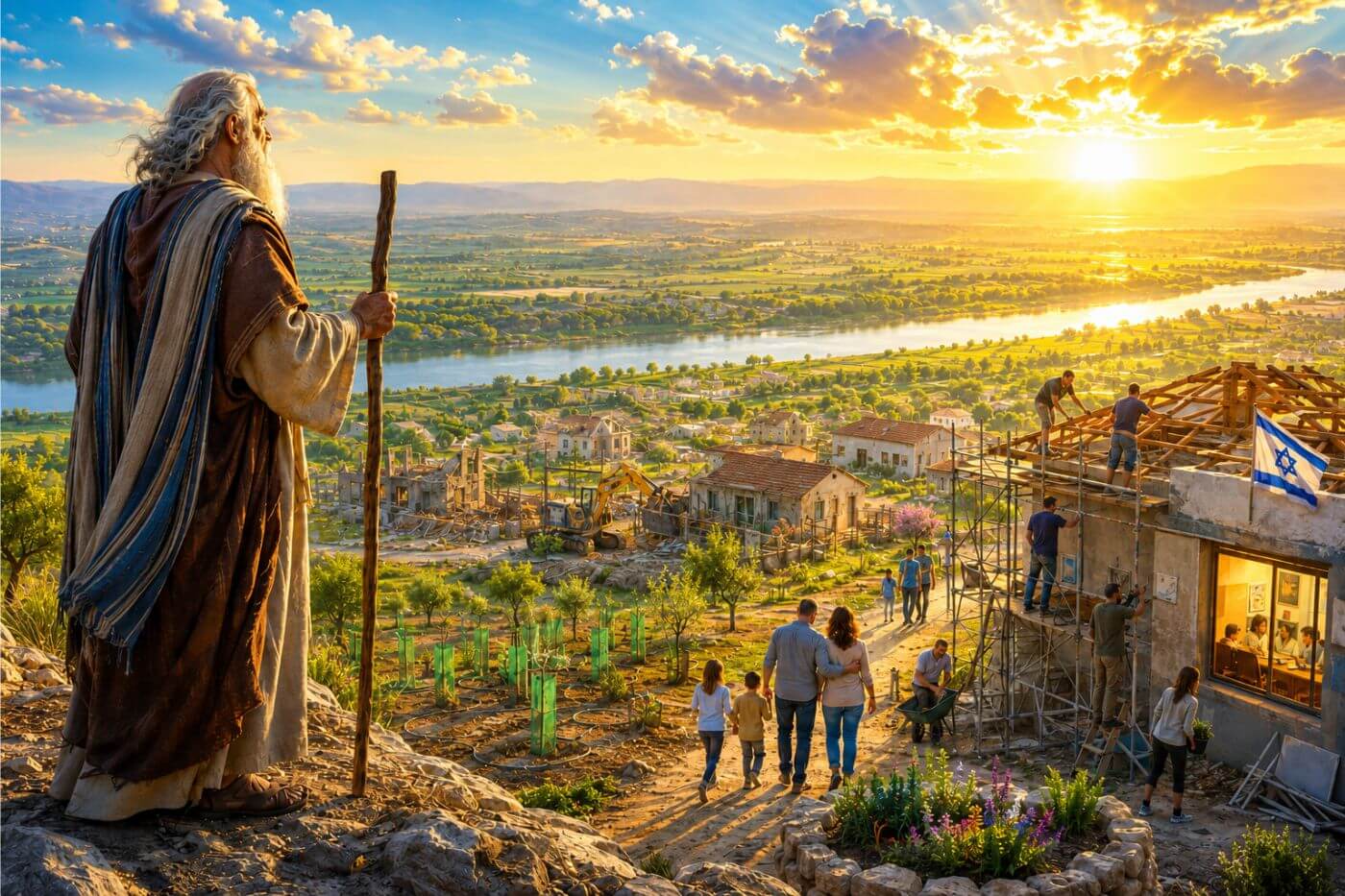
This was not a casual request. Entering the Land had been the goal toward which Moses had labored for forty years. He had confronted Pharaoh, led the people through the sea, received the Torah at Sinai, endured their rebellions, defended them after the sin of the Golden Calf, and guided them through the wilderness. Now, with the Promised Land before him, he begged to complete the journey.
But God refused:
“Enough! Speak to Me no more of this matter”
(Deuteronomy 3:26).
Unlike the people in Isaiah’s prophecy, Moses’ punishment is not reversed. His plea is denied, and his deepest longing remains unfulfilled. Moreover, there is no indication that this ceased to trouble him.
How, then, are we to read Vaetchanan, in which Moses’ fortunes are not reversed and he is not granted the comfort he seeks, on Shabbat Nachamu, whose message appears to be precisely the reversal of Israel’s fortunes and the consolation that follows?
Perhaps the juxtaposition teaches us that there are two different forms of comfort.
Sometimes comfort comes because our circumstances change. The danger passes, the exile ends, the captive returns, the illness recedes, or the ruined home is rebuilt. This is the comfort promised by Isaiah: suffering gives way to redemption.
But sometimes circumstances do not change. A loss cannot be undone. The dead cannot be restored to life. Years of fear, displacement, and sacrifice cannot simply be erased. In such cases, consolation may come not through the reversal of the past, but through the actions we undertake to build a better future even while the pain remains.
Moses exemplifies this second form of neḥamah.
God does not grant his request, yet Moses does not allow his disappointment to consume his remaining days. Immediately after denying his plea, God commands him to strengthen and encourage Joshua, “for he shall cross over before this people, and he shall cause them to inherit the Land” (Deuteronomy 3:28).
Moses will not enter, but he will prepare Joshua to lead those who will.
Indeed, the entire Book of Deuteronomy may be understood as Moses’ response to the knowledge that Israel’s future will unfold without him. He reviews the people’s history, teaches them the commandments, warns them against future dangers, renews the covenant, and prepares the next generation to build the society that he himself will never see.
His pain remains, but it is transformed into responsibility.
This is an essential message for Israel today.
We naturally pray for the first kind of consolation: that suffering will end, security will be restored, displaced families will return home, wounded soldiers will recover, and shattered lives will somehow be made whole again.
But not everything can be reversed. The communities devastated on October 7 may be rebuilt, but those who were murdered will not return. Homes can be reconstructed, but memories of terror cannot simply be erased. Families may return to the north and south, but they will not return as the same people who left.
Nevertheless, rebuilding has begun. Through the government’s Tekuma program, together with the efforts of the communities themselves and numerous civic and charitable organizations, homes, schools, farms, and public buildings are gradually being restored throughout the Gaza border region. The process has been uneven and, at times, painfully slow. Yet every act of reconstruction declares that destruction will not have the final word.
Every rebuilt house, replanted field, reopened classroom, and restored community is an act of neḥamah—not because it eliminates the pain, but because it refuses to allow the pain to define the future.
Moses teaches us that consolation is not always something that happens to us. Sometimes it is something we create.
True comfort begins when pain is transformed into purpose, loss into responsibility, and memory into the determination to build a future worthy of those who did not live to see it.
Shabbat Shalom.
–
For more insights on Torah and current events in Israel, visit https://davidharbater.com/parasha-current-events/
Related Topics
Related Posts