
Rabbi, Economist and Community Builder
What Does it Mean to Know Another Person?
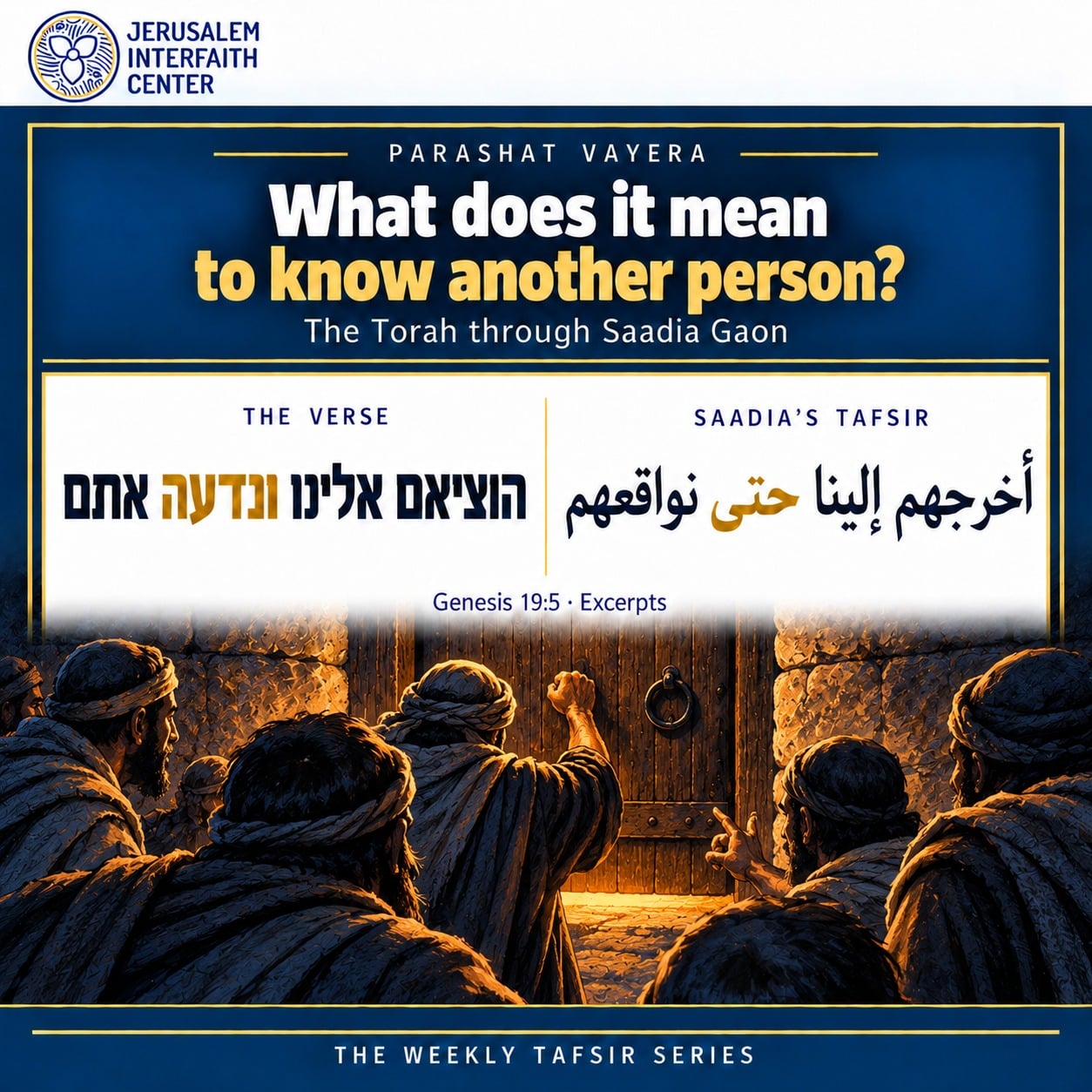
Rasag for Parshat VaYera
When we say that someone knows something, we generally mean that they have acquired an understanding of, or familiarity with, something outside themselves. But in the Bible, the word “know” does not always carry this meaning.
Already in the Book of Genesis, we encounter the verb “to know” in the story of Adam and Eve:
“Now Adam knew Eve his wife, and she conceived and bore Cain” (Genesis 4:1).
The second part of the verse makes it clear that Adam and Eve engaged in sexual intercourse, which led to Eve’s pregnancy and eventually to Cain’s birth. The Torah, however, sometimes uses indirect language to describe sexual relations. In this case, it chooses the verb “to know,” giving the act a meaning that extends beyond the merely physical.
Rabbi Saadia Gaon (Rasag), by contrast, opts for a more explicit translation. Already in Genesis, he translates the word “knew” as وَاقَعَ (wāqaʿa). The Arabic root و-ق-ع (w-q-ʿ) primarily conveys meanings such as falling, occurring, or taking place. The verb وَاقَعَ, in the third Arabic verbal form, can also mean to have sexual intercourse with someone.
As we have discussed before, more than a thousand years ago, Rabbi Saadia Gaon produced his monumental Arabic translation of the Torah, known as the Tafsir (تفسير). This Arabic word means “interpretation” or “explanation” and comes from a root related to the Hebrew word pesher (interpretation).
Saadia’s choice of words often reveals how he himself understood the deeper meaning of biblical verses. Each week, we select a verse from the weekly Torah portion and explore a new insight emerging from his translation.
This week’s Torah portion, Vayera, offers a particularly striking example.
The Torah tells us how the wicked men of Sodom demanded that Lot bring out the visitors who had arrived at his home, who were, in fact, angels:
“Bring them out to us, that we may know them” (Genesis 19:5).
In biblical Hebrew, the verb “to know” can refer not only to acquiring information about another person but also to intimate relations. Yet in the case of the men of Sodom, the word takes on a threatening meaning, associated with violence and domination.
Saadia translates the verse as follows:
أَخْرِجْهُم إِلَيْنَا حَتَّى نُوَاقِعَهُم
The first two words, akhrijhum ilaynā (“bring them out to us”), are a fairly literal translation of the Hebrew.
But then Saadia makes an interesting choice. Instead of translating the Hebrew conjunction vav (“and”), he uses the Arabic word حَتَّى (ḥattā).
In Classical Arabic, حَتَّى can carry several meanings depending on the context, including “until,” “until such time as,” “so that,” and “in order to.”
In our verse, it means “so that,” explicitly indicating the purpose of the action.
In other words, Saadia does not simply translate the Hebrew conjunction literally. He chooses an Arabic word that clarifies that the demand to bring out the visitors was not an end in itself, but was intended to enable the sexual act.
He then translates “that we may know them” as نُوَاقِعَهُم (nuwāqiʿahum), making it explicit that the men of Sodom were demanding sexual intercourse.
Thus, Saadia clarifies for his Arabic-speaking readers the precise purpose of the men’s demand, leaving no room for an alternative interpretation.
In doing so, he follows the approach we have encountered throughout this series: bringing the Torah closer to the world of his readers, not only by translating it into the language of culture and learning used by Jews living in Islamic lands, but also by choosing words and grammatical structures that make the meaning of the biblical text more accessible.
Once again, Saadia’s choice of Arabic vocabulary allows us to see a particular dimension of the verse more clearly.
And this is precisely one of the reasons why Rasag’s Tafsir is among the greatest treasures of Judeo-Arabic literature. For centuries, it shaped the way Arabic-speaking Jews read and understood the Bible, and its influence extended far beyond the act of translation itself.
In an increasingly divided and polarized world, linguistic differences can easily become yet another wall separating people from one another.
Through this weekly series, we seek to demonstrate the opposite: how the similarities and differences between Hebrew and Arabic can become a source of connection, and how these two sister languages can illuminate one another, revealing profound ideas that neither language brings to light in quite the same way on its own.
We owe a deep debt of gratitude to Rabbi Yom Tov Gindi of Kfar Chabad, who several years ago published a modern edition of Rasag’s Tafsir in Arabic script, making this remarkable work accessible to all of us.
We could not have embarked on this journey without him, and we invite you to join us.
Shabbat Shalom, and see you next week!
Related Topics
Related Posts