
Shabbat Returns to the US Supreme Court
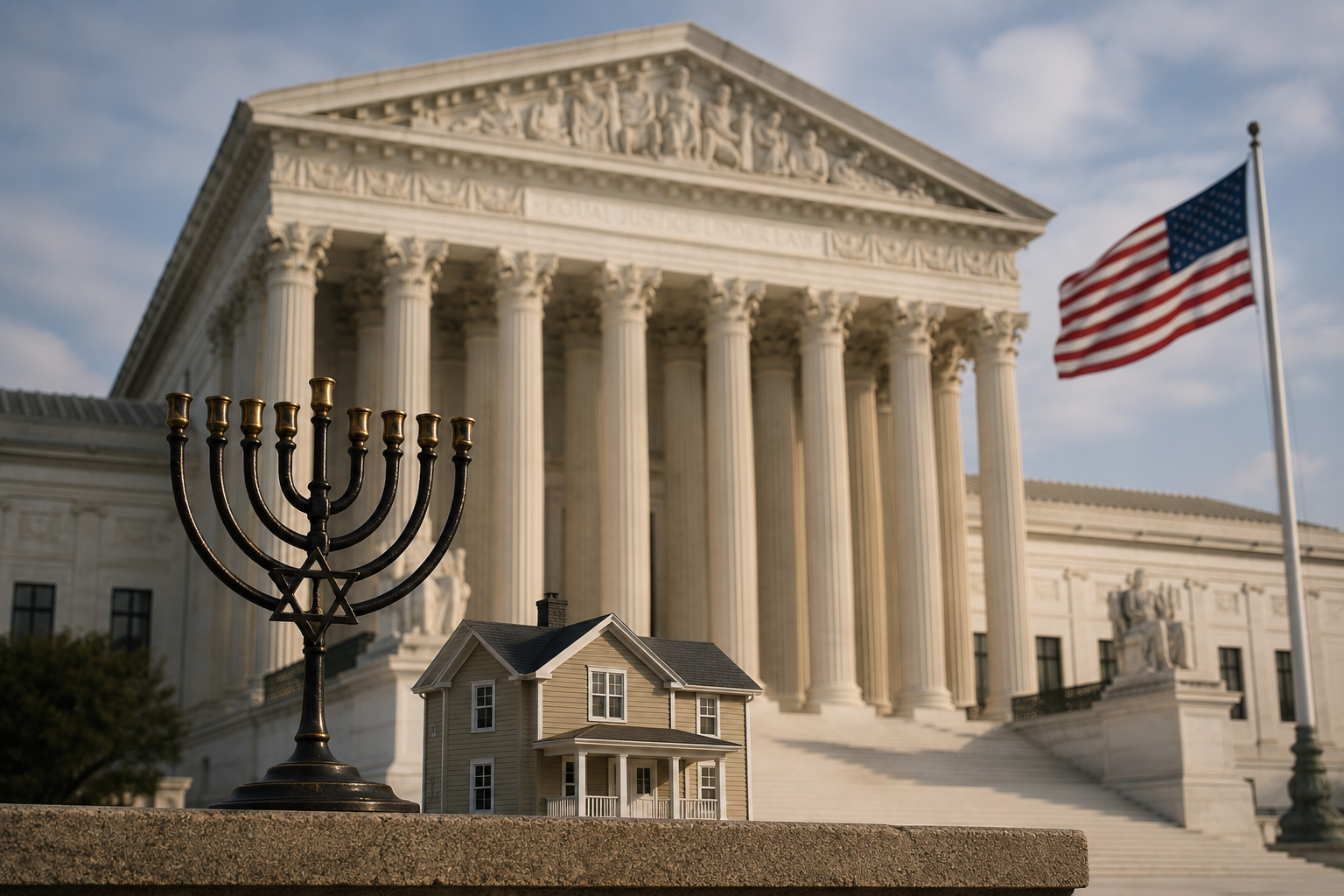
Three days before the Republic marks its 250th birthday, the United States Supreme Court agreed to answer a question that would have troubled the sleep of American Jews as far back as colonial Newport and Charleston: whether a government of the United States may instruct an observant Jew that he cannot pray as his faith commands.
The case is Grand v. City of University Heights. Daniel Grand, an Orthodox Jew in a Cleveland suburb, wished to gather a minyan in his home on the Sabbath — the quorum of ten men that Jewish law requires before the holiest prayers may be spoken aloud. His synagogue lay beyond walking distance, and the Sabbath forbids him the automobile. The home minyan, then, was not a preference to be indulged. It was the only door left open.
The City shut it. Within hours of one neighbor’s complaint, before any hearing, before any inquiry, the municipality issued a cease-and-desist order that pronounced his prayer group an illegal “place of religious assembly” and a “shul or synagogue.” Grand canceled the gathering. Then the mayor, not content with the order, stood before a public meeting and invited Grand’s neighbors to watch the house and report any activity “consistent with” worship. A neighbor obliged, training cameras upon the home. The police cruised past. When Grand at last sought the protection of a federal court, the Sixth Circuit declined to say whether any of this was lawful. He had come too soon, it held; he must first exhaust the very administrative machinery that had been turned against him, and await a “final determination,” before the Constitution might be troubled on his behalf.
To those who labor in this vineyard, the case did not fall from the sky. It is the latest entry in a ledger nearly as old as the country itself — the running account of what happens when a law drafted with the majority in mind is laid upon a people who keep a different calendar.
The Wager
American Jewish history begins not with a grievance but with a wager. The Jews who stepped ashore at New Amsterdam in 1654, and at Newport and Savannah and Charleston in the generations after, staked everything on a proposition that every prior chapter of the Diaspora had taught them to distrust: that here, and only here, a man might be wholly a Jew and wholly a citizen at once, owing no apology to either.
The founders honored the wager in language of startling generosity. Washington, writing to the Hebrew Congregation of Newport in 1790, pledged a nation that would give bigotry no sanction and persecution no assistance — a sentence no sovereign had ever before addressed to a Jewish community as a matter of right rather than sufferance. But generosity written in the universal key must eventually meet the particular. And the particular, for the Jew, is stubborn. The nation rests on Saturday and Sunday; the Sabbath begins Friday at dusk. Commerce presumes a man available six days in seven; the observant Jew offers five. The zoning map imagines a house of worship as a structure with a steeple and a parking lot; a minyan asks only for ten men, a room, and a scroll.
And so every American Jewish generation has been handed the same brief to argue: that a law neutral on its face may be merciless in its operation, and that the Constitution must have something to say about the difference. The venue changes — the shuttered shop, the withheld paycheck, the forbidden yarmulke, now the living room — but the motion is always the same.
The Sabbath in the Dock
Candor compels an admission: for most of the twentieth century, the Jew who asked an American court to shelter his observance went home empty-handed.
In Braunfeld v. Brown, 366 U.S. 599 (1961), Orthodox merchants in Philadelphia, having already darkened their shops for the Sabbath, were commanded by Sunday-closing laws to darken them a second day, surrendering a sixth of their livelihood to a calendar not their own. The Court was unmoved; the statute, it reasoned, merely made “the practice of their religious beliefs more expensive.” It fell to Justice Stewart, in dissent, to name the thing plainly: a “cruel choice” between faith and bread that no State should be permitted to exact. Two years on, the wind seemed to shift. In Sherbert v. Verner, 374 U.S. 398 (1963), the Court forbade South Carolina to deny unemployment benefits to a Sabbath-keeping Adventist, for the denial “forces her to choose between following the precepts of her religion and forfeiting benefits.” For a season, the rule was that a burden on conscience demanded a compelling reason.
The season did not last. In Trans World Airlines v. Hardison, 432 U.S. 63 (1977), the Court hollowed out Title VII’s promise of accommodation, ruling that an employer need suffer no more than a “de minimis” cost to spare a worker’s Sabbath. For nearly half a century the message to the Sabbath-observant was thus: your covenant is honored, provided honoring it troubles no one. And in Estate of Thornton v. Caldor, 472 U.S. 703 (1985), when Connecticut dared to grant Sabbath-keepers an unqualified right to their day, the Court struck the law down, holding that so “unyielding [a] weighting in favor of Sabbath observers over all other interests contravenes a fundamental principle of the Religion Clauses.” The Jew was left in a fine irony: the state might not crush his Sabbath, but neither might it guard it too well.
Nor was the indignity confined to the ledger. In Goldman v. Weinberger, 475 U.S. 503 (1986), Captain Simcha Goldman — Orthodox Jew, ordained rabbi, Air Force psychologist — was ordered to bare his head, to remove the yarmulke he had worn for years without incident. The Court sided with the regulation, declaring that “the First Amendment does not require the military to accommodate such practices in the face of its view that they would detract from the uniformity sought by the dress regulations.” An American officer was made to choose between the covering he owed his God and the uniform he owed his country. That a rabbi in his nation’s service should be handed such a choice is the truest measure of how far, in practice, the promise of Newport could recede.
The Arc, and How It Bends
Yet the arc bends — sometimes because the Court repents, and sometimes because the people, through their Congress, insist. After Goldman, the legislature did what the judiciary would not, enacting the statute that today permits the serviceman his neat and conservative article of faith. The robe deferred; the people did not.
The most consequential repentance came only three years ago. In Groff v. DeJoy, 600 U.S. 447 (2023), a unanimous Court at last buried Hardison’s “de minimis” rule, holding that an employer must now demonstrate “substantial increased costs in relation to the conduct of its particular business” before a worker’s faith may be sacrificed to convenience. Half a century of treating the Sabbath as a trifling inconvenience ended in a single, unanimous stroke. It is worth pausing on that unanimity, for it signals something the mid-century Court kept forgetting and the present Court appears to have remembered.
This is the tradition into which Grand arrives — and why the case reaches far beyond one man and one suburb.
Why This Case Is Different
Grand concerns neither a paycheck nor a uniform nor a shop. It reaches the root: the right to pray at all, in the one place the American imagination has always held inviolable — the home.
The thread from Braunfeld to Grand is unbroken. In each, a law that never once utters the word “Jew” falls hardest upon the Jew, because Jewish obligation will not bend to the majority’s clock. The Philadelphia merchants sought no favor; they asked only to keep their doors open on the day that was not their Sabbath. Daniel Grand seeks no favor; he asks only to pray with his neighbors on the day that is, in the sole place his feet can carry him. There is a wearier thread as well: the long, well-documented practice of employing the bland vocabulary of land-use regulation to keep the Jew at arm’s length — the village a federal court found to have been incorporated for the express purpose of excluding Orthodox and Hasidic Jews, the towns that turned away schools and seminaries through permit processes neutral in name and hostile in fact. The code never says “Jews.” It has never needed to.
The Sixth Circuit’s answer to all of this was to avert its eyes — to rule not that the City had acted lawfully, but that Grand must wait. Wait for what, and at what cost? The Sabbath does not adjourn pending administrative review. It returns every seventh day, indifferent to the docket, and every Sabbath spent in enforced solitude is a commandment left unfulfilled and unrecoverable. A denied building permit may be cured with a check. A lost Sabbath cannot be refunded.
The Semiquincentennial Question
There is something fitting, and something chastening, in the timing. On the Fourth of July the nation will celebrate two hundred fifty years since a fragile confederation declared that rights descend not from the state but from the Creator, and that government exists to secure what it did not grant. For the American Jew, the anniversary is no abstraction. It is the anniversary of the wager itself.
Washington’s pledge was never self-executing; no promise is. Each generation has been required to make it good in its own courtroom. The merchants of Philadelphia labored at it. Captain Goldman labored at it, bareheaded and unbowed. Gerald Groff labored at it. And now Daniel Grand labors at it — not for wages or rank, but for the oldest and plainest act his tradition knows: ten men, one room, the words said aloud.
Two hundred fifty years on, the argument that began in colonial statehouses — whether “all” was meant to include the Jew — has returned once more to the nation’s highest bench. The National Jewish Advocacy Center is proud to stand within it, for itself, for the Orthodox Union, and for Young Israel, and for every Jewish community ever informed, in the courteous cadences of the zoning ordinance, that it is not wanted here.
We are, in the end, hopeful. The Court that decided Groff has grasped what its predecessors too often mislaid: that a liberty which shelters only the majority’s faith, and only upon the majority’s calendar, is not liberty but its counterfeit.
The Sabbath comes every seven days. It does not wait upon the bureaucracy. Neither, we pray, will justice.