
Using science background to write rationally about Israel, Jews and Academia
Shall we insist on calling Hamas a terrorist organization?
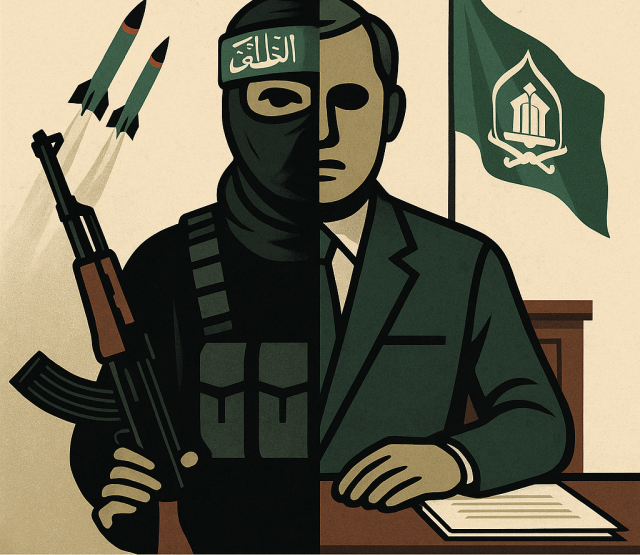
Hamas: terrorists or government
In the Jewish community, debates often flare over the refusal of Western media outlets to consistently call Hamas a terrorist organization. For many, the label is obvious. October 7 was the largest single-day massacre of Jews since the Holocaust. Hamas openly proclaims the destruction of Israel as its goal. Its methods—suicide bombings, indiscriminate rocket fire, mass killings of civilians—fit every standard definition of terrorism. So why the hesitation? And why do some journalists and policymakers reach instead for euphemisms like “militants” or “fighters”?
The usual response of Israel supporters is outrage and accusation of the media to kowtowing to terrorists, antisemitism, and poison of editorial rooms by the postmodernist anticolonial ideology. This can be true or the real reasons might lie elsewhere, but the question I offer for discussion is: “Is it wise for us to insist on calling Hamas a terrorist organization?” What if this label actually let Hamas off the hook and make it more difficult to explain and defend Israel’s actions in Gaza?
What if we shall treat Hamas not as just a terror group, but as a de-facto government of Gaza? Recognizing this reality does not legitimize Hamas, but burdens it with responsibility, which they are trying to escape. It reframes October 7 not merely as a terrorist outrage but as an act of war by a hostile power. And it means that Israel’s military response must be understood in the framework of wartime combat, not a counter-terror operation against a limited number of terrorists.
Using terrorist label actually backfires against Israel as the saying goes: one man’s terrorist is the other man’s freedom fighter. That framing has emotional force but it carries a perverse side effect: it de-politicizes Hamas. A terrorist group has no obligations to its population or to international law. Its actions are treated as criminality rather than policy. By insisting Hamas is merely a terrorist organization, the world implicitly shifts responsibility for Gaza’s humanitarian situation onto Israel and the international community.
If Hamas is “just terrorists,” then Gaza is leaderless, abandoned, a stateless humanitarian ward. That logic allows Hamas to escape accountability for corruption, for abuse of aid, for the misery of its people. In short, the terrorist label relieves Hamas of the very thing that governments most dread: responsibility for their subjects.
Since violently seizing power in 2007, Hamas has governed Gaza in every meaningful sense. It runs ministries, collects taxes, issues permits, controls the police, manages border crossings, and regulates the press. Its rule is authoritarian and corrupt, but it is rule nonetheless. No one seriously denies that Hamas exercises effective control over Gaza’s territory and population.
That control brings obligations. Under international law, de-facto authorities, whether recognized or not, are bound by humanitarian norms. They are responsible for protecting civilians, ensuring that their needs are met, and refraining from war crimes.
Yet when the international community insists on calling Hamas only a terrorist organization, it helps Hamas dodge those obligations. The needs are fulfilled through the aid routed through UN agencies as if Gaza were an orphaned territory rather than a governed polity. War crimes like the use of human shields are described as “terrorist tactics” rather than state crimes. The fiction of statelessness serves Hamas’ interests perfectly: all the power of sovereignty, none of the responsibility.
The implications of this framing for forming an attitude toward October 7 are profound.
If Hamas is merely a terrorist group, then October 7 was the largest terrorist attack in Israel’s history. The analogy is September 11: a fanatical network striking civilians.
But if Hamas is a government, October 7 was something else – an act of war. It was not only a terror raid but a declaration by Gaza’s rulers that they were engaging Israel in open hostilities.
This distinction matters. If October 7 was terrorism, Israel is engaged in counter-terrorism. The proper yardsticks are police operations, hostage rescues, targeted raids. Civilian casualties are treated as evidence of excessive force.
If October 7 was an act of war, Israel is at war. It is fighting not gangs of militants but the organized army of a neighboring polity. The fact that Hamas fighters do not wear a uniform does not change the fact that Israel deals with an organized and structured armed force. Hamas fighters deliberate refusal to wear uniforms and their practice of hiding among civilians violates the laws of war under the Geneva Conventions. The yardsticks shift: military proportionality, battlefield necessity, laws of armed conflict. Civilian casualties remain tragic, but they are judged in the grim arithmetic of wartime urban combat against an enemy that does not respect the rules of war.
This reframing changes the norms applied to Israel’s military operation in Gaza. Its military campaign must be judged by the same standards as other wars. The blockade and bombardment become the standard forms of siege warfare, ugly but not unprecedented in state-on-state conflicts. In fact, modern history is full of such examples: the NATO-backed siege of Belgrade during the Kosovo war in 1999, the U.S.-led sieges of Fallujah in 2004, or the months-long siege of Mosul during the campaign against ISIS in 2016–17. All were marked by high civilian casualties, yet none were treated as illegitimate per se, their legitimacy was judged by whether combatants adhered to the laws of war. This reframing also rebuts the frequent accusation of genocide. However destructive Israel’s campaign has been, its actions fall within the framework of warfare against a governing enemy, not an exterminatory campaign against a people.
It also changes the attitude toward Hamas. As Gaza’s rulers, they and not Israel must be held accountable for civilian suffering. That means responsibility for sheltering civilians, for ensuring access to food, medicine, and fuel, and for ending the use of schools and hospitals as military infrastructure. The fact that it both governs and terrorizes makes it doubly culpable.
The word terrorist provides moral comfort to supporters of Israel because It reduces Hamas to criminal monsters, allowing us to denounce it without nuance. But comfort is not clarity. Clarity demands that we see Hamas as what it is: a government that declared war on Israel. They did so with methods that meet every definition of terrorism, but the act was nonetheless an act of war. That recognition changes the conversation. Israel’s military campaign is not a rogue genocidal overreaction to terrorism but a war against an enemy polity. Hamas’ atrocities are not simply terror crimes, but war crimes committed by a governing power. Gaza’s humanitarian crisis is not solely Israel’s burden but the responsibility of the rulers who initiated war.
This reframing does not solve the conflict. But it strips away the illusions that let Hamas evade accountability while Israel alone is cast as the villain. To insist on calling Hamas merely a terrorist group is to grant it a dangerous gift: the power of sovereignty without the weight of responsibility.
Related Topics
Related Posts