
She will dance again
This was a strange week. In Israel, October 7 now comes around twice. By the Hebrew calendar, it falls on Simchat Torah, the day we dance with the Torah scrolls. By the regular calendar, this year it fell on Wednesday. Three years on, the terrible days between the two dates have become a kind of mourning limbo.
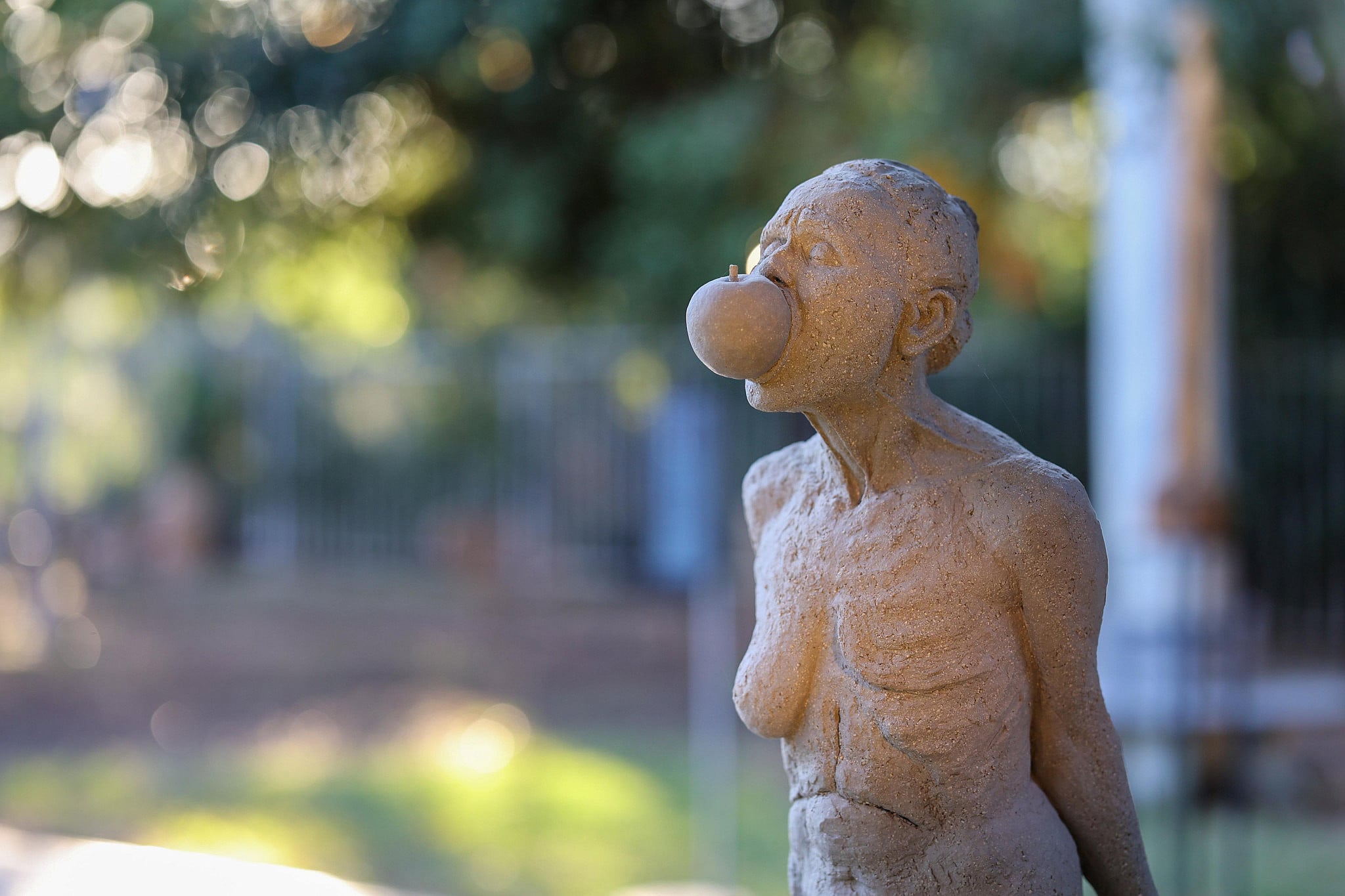
And this year I had a phone call to make. On Saturday night, with no one in the garden of Jerusalem’s Bible Lands Museum, Eva Avidar’s Bite fell. Our maintenance staff found her and sent me a photo. Her feet were still fixed to the steel pedestal, and her body hung forward over the cable railing, headfirst toward the grass. The head lay a little way off with the apple still in its mouth, beside an ancient column that fell long before any of us got here.
Bite (2017) is a self-portrait in clay. Eva stretches toward an apple, hands gripping her own flesh, pushed, as she puts it, “to the very edge of balance,” until her mouth closes on the fruit. The work began in personal pain. After October 7, when curator Yael Boverman Attas chose it for our Jerusalem Biennale exhibition “As Humankind,” it came to mean something bigger, a body pushed past its limits and still reaching.
On Sunday I made the call and told Eva that her work was broken. She understood before I’d finished my first sentence. I braced for the worst. But instead, she talked about the lifecycle of a sculpture, and about where she is in her own life in contrast to where she was back in 2017. “Art also moves in cycles. No piece ever remains the same,” she said and simply took the fall in stride, as if it were just the next turn of the cycle.
On Simchat Torah we read the Torah’s last verse, which praises Moses for what he did “before the eyes of all Israel.” Rashi says it refers to the moment he smashed the tablets, and that God approved. The Talmud (Berakhot 8b) adds that the broken tablets weren’t thrown away. They were kept in the Ark alongside the whole ones. Then we roll the scroll straight back to the beginning, to a garden, a tree, and a piece of fruit.
The Hebrew root ש-ב-ר, “break,” gives us mashber, crisis. In the Bible, though, a mashber is a birthing stool: “children have come to the mashber, and there is no strength to deliver” (Isaiah 37:3). I’ve heard mashber in more museum meetings than I can count. I never thought of it as a place to give birth.
By Friday Bite stood again. Eva pieced her back together indoors, with masking tape wrapped around her waist, a metal rod through the length of her body. She was draped in a white cloth while the joins set, and then she went back out to the garden in time for a gallery talk. She looks no worse for wear, at least on the outside. Like all of us, these days.
I run a museum full of ancient artifacts, so most of what I look after arrived broken. Our statues are torsos without heads and feet without bodies, and our inscriptions stop mid-sentence. We light the fragments carefully and ask visitors to imagine the rest. Bite gets something almost nothing in our collection ever got. She gets to stand up again.
The broken tablets go into the Ark with the whole ones. She’ll dance again, and so, I hope, one day, will we.