Shem and Yefet – When Dignity Depends on Others
Having written about Noach in detail last year, I looked for and found two other important role models in the parsha: his sons, Shem and Yefet. They are role models in a subject which is profoundly important to me.
Their brief, easily overlooked episode contains a hugely important lesson about dignity, responsibility and how we treat people at their most vulnerable.
This lesson has become deeply personal. As a terminal illness has progressively taken much of my physical independence, so tasks I once did without thinking now require help.
I am learning and also hoping that losing independence is not the same as losing dignity. Care systems may understandably focus on symptoms and practical tasks, but when people become dependent, their dignity should remain; only their ability to protect it changes.
That places an extraordinary responsibility on those around them – a responsibility Shem and Yefet model.
After the Flood, Noach plants a vineyard, becomes intoxicated and lies uncovered in his tent. Cham sees him and tells his brothers.
וַיַּרְא חָם אֲבִי כְנַעַן אֵת עֶרְוַת אָבִיו וַיַּגֵּד לִשְׁנֵי אֶחָיו בַּחוּץ
“Cham, the father of Canaan, saw his father’s nakedness and told his two brothers outside.” (Bereishit 9:22)
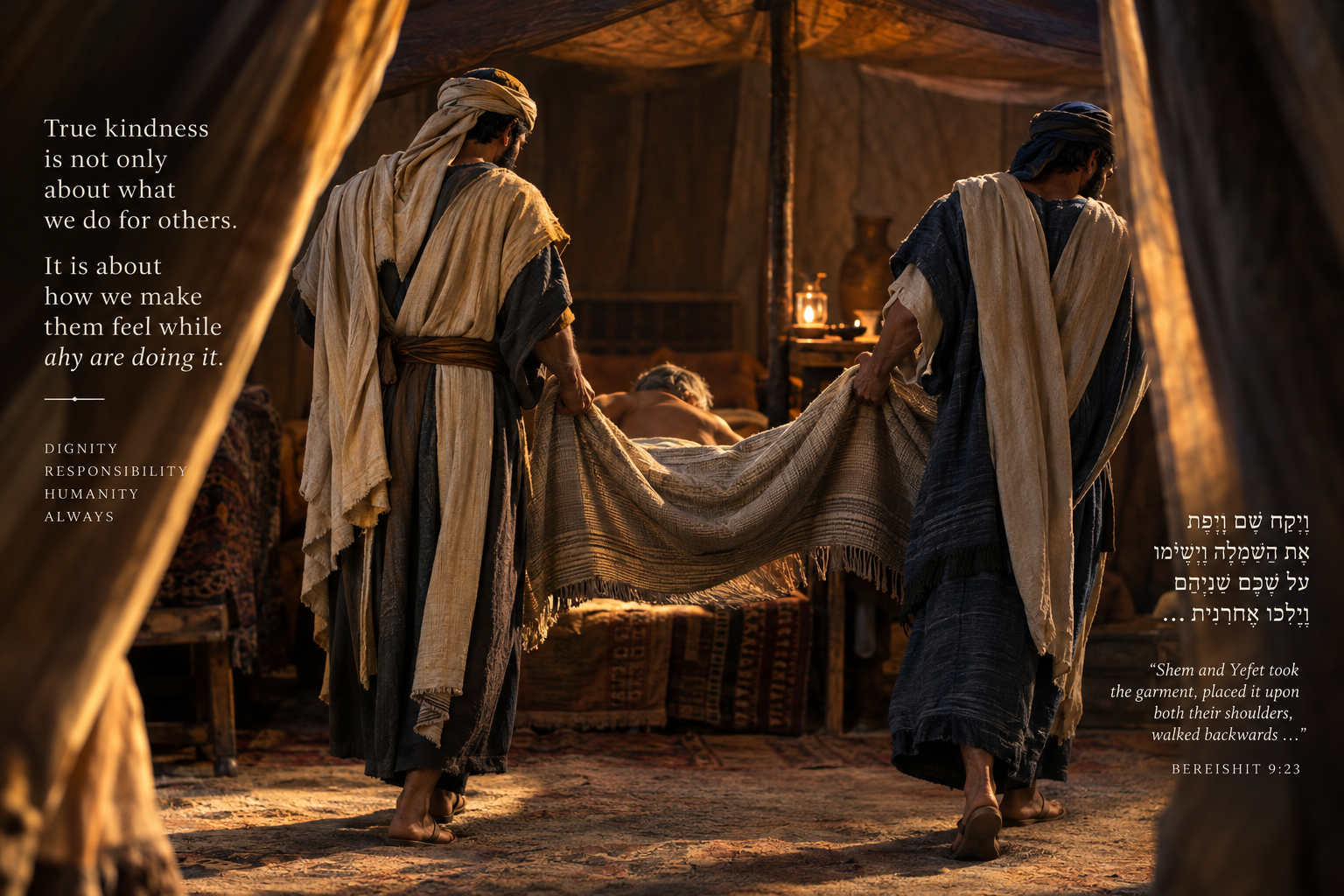
וַיִּקַּח שֵׁם וָיֶפֶת אֶת הַשִּׂמְלָה וַיָּשִׂימוּ עַל שְׁכֶם שְׁנֵיהֶם וַיֵּלְכוּ אֲחֹרַנִּית וַיְכַסּוּ אֵת עֶרְוַת אֲבִיהֶם וּפְנֵיהֶם אֲחֹרַנִּית וְעֶרְוַת אֲבִיהֶם לֹא רָאוּ
“Shem and Yefet took the garment, placed it upon both their shoulders, walked backwards and covered their father’s nakedness. Their faces were turned backwards, and they did not see their father’s nakedness.” (Bereishit 9:23)
Noach had defied his generation, obeyed G-d, built the ark and preserved human and animal life. Now the man who had saved humanity could not cover himself.
His sons could define him by this humiliating moment or remember the father whose dignity endured even when he could no longer defend it. Cham saw and told; Shem and Yefet saw a responsibility and acted.
The difference is between exposing another person’s vulnerability and treating it as something entrusted to our protection.
Rashi notes that although both brothers participated, the Torah uses the singular vayikach, “he took”:
לִמֵּד עַל שֵׁם שֶׁנִּתְאַמֵּץ בַּמִּצְוָה יוֹתֵר מִיֶּפֶת
“This teaches that Shem exerted himself in the mitzvah more than Yefet.” (Rashi on Bereishit 9:23)
The Netziv, Rabbi Naftali Zvi Yehuda Berlin, explains in Haamek Davar what the singular verb reveals about Shem’s involvement:
ולא משום שהרגשו של שם היה חזק יותר אלא משום דשם היה הרגשו משום מצוה… משא״כ יפת שהרגשו היה מצד שכל אנושי
“It was not because Shem’s feelings were stronger, but because Shem felt bound by a mitzvah … whereas Yefet was moved by human reason.”
Whatever the precise meaning of mitzvah before Sinai, the Netziv’s distinction is practical: Shem experienced the obligation as personally binding. Yefet also wanted their father covered, but Shem took responsibility not only for ensuring that it was done, but for ensuring that it was done properly and with dignity. Hence the singular vayikach: “he took.”
This does not diminish Yefet’s compassion. The Netziv distinguishes between being moved by human reason to ensure that something is done and experiencing the mitzvah as a personally binding responsibility to ensure that it is done in the fullest and most dignified way.
Recognising that someone deserves dignity is not the same as accepting responsibility for protecting it. It is easy to leave that duty to a nurse, caregiver, doctor, family or institution. Shem simply acted.
The Netziv further explains in Haamek Davar on Bereishit 9:23:
משום דלא היה אפשר לכסותו בכבוד אם לא שיעשו שניהם
“Because it was not possible to cover him with dignity unless both of them participated.”
The crucial word is b’kavod – with dignity. Shem might have had no choice but to have thrown a garment over Noach alone, but he needed help to cover him properly and respectfully.
The goal was not merely to complete the task, but to preserve Noach’s dignity while doing so.
A person can be washed, dressed, fed or moved while something deeply human is overlooked. Shem’s willingness to accept help also shows that doing the mitzvah properly mattered more than doing it alone.
מ״מ הלכו אחורנית להראות שעיקר הכניסה והביאה באוהל הוא בע״כ
“Nevertheless, they walked backwards to demonstrate that their very entry into the tent was undertaken out of necessity.” (Haamek Davar on Bereishit 9:23)
They walked backwards to show that they entered their father’s private space only because he needed help. Even their assistance was restrained.
Dependence may give us responsibilities towards another person, but not ownership over their privacy, decisions or sense of self.
Helping someone does not and should not give us ownership of their vulnerability.
גָּדוֹל כְּבוֹד הַבְּרִיּוֹת
“Great is human dignity.” (Berakhot 19b)
Berakhot 19b gives human dignity practical halachic weight, within defined limits; it is more than a social ideal. Bava Metzia 58b goes further:
כָּל הַמַּלְבִּין פְּנֵי חֲבֵרוֹ בָּרַבִּים כְּאִילּוּ שׁוֹפֵךְ דָּמִים
“Whoever publicly humiliates another person is considered as though he sheds blood.” (Bava Metzia 58b)
כִּי בְּצֶלֶם אֱלֹקִים עָשָׂה אֶת הָאָדָם
“For in the image of G-d He made man.” (Bereishit 9:6)
Just a few verses earlier, the Torah declares that humankind was made b’tzelem Elokim, in the image of G-d. Read alongside that verse, Shem and Yefet’s actions illustrate the responsibility to protect another person’s dignity.
Human worth cannot depend on strength, health, independence, usefulness or the ability to speak, walk, work or care for oneself. Nor does it disappear through error or embarrassment.
Noach’s condition had changed; his intrinsic worth had not.
Progressive illness has taught me that dignity becomes especially precious as independence fades, because the ordinary means of protecting it are gradually lost.
I may need and will need ever more help dressing, moving, eating or communicating, and sometimes cannot express what I need despite remaining fully aware. I then depend not only on physical assistance, but on judgement, patience and sensitivity.
I need people to speak to me, not about me; include me in decisions; let me try things myself; respect my privacy; and preserve as much control as possible. These are not luxuries, but expressions of dignity.
I am deeply grateful to those who care for me and know how demanding that responsibility is. This is not a demand for perfection, only a reminder that the person receiving care remains fully human, however limited their physical capabilities.
Shem and Yefet did not turn away from their father; they turned their faces away from his humiliation.
They neither abandoned him to preserve his privacy nor sacrificed his privacy to help him. They protected both.
Their greatness lay not in dramatic courage, but in the careful placement of a garment, the direction of their steps and the restraint of their gaze. Their father had saved humanity; now they protected his humanity.
We cannot always restore health, independence or control, undo mistakes or remove suffering. But we can choose whether our actions preserve or diminish dignity.
A person’s dignity does not disappear when they become dependent on others. The responsibility for protecting it simply becomes shared.
Sometimes the greatest kindness is stepping forward without taking away the dignity of the person we are trying to help.