Professor of Jewish and Israeli History
Shimon Peres, Arab Citizens, and Religious Parties
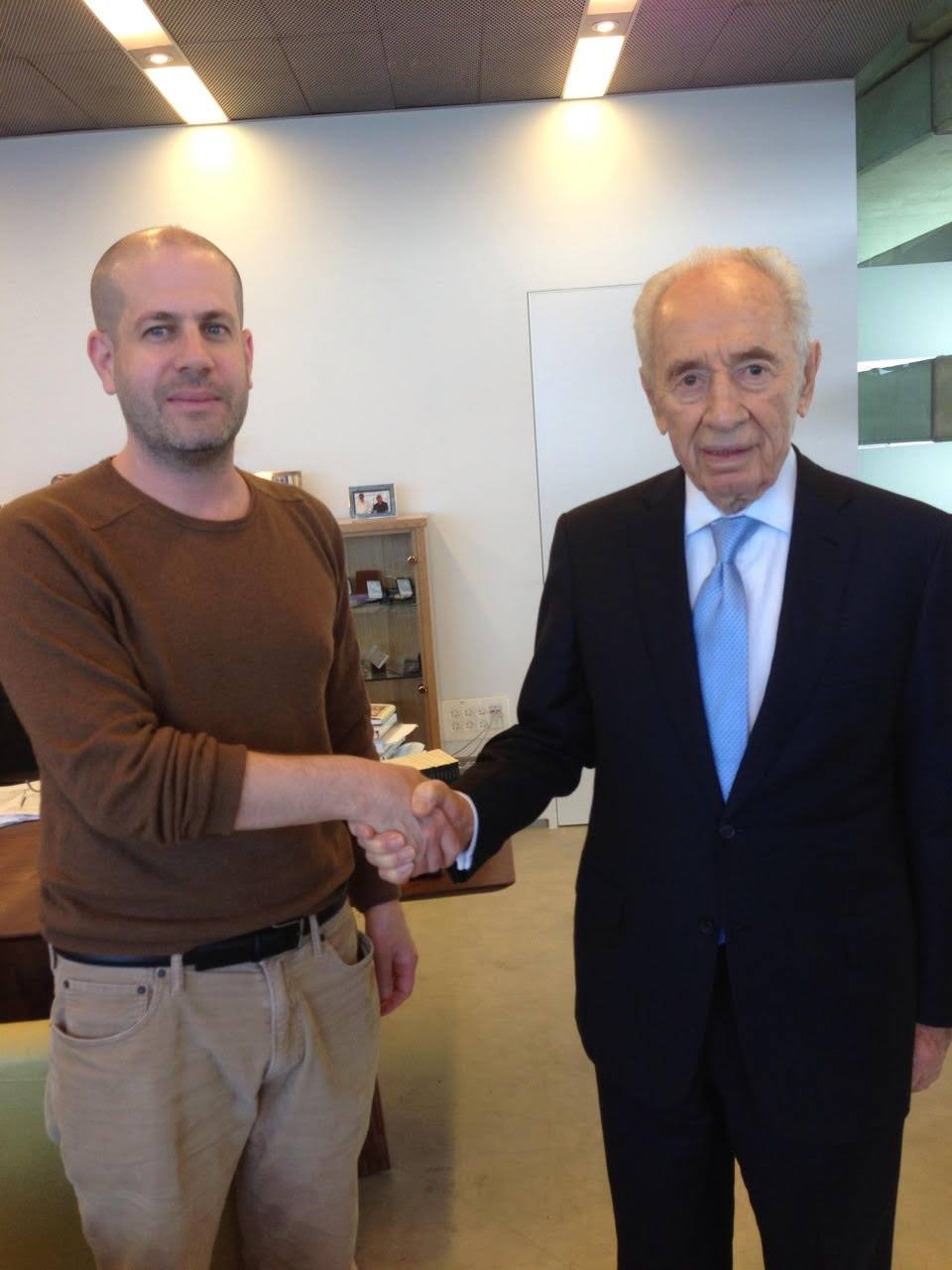
Professor Eran Eldar Meeting with Shimon Peres. Credit: Private Collection
Few leaders of the Labor movement combined a universal vision with political pragmatism as effectively as Shimon Peres. Throughout his decades of public service, Peres developed a nuanced approach toward both Israel’s Arab society and the country’s religious political parties. In both cases, he sought to integrate groups that were often perceived as “peripheral” or “other” into the political system, but for different reasons: in the case of the Arab population, out of a vision of civic equality and partnership; in the case of the religious parties, out of recognition of their political influence and their importance to governmental stability.
While working on one of my books on the history of the Labor Party, I met Shimon Peres in 2014 at the Peres Center for Peace in Jaffa. During our conversation, his tendency to view Israeli politics through a long-term lens, beyond the disputes of the moment, was unmistakable. He repeatedly emphasized the importance of shared life between Jews and Arabs in Israel and the need to build bridges among different segments of Israeli society, an approach that characterized his public activity for decades.
Israel’s Arab Population: From Civic Equality to Political Partnership
Peres’s outlook toward Israel’s Arab citizens developed within the historical tradition of Mapai and the Labor movement, but over time it acquired a more distinctly liberal and civic character. Already in his early political years, he recognized the importance of integrating Arab citizens into Israel’s civic and economic systems. Beginning in the 1980s and especially the 1990s, however, the issue became increasingly central to his worldview.
Peres viewed Arab citizens as an inseparable part of the State of Israel. In his eyes, strengthening their civic and economic standing was not merely a moral obligation but also a national interest. He believed that economic disparities and prolonged discrimination could undermine the state’s stability, whereas fuller integration of Arab society would contribute to economic growth, democratic vitality, and improved relations between Jews and Arabs.
This approach became particularly pronounced after the signing of the Oslo Accords. Peres believed that regional peace and internal coexistence were complementary processes. In his view, it was impossible to pursue reconciliation with the Arab world while neglecting Israel’s Arab citizens. He therefore supported expanding government investment in Arab localities, strengthening education, and increasing economic opportunities.
At the same time, Peres never embraced a post-Zionist position. He regarded Israel as the nation-state of the Jewish people, while believing that its Jewish character could and should be combined with a profound commitment to civic equality. This outlook distinguished him both from nationalist elements on the right and from circles that sought to redefine the state’s national identity.
Relations with the Arab Parties
One of the most notable features of Peres’s approach was his willingness to consider political cooperation with Arab parties. During the period of the second Rabin government (1992-1995), he supported parliamentary cooperation with Hadash and the Arab Democratic Party, which provided the government with a parliamentary safety net in the Knesset. In his view, reliance on the votes of Arab members of parliament was a natural expression of Israeli democracy.
This approach provoked sharp criticism from his political opponents, who argued that governments should not depend on non-Zionist parties. Peres rejected these arguments, emphasizing that Arab citizens had an equal right to participate in the political process and influence decision-making.
The Religious Parties: Ideological Rivals, Political Partners
Unlike his approach toward the Arab population, which was grounded in considerations of civic equality and social partnership, Peres’s attitude toward the religious parties was shaped largely by the pragmatics of Israeli politics.
Peres was not a religious man. His worldview was secular and modernist. He believed in technological progress, globalization, and cultural openness. Nevertheless, he recognized that Jewish tradition and religion played a central role in the identity of Israeli society.
Unlike some leaders of the secular left, Peres generally avoided direct confrontation with the religious public. He regarded the religious parties as legitimate partners within the political system and sought throughout his career to build broad coalitions with them. In many cases, he preferred dialogue and compromise to ideological confrontation.
This approach was reflected in his relationships with the National Religious Party (NRP), Agudat Yisrael, and later Shas. Although some of these parties opposed his diplomatic positions, particularly regarding the peace process, Peres believed that common ground could still be found on many other issues.
Shas and the Politics of the Periphery
Peres took a particular interest in the phenomenon of Shas. He understood that it was not merely a religious party but also a social movement representing large segments of Mizrahi Jews who had experienced longstanding social and economic marginalization. Contrary to the common portrayal of Shas as a purely sectoral party, Peres saw it as an expression of social protest and a demand for inclusion within Israel’s centers of power.
For that reason, he repeatedly sought to maintain a dialogue with the party’s leaders and to include them in Labor-led coalitions. Although the relationship was at times complex and marked by tension, he believed that excluding the ultra-Orthodox and Mizrahi public from the political mainstream would be a strategic mistake.
Conclusion
Shimon Peres’s approach toward Israel’s Arab population and the religious parties rested on a common underlying principle: a stable and resilient Israeli society requires the broadest possible inclusion of diverse groups within the political sphere. Toward Arab citizens, this principle took the form of a vision of civic equality, economic development, and democratic partnership. Toward the religious parties, it was expressed through a willingness to make political compromises and an acknowledgment of their social and electoral weight.
In this respect, Peres represented a distinctive tradition within the Labor movement: a combination of universal vision, commitment to Zionism, and political pragmatism. For him, the strength of Israel’s democratic system was measured not by its ability to exclude different groups, but by its ability to integrate them into a shared civic and political framework. This approach accompanied him from the beginning of his career to his final years and became a central component of his public legacy.
Related Topics
Related Posts