Geopolitical Analyst: Bridging Somaliland & Israel to the world
Short of US Recognition: What Is Next for Somaliland?
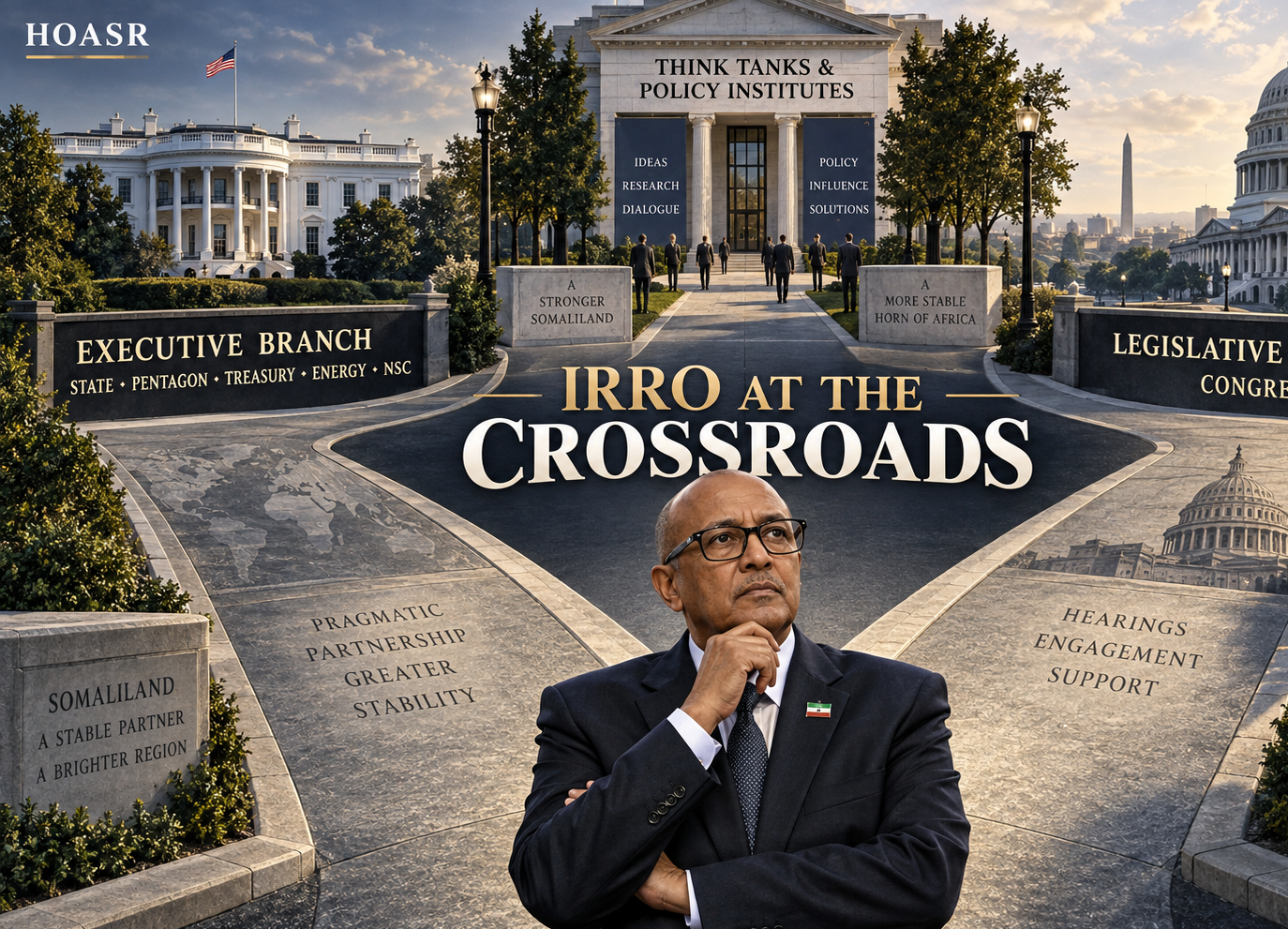
President Irro’s Washington campaign reached Congress, executive agencies and influential policy institutions despite no immediate decision on Somaliland recognition. Original HOASR Infographic Artwork
President Abdirahman Mohamed Abdullahi Irro did not secure formal United States recognition during his Washington visit. Judged only by that standard, the trip ended without its largest objective. A closer reading produces a different conclusion. Irro and his delegation established contact across the parts of the American government that can deepen relations with Somaliland even while official recognition remains unresolved.
At a media briefing reported by Jewish Insider, Irro said the delegation met representatives of the State Department, Pentagon, Treasury Department, Department of Energy and National Security Council. Somaliland’s Washington representative, Bashir Goth, also said Pentagon officials indicated an intention to expand the American training presence in Hargeisa.
The significance lies in the breadth of the engagement. Somaliland’s case moved beyond congressional advocates and policy institutes into agencies responsible for diplomacy, defense, financial regulation, energy policy and national security. Recognition remains the political prize, but the machinery of a practical relationship is beginning to take shape.
Recognition Was Not the Only Measure
Somaliland understandably presents recognition as the final test of foreign policy success. The country restored its sovereignty in 1991, has maintained its own institutions and has repeatedly argued that its brief independence in June 1960 and subsequent union with Somalia support its legal case. Washington, however, has continued to recognize Somalia’s sovereignty and territorial integrity, including Somaliland. That policy did not change during Irro’s visit.
Yet the United States has already created room for differentiated engagement. A State Department report to Congress examined ways to improve American engagement with Somaliland while preserving the existing recognition policy. It identified areas such as maritime security, counterterrorism, trade and investment. The report established a useful distinction: Washington can treat Somaliland as a separate and capable partner in selected fields without immediately changing its legal position on Somalia.
Irro’s Washington campaign tested how far that distinction can be carried. The answer is still developing, but the meetings suggest that recognition is no longer the only available route to stronger relations. Security assistance, direct economic engagement, financial access and an American official presence could each advance separately. Together, they would give Somaliland a more substantial relationship with Washington than the formal diplomatic language currently suggests.
Executive Branch Contact Changes the Baseline
Before the visit, much of Somaliland’s visible support in Washington came from members of Congress, former officials, think tanks and advocacy organizations. Those networks remain valuable, but they cannot implement foreign policy by themselves. Executive agencies control diplomatic reporting, military cooperation, sanctions and financial rules, development programmes, energy engagement and the advice that reaches the president.
Irro’s confirmed contacts with officials from five parts of the executive branch therefore alter the baseline. The visit did not produce a treaty, public memorandum or formal policy announcement. It did, however, give Somaliland’s leadership direct access to the institutions that would evaluate and execute any future change in American policy. It also allowed those agencies to hear Somaliland’s case from its president and ministers rather than through intermediaries.
This does not guarantee that Washington will accept Hargeisa’s proposals. The level of the officials remains undisclosed, and follow-up will determine whether the meetings become working channels or remain a single round of consultations. Still, direct institutional contact is harder to dismiss than general expressions of congressional sympathy. It gives both sides people and offices through which the next discussion can occur.
Security Cooperation Can Move First
Defense cooperation is the area most likely to advance before recognition. The United States is concerned with Houthi pressure near Bab el Mandeb, threats to commercial shipping, Al Shabaab, arms trafficking and China’s military presence in Djibouti. Somaliland offers a stable coastline, the Port of Berbera, a long airfield and a government seeking a closer Western partnership.
Goth’s statement about a larger American training presence in Hargeisa is consequently the most operational claim to emerge from the briefing. If implemented, an expanded programme could improve military professionalism, maritime monitoring, counterterrorism capacity and communication between American and Somaliland security institutions. It would also normalize direct cooperation without requiring the United States to recognize Somaliland first.
The claim still requires official American confirmation. Training can range from occasional courses to a continuing advisory presence, and those arrangements carry very different political meanings. Somaliland should avoid presenting an intention as a completed deployment. Clear information about the mandate, scale, duration and participating institutions would protect the government’s credibility and prevent exaggerated reports about foreign bases.
Irro had already framed this security offer publicly. At the Hudson Institute, he presented Somaliland as a potential American partner in the Horn of Africa and tied Berbera to Red Sea security and wider competition involving China, Iran and other powers. Whatever the weaknesses of the fireside discussion, the subsequent agency contacts show that Washington’s interest cannot be measured by one interview alone.
Financial Access Is Practical Diplomacy
The Treasury dimension may have the most immediate effect on ordinary economic life. Somaliland’s lack of recognition complicates correspondent banking, investment screening, insurance and compliance. Foreign institutions frequently classify transactions through Somalia or treat Somaliland as an uncertain jurisdiction. The result is higher cost, slower transfers and hesitation among investors who might otherwise consider projects in ports, livestock, fisheries, telecommunications, energy and minerals.
Representative John Rose placed this problem before Treasury Secretary Scott Bessent during the House Financial Services Committee’s September 15 hearing. Rose referred to the Somaliland Economic Access and Opportunity Act and asked Treasury to examine the barriers separating Somaliland from American financial markets. Bessent agreed to receive a briefing and engage further. The exchange followed Rose’s meeting with Irro and converted a diplomatic appeal into an identifiable administrative question.
Treasury cannot recognize a state, but it can clarify risk, improve institutional understanding and advise on lawful channels for financial engagement. Progress in this area would strengthen Somaliland’s private sector and make future American investment more realistic. It would also demonstrate that relations can deliver measurable economic results before the recognition debate is settled.
Energy and Minerals Expand the Relationship
Engagement with the Department of Energy widens the agenda beyond diplomacy and security. Somaliland has promoted renewable energy, hydrocarbons and critical-mineral prospects, although many projects remain underdeveloped and require credible geological data, transparent licensing and strong legal safeguards. American interest should not be assumed merely because a meeting took place, but the contact creates a route for technical discussion and private-sector introductions.
For Washington, critical minerals and resilient supply chains are part of competition with China. For Somaliland, the opportunity is to present itself as a transparent, commercially serious jurisdiction rather than simply advertising untapped wealth. That requires audited information, stable contracts, environmental standards and protection against opaque concessions. If those foundations are built, energy and minerals can add an economic pillar to a relationship currently dominated by security.
A Diplomatic Presence Without Recognition
Somaliland has also sought an American consulate or another official presence in Hargeisa. Such a step would be politically important, but it would not automatically amount to recognition. Governments often maintain liaison offices, diplomatic facilities or specialised missions in territories whose final status they have not recognized. Washington could therefore improve reporting, coordinate assistance, support American visitors and communicate directly with Somaliland institutions while keeping its formal position unchanged.
A permanent presence would reduce Washington’s dependence on information filtered through Mogadishu or distant embassies. It would also acknowledge a practical reality: American officials already engage Somaliland’s government on security, democratic governance and commerce. The strongest case for an office is administrative usefulness and improved policy accuracy. Presenting it as recognition by another name would make the proposal harder for Washington to accept.
Congress Keeps the Political Door Open
Congress remains essential because executive agencies usually move cautiously when a territorial question carries regional consequences. Irro met lawmakers from both chambers, including Representatives Rose and John Moolenaar and Senator Ted Cruz. Cruz later described Somaliland as a reliable American partner in counterterrorism and the protection of shipping around the Horn of Africa. The Somaliland Foreign Ministry recorded these meetings as part of the delegation’s continuing Washington programme. Official Somaliland reporting also placed Berbera, regional security and economic cooperation at the centre of the discussions.
Legislators can press agencies for reports, introduce bills, alter appropriations language and require Somaliland to be assessed separately from Somalia in particular programmes. Those steps can gradually change bureaucratic practice. They also ensure that recognition remains a live political question even when the White House is unwilling to decide it.
What Washington Still Has Not Done
The progress should not be overstated. The White House has not changed American recognition policy. No meeting with President Donald Trump or Secretary of State Marco Rubio has been confirmed. No Cabinet department has announced a new bilateral agreement, and the reported expansion of military training has not yet appeared in a Pentagon statement. The visit opened channels, but most proposed outcomes remain at the consultation stage.
There is also a danger in equating access with policy. Photographs, briefings and meetings establish political contact; they do not prove that an agency has adopted Somaliland’s position. Hargeisa will need disciplined follow-up, written proposals and officials capable of answering detailed questions about security, investment law, civilian oversight and regional consequences. Washington will judge Somaliland not only by its strategic location but by the reliability of its commitments.
The Path Between Isolation and Recognition
Irro’s visit points toward a possible interim American policy: deeper functional engagement without immediate recognition. Under such an approach, the United States could train Somaliland forces, expand maritime-security cooperation, improve financial access, encourage responsible investment, establish a presence in Hargeisa and consult Somaliland separately on Red Sea policy. None of those measures settles the legal question, but together they would narrow the distance between diplomatic language and political reality.
This arrangement would bring opportunities and risks. It could give Somaliland practical benefits and demonstrate its value as a partner. It could also allow Washington to postpone recognition indefinitely while receiving many of the strategic advantages Somaliland offers. Hargeisa should therefore treat functional engagement as a stage to consolidate, not as a substitute for its political objective. Each agreement should strengthen Somaliland’s separate international identity, institutional capacity and ability to negotiate the next step.
Irro left Washington without the formal declaration Somaliland wanted. He nevertheless reached agencies that can change how the United States deals with Somaliland in practice. The test now is whether the meetings produce training programmes, financial guidance, investment mechanisms, regular diplomatic contact and an American presence in Hargeisa. If those results follow, the Washington visit will have established something more durable than a headline: the working foundations of a bilateral relationship that exists before recognition and may eventually help make recognition possible.
Related Topics
Related Posts