
Showing up, without illusions: Bondi, Zionism, and living inside Jewish history
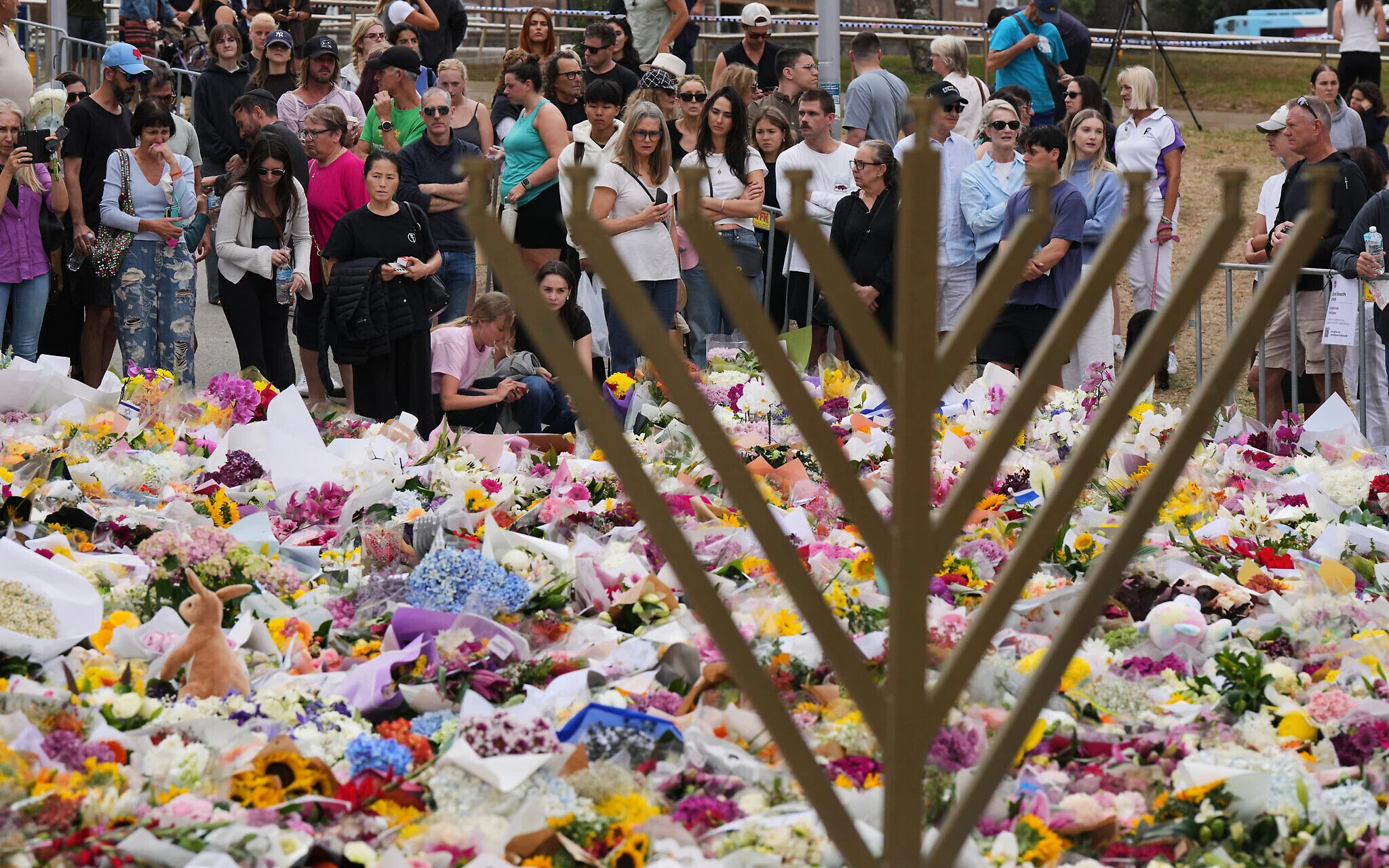
On a Tuesday morning in mid-December, I received a short message from a friend. Rav Avi Weiss was flying to Sydney the next day, in the immediate aftermath of the terror attack at Bondi Beach, and asked if I would join him. There was no extended deliberation. Not because the decision was easy, but because it did not present itself as a decision at all. The question carried its own answer. Not “Why go?” but “How could I not?”
That instinct is often misunderstood as emotional or impulsive. It is neither. It reflects a way of understanding Jewish life shaped by a long memory of responsibility, one that for some has receded in modern times but has regained urgency in recent years. Our connection runs deep, and our mutuality is not optional.
Zionism was never only a political project. At its core, it was a rejection of Jewish passivity. It insisted that Jews would no longer live as spectators to their own fate, commenting from the sidelines or waiting for others to decide what would happen to them. Since 1948, Jews no longer experience history as something that happens elsewhere or something that can be managed at a safe distance. Jewish life now unfolds inside history again, with all the exposure and responsibility that entails.
For many, there was an expectation that reentering history would also alter it, that Jewish sovereignty and agency would create a new timeline, or at least a different set of rules. This expectation appears in different forms: in Zionist triumphalism, in Diaspora optimism, and even in the belief that Jewish vulnerability belongs only to the past. October 7 was a violent reminder that this assumption was misplaced, first and most directly for Israelis, but with consequences that reverberate far beyond Israel’s borders.
Spending a week in Bondi after the attack clarified this for me from a different angle. The community did not suddenly discover antisemitism in Australia. That was never the illusion. What crystallized instead was the understanding that Jewish agency does not determine how the world sees Jews. It determines how Jews see themselves, and how they choose to stand in a world that has not fundamentally changed.
At a Shabbat dinner in Sydney, the conversation turned sober. We spoke about the rise in attacks against the Jewish community in Australia, the presence of armed guards outside synagogues, and the vandalization of Jewish institutions. Someone asked whether this moment felt uncomfortably reminiscent of the late 1920s and early 1930s in Germany, when Jews were attacked, and governments hesitated to respond. The question was not offered as a historical equation, but as a measure of anxiety and severity. It reflected a recognition that political hesitation, when left unchallenged, has consequences, and that history rarely announces its turning points in advance.
Beyond the horror of the attack and the communal grief that followed, Bondi exposed another familiar reflex. Antisemitism rarely transpires without an attendant “explanation”. More often, Jewish suffering is immediately contextualized, reframed, or rationalized as a “legitimate” response to Jewish action. During a taxi ride in Sydney, a driver who described himself as half-Jewish moved quickly from condolences to accusations about Israel. He did not “justify” the attack. He “explained” it.
I reminded him that this reflex long predates the State of Israel. Jews were massacred in Hebron in 1929 without sovereignty, without an army, and without political power. Then, as now, violence was framed as defense of Al-Aqsa. The details change. The justification remains. When Jews are murdered for being Jews, explanation often becomes a way of avoiding responsibility and shifting blame from the attacker and the enabler to the victim.
What I found in Sydney, however, was not panic or withdrawal. Fear and grief were present, but neither defined the community’s posture. What stood out instead was insistence. Insistence on gathering publicly. On lighting candles. On refusing to allow Jewish life to retreat into a private space in response to violence. This was not performative courage. It was a robust rejection of victimhood and a recognition that what had shifted for Jews was not the external conditions, but the internal posture with which Jewish life is lived.
This helps explain a distinction between Israelis and Jews living elsewhere. Israelis tend to associate fear with physical danger: rockets, terror attacks, war. Diaspora Jews increasingly experience something related but distinct. Not only fear of violence, but fear of visibility itself. Fear of being identified – or even targeted – simply for showing up as Jews in ordinary public spaces. These are not competing fears. They are expressions of the same condition: a people living openly within history, rather than alongside it.
None of this offers resolution. Living inside history does not produce certainty or closure. It carries cost and risk. But it also restores responsibility, and with it, agency. Jewish history has always carried trauma and hope together, not as alternatives, but as inheritance. Not naïve hope, but the disciplined hope that emerges through public Jewish life and obligation.
We did not go to Sydney to fix anything. We went because Jewish life no longer unfolds outside history, and because a people that claims agency cannot organize itself around explanation or retreat. In showing up, we remind ourselves that we are not merely reacting to events, but choosing our posture within them.