
Reading Israel and Judaism
Featured Post
Prayer books: Unexpected field guides
Even when my heart is closed, it cracks open a little for the prayers of the siddur or mahzor, and lets their words fall in
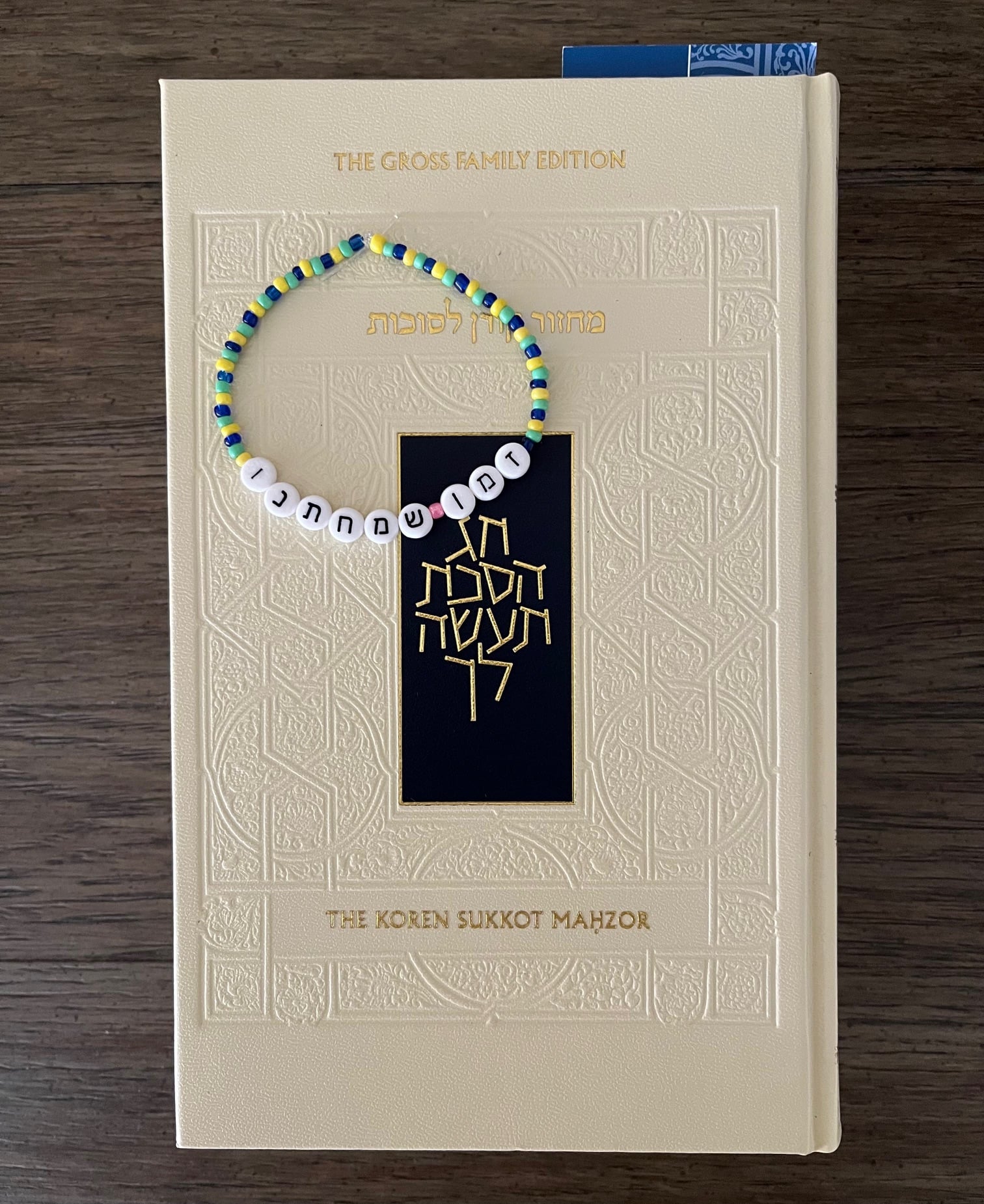
Koren's Sukkot mahzor. Photo by author.
For someone who questions faith and liturgy and isn’t sure how to answer the question are you religious/observant, I have a strange fascination with siddurim and mahzorim. Or maybe it’s not so strange. Maybe it’s only natural to want to read the prayers themselves in order to better understand them, to unpack the language and words in order to better grapple with them.
In his book A Guide to Jewish Prayer, Rabbi Adin Steinsaltz wrote, “No other book contains, as does the Siddur, the entirety of Judaism. The Siddur is like a garland, intertwining all the strands of Judaism and encompassing all fields of Jewish creativity in all their variegated forms….In the same way as the Siddur represents the entire expanse of Judaism, it also reflects it through the dimension of time, in the generations of Jewish creativity.” In essence, it becomes a vehicle for our constant conversations with G-d; we can return to it again and again and find what we need at any given moment.
Taken that way, it’s not strange at all that I have become a little obsessed with different siddurim and mahzorim.
While my shul uses the Siddur Sim Shalom and the Mahzor Lev Shalem, at home I have a variety of Koren siddurim and mahzorim. Sometimes I bring them to shul, but I always end up frantically flipping the pages to find where I should be since the pagination doesn’t align. But for someone whose faith coexists with doubt/skepticism, I enjoy reading the extensive and thoughtful commentary found in these books, as well as the translations when needed.
During the High Holidays, I read my mahzor, even when I didn’t attend shul, and gained a deeper appreciation for the holidays at which I’ve always bristled. The introduction essay(s) and the commentary made me think, and I liked sitting with the challenge of confronting my own beliefs up to that point. For Sukkot, I admit I gained a whole new sense of awe at the holiday after reading Rabbi Lord Jonathan Sacks’s introduction in the mahzor. In this sense, the mahzor was a sort of travel guidebook, showing me around and leaving me to explore further. I’ll be using it again later this week for Shemini Atzeret and Simchat Torah.
There was also no shortage this year of other mahzorim and reading supplements, especially about October 7 and grappling with the Tishrei holidays. I saw these as guidebooks of a sort, helping us wade through our grief, our anger, and even our incredulity that the High Holidays are here and yet 101 of our brothers and sisters are still not home. These books and readings did not provide answers or clarity, but rather a sort of quiet companionship. I see you. I hear you. Hineini. I’m here, too, in this space.
For everyday use, I never knew how strongly one could feel about a preferred siddur until this past year. Sure, there’s the perennial debate over Koren vs. Artscroll, but then there are the different kinds of siddurim. Educational siddurim, like Koren’s NCSY siddur and the Aviv weekday siddur, have questions designed to make readers think about broader concepts and how to apply prayer to everyday life, in addition to translation and commentary. While geared mainly toward teens and young adults, I admit I enjoy these and appreciate the thought-provoking questions. The Ani Tefilla series also has commentary and questions, but is more geared toward young adults and adults. But don’t worry, the standard Koren Sacks siddur and the Shalem siddur are still excellent, too (it’s Rabbi Sacks; you cannot go wrong with him). The rabbi emeritus at my shul gave me a copy of the Nehalel Shabbat siddur, which is a beautiful, full-color siddur filled with pictures. The siddur is described as “visual midrash” about the text, and that is a perfect description of it. Though I attend shul fairly regularly, there are certain services where I still feel out of place, and, again, my siddur is like a guidebook to help me navigate and feel less unmoored.
I recently got the Rabbinical Council of America’s Siddur Avodat Halev, which very purposefully includes women: there are prayers for lifecycle events for women, the prayer for the US includes the possibility for a woman president, there’s commentary about various Jewish women, and much more. Historical and contemporary Jewish sources are cited, as are subjects like biology, physics, and literature. There are also more than 15 essays in the back about prayer. I’m still working my way through this one, but I’m especially enjoying it for the scholarly aspects.
Do these books eradicate my doubt or skepticism? No. Do they provide answers? Not exactly. But who are we, if not people who “wrestle with G-d”? These books remind me that it’s okay to question. If I cannot quite bring myself to say all the prayers, let me sit with the siddur and read some commentary. Let me read a perspective that maybe I hadn’t thought about. Similar to how it says to place these words “upon your heart” in the Shema, and how it has been interpreted to mean that even if your heart is closed, if the words are simply placed there, when the heart cracks open a little, the words can fall in, that’s how I see my reading and study of the siddur. Even on a day when I’m not quite sure, I’m still showing up in some way, taking in the words, staying ready.
Right now, what else is there to do?
Related Topics