The Newest Yizkor Has a Timestamp
Three years after October 7, Israelis are writing the next chapter of Jewish memory while it happens, with stickers, red anemones, 2,100 filmed testimonies and a dawn minyan that stops at 6:29
This year, for the first time since that morning, Simchat Torah fell on Shabbat again.
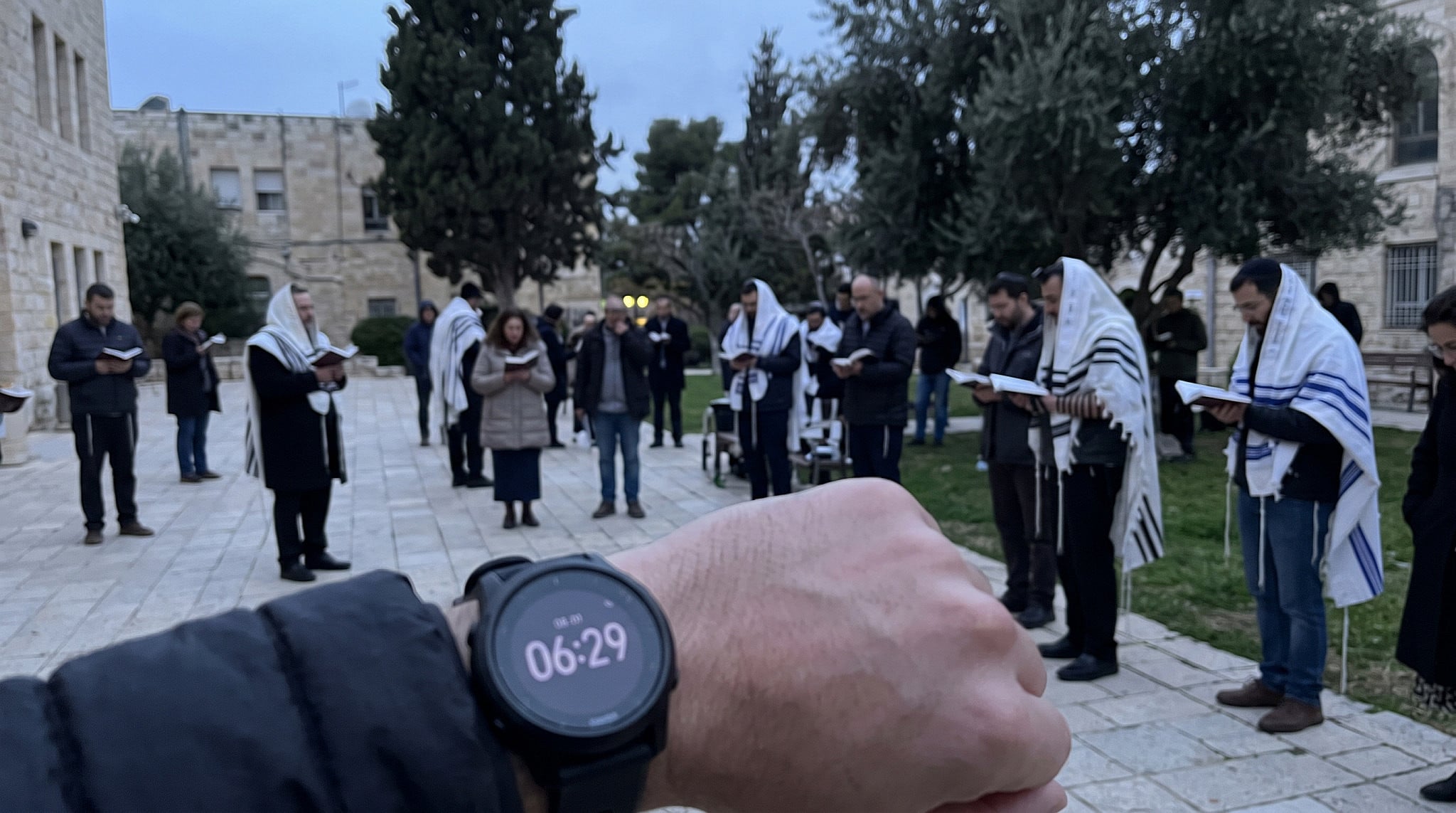
Na’ama and I set the alarm for 5:45. It was still dark when we walked to a 6:10 minyan organized by bereaved families, including Tzvi and Sarit Zussman, whose son Ben we knew as a kid.
Ben was 22 when he fell in Gaza in December 2023. Before he went in, he wrote the letter every combat soldier writes and hopes will never be opened. In it he told his family that if something happened to him, they should turn his shiva into “a week of friends, family and fun.” He was not giving them permission to sink into sadness. Indeed, when we paid a shiva call on the third day of Hanukkah, Na’ama was asked by Sarit to lead the singing of Maoz Tzur, to remember a miracle that happened more than two thousand years ago. She asked that we don’t skip a verse.
The idea of the minyan was to reach Yizkor at 6:29. That is the minute the rocket barrage began, the start of a massive attack and muderous rampage that would kill some 1,200 Israelis by the day’s end.
I will admit that when I first heard about it, I thought it was unnecessary. A little gimmicky even. We say Yizkor every year. Did we really need a stopwatch?
Then I thought about what this holiday has become. Since 2023, Simchat Torah has been a day no one quite knows how to hold. Do we dance? Do we mourn? Every synagogue does it a bit differently. At Hakhel, where we belong, we have a new tradition of two slow, somber hakafot where we remember the past, pray for a better future, and shuckle, not really dance, followed by five “regular” happier hakafot.
But the families had found another way to strike that balance. Grieve at dawn, at the exact minute. Then, later, let the Torah scrolls come out. One of the Torahs was dedicated in memory of local fallen civilians and soldiers.
So we went to this special gathering. And it was beautiful, moving, and completely appropriate for the day.
Standing there at 6:29 in year three, I understood something. What feels awkward and invented today can become, in a generation, a symbol, a ceremony, a mechanism of remembering. I was not watching people grieve. I was watching a ritual being born.
This is not new
Every Jewish ritual of memory began as somebody’s improvisation that somebody else found strange.
Yizkor itself, the prayer we say four times a year for our dead, was not given at Sinai. It grew largely out of the Rhineland massacres of the First Crusade in 1096, when Ashkenazi communities began to read the names of their murdered aloud from memorial books and, over time, made the reading part of the festival service. The prayer we now treat as ancient was once a raw response to slaughter.
Tisha B’Av is the same. Its kinot (the lamentations recited sitting on the synagogue floor) kept growing over the centuries: the Crusades, the burning of the Talmud in Paris, the Holocaust. Growing up, I used to tell my father that the kinot for the Temple never really reached me. They were beautiful, but they were about stones and priests two thousand years away. The Holocaust kinot were different. They were about my grandparents’ generation (though my grandparents were not survivors), and they made my throat close.
But now the OU added a new kinah: “In Be’eri and Re’im, Kfar Aza and Sderot.” Many congregations recited Yagel Haroush’s “Kinat Be’eri” Written two weeks into the war, every stanza opening on Eicha, the same “how” that opens the Book of Lamentations.
Now, these are the kinot that shake me to the core. I know the names in them. I have driven those roads. I have seen Beeri’s houses burn. I finally understand that every generation sits on the floor and weeps for the ancient destruction, but it always adds its own.
While it’s unimaginable today, I guess one day, a child will tell his father that the Be’eri kinah feels distant, and that something newer is what moves him. That is how a people’s memory works, in layers.
After the Holocaust, survivors from hundreds of destroyed towns wrote yizkor bikher, memorial books, page after page of names, streets, shops and faces, so that their dead would not dissolve into a number. When Lee Yaron published 10/7: 100 Human Stories, the novelist Joshua Cohen wrote in its afterword that it belongs to that tradition. Yaron said she wrote it “to keep people alive on paper.”
The historian Yosef Hayim Yerushalmi argued in Zakhor that Jews, for most of their history, did not remember through history books. They remembered through ritual and liturgy, through what they did together on a given day. Zachor is a commandment, and commandments are actions that need a form, time, and place.
That is what is happening in Israel right now. Except that this time we are doing it while the wound is still open.
Memory before history
In the days after October 7, I served along the Gaza border. One of my jobs was, literally, gatekeeper. The devastated and mostly deserted kibbutzim of Be’eri, Alumim, Kfar Aza, Nahal Oz, Re’im, and Sa’ad were now a closed military zone, and I had to tell the soldiers at the gate of each kibbutz who was allowed in.
Within days I noticed something I was not expecting: the growing hunger to document and record anything and everything. There were military archival units, several government offices sending people down, diplomats, historians, volunteer documentary filmmakers, authors, you name it.
It started as a drip and became a flood, until one kibbutz security chief got so fed up he declared: that’s it, nobody else comes in.
In the end I let in hundreds of them. They came with cameras, microphones, notebooks, hard drives. They were not there to rescue anyone. They were there so that what happened would not be lost.
At the time I didn’t fully understand it. Today I do.
Ofer Aderet’s recent piece in Haaretz maps some of what those people built.
- Edut 710 started on a Zoom call on October 9, 2023. It has now filmed about 2,100 testimonies, and this week launched a searchable archive with the Hebrew University.
- Yad Ben-Zvi has catalogued about 11,000 “trauma objects” from the destroyed communities and stores them in conservation warehouses in Netivot and Sderot: a piano sprayed with bullets, a dishwasher still full of plates, a children’s book with bullet holes from the kindergarten in Kfar Aza, a baby stroller from Kibbutz Holit that appeared in a Hamas video. They cut whole walls out of homes because a family had marked their children’s heights on them.
- Writing Their Lives, founded by Dana Naomi Ben Shlomi, has more than 500 volunteers and has published 70 books, each one the life story of a single person who fell or was murdered. This is in addition to the many dozens of books (hundreds?) written by survivors, families, and other authors.
- A citizen-built database run by Yuval Harpaz, Keren Yellin-Mor and Or Sagi recently gave a Nova family, almost three years later, the exact coordinates where their son was killed.
The National Library, which within a month held 200,000 videos, now holds millions of files. “We collect everything from everyone,” says Maya Gan-Zvi, who runs its October 7 archive. “We can’t allow ourselves, at this stage, to know or to say what matters and what doesn’t.” A horror video uploaded to Telegram, she notes, can vanish in two hours.
Nirit Shalev-Khalifa, who has spent three years in those warehouses, put it in words I keep returning to: “What is preserved will gain eternal life. What stops being present is condemned to forgetting, and forgetting means perdition.”
Normally a society grieves first and builds its memory later. Monuments come decades after wars. Archives are opened by historians, not by volunteers on a Zoom call two days after the massacre. We, Israelis, did it in reverse.
Itay Ken-Tor of Edut 710 has noticed something remarkable in his testimonies. In the early months, people spoke almost only about the day itself. Now, he says, “the part about October 7 gets shorter, and the part that came after gets longer.”
Over the last three years I’ve watched memory form. You can literally watch memory reshaping itself on camera, and in the books that are being published every week.
Who will believe us?
Why the urgency? Why did hundreds of people race south with cameras while the smoke was still rising?
Part of it is love. Part of it, I think, is an old Jewish fear: that we will not be believed.
Raquel Ukeles of the National Library said it plainly in early 2024: “The massive amount of documentary evidence is in itself the evidence against those who deny.”
Nowhere is this clearer than in the work of the Civil Commission on October 7 Crimes, led by the remarkable Dr. Cochav Elkayam-Levy. For two years its team went through more than 1,800 hours of footage, 10,000 photographs and over 430 testimonies, and built the Civil Commission Archive of October 7 War Crimes, cross-referencing every finding. Its report on sexual terror on October 7 and in captivity identifies 13 patterns of violence.
The Commission had to coin new language along the way: “kinocide,” for the deliberate targeting of families as families. The Dinah Project at Bar-Ilan proposed a legal framework for victims who were, in its words, “permanently silenced.” Their testimony has to be carried by others, or it will not exist. Hillary Clinton called the Commission’s report “an act of witness against that erasure.”
This is not new either. In March 1944, after a Dutch minister urged listeners on the radio to keep their wartime diaries, Anne Frank began wrote hers for readers after the war.
In the Warsaw Ghetto, Emanuel Ringelblum and his Oneg Shabbat group buried tens of thousands of pages in tin boxes and milk cans so that someone, someday, would know.
Maybe our generation uploads instead of burying, but the instinct is identical.
Ritual from below
Some of this memory work comes from above. Most of it has grown from below.
Consider these initiatives:
- Stickers. Before 2023, memorial stickers were a quiet custom among discharged soldiers backpacking in India and South America. Now they cover lampposts, laptops and car windows across the country, and Israelis traveling abroad pack them in their luggage. One wall at Tel Aviv’s Hashalom train station holds some 350 faces. When we traveled to Italy this summer, it was not at all surprising to find the walls of the Jewish Ghetto in Rome covered with dozens of stickers of fallen Israeli soldiers, including Yuval, a son of our friends. I thought of sending the familyva photo, until I realized how common this has become. Dr. Yael Netzer, who studies these stickers, hears in each one a parent saying: My child was killed, and you don’t even know, because he is one of 1,200. The National Library is now archiving them. Its staff call them “spontaneous, mobile monuments.” But it may become a new tradition. Maybe it already has.
- The red anemone. The kalanit that carpets the western Negev every winter was the symbol of a joyful festival called Darom Adom, the Red South. After October 7 the festival changed its name to Darom BaLev, the South in the Heart, and the organizers asked people not to call it a festival at all. A volunteer project called “Anemones Before the Rain” has placed more than 100,000 handmade clay anemones, at the Nova site and as far away as a Hillel rooftop in Washington, D.C. A flower has become a grave marker. So I wasn’t surprised on Simchat Torah to find beautiful red anemones on top of our Aron Kodesh at shul.
- Yellow and orange. The yellow ribbon came from 1979 America and the Iran hostage crisis. The empty chair at the Shabbat and seder table was borrowed from the Soviet Jewry movement; the Hostages Forum’s Haggadah sold more than 250,000 copies. Orange became the color of Ariel and Kfir Bibas, for their red hair. None of these symbols was new. Each was picked up, carried and given a new weight. What happens to these colors and symbols three years later is unclear.
- Bodies and names. People tattooed “7.10.23” on their arms. In the first six weeks of the war, 45 Israeli babies were named Be’eri and three were named Nova.
And here is the part that I find most tender: rituals also need endings.
No one showed this better than Rachel Goldberg (now Goldberg-Polin). Early on, she began writing the number of days since October 7 on a strip of masking tape and wearing it on her chest. A photo stays the same, she explained; a number keeps growing. On day 100 she asked others to join her, and they did, from Jerusalem to New York and far beyond. She kept counting even after we buried her dear son Hersh, who was murdered in captivity, on day 328. Every night the strips went up on a wall at home; by the end, the family had some 3,000 of them. When the remains of Ran Gvili, the last hostage, came home in January, she and Jon took off their tape “in solidarity with all of the families who have had to bury loved ones.” Around the world, people took theirs off too.
One rabbi covered his dog tag with painter’s tape and said, “It’s over, but it is not over.” Some synagogues set up genizot for the yellow pins. The clock in Hostages Square stopped at 843 days and 12 hours.
I guess learning when to take a symbol off is part of how it becomes memory rather than wound.
Netzer also heard something harder from families: that today you are expected to make a sticker, and that not making one raises questions. While that sounds like another unnecessary burden for bereaved families, I don’t read it as criticism. I read it as the moment a custom becomes a ritual. It is what happens when something improvised starts to feel obligatory.
Who owns the memory
Every one of these projects sits inside a larger, painful argument: who gets to tell this story?
In March 2024 the government set the official memorial day on 24 Tishrei, two days after Simchat Torah. Ofer Aderet put it in one line: “October 7 has already become a concept. 24 Tishrei has not.” This week, on Monday, the state held its ceremony at Mount Herzl, under the official name “the Massacre and the Heroism,” by registration only.
Tomorrow, on October 7 itself, the families’ October Council will hold its own national day: a silence at 6:29, a ceremony in Ganei Yehoshua hosted by former hostage Eli Sharabi, and an exhibition that asks visitors to write the questions a state commission of inquiry should answer.
Two calendars. Two ceremonies…
The families have been clear about why. “I will not let any politician determine how my friends will be remembered,” said Yonatan Shamriz of Kfar Aza in 2024. Inbal Goldstein, whose brother Nadav and niece Yam were murdered in Kfar Aza, told Eyal Lahav’s podcast Voices from the Otef: “Who are you to tell us how to mourn? My family is not yours to use to advance your political agendas.” She has stopped saying zichronam livracha, may their memory be a blessing. She says aleihem hashalom, peace be upon them, because, she says, in their name we owe each other peace here, between ourselves, first.
This is not a sign that memory is failing. It is how memory forms.
The Jewish calendar is full of these fights. When the Knesset set Holocaust Remembrance Day on 27 Nisan, the Chief Rabbinate had already chosen the Tenth of Tevet as a general day of Kaddish, and many religious Jews still mark it then.
Yitzhak Rabin’s official memorial day is 12 Cheshvan, yet most Israelis remember him on November 4. In recent years, many religious schools have instead put the focus of that week on Rachel Imeinu, whose traditional yahrzeit falls on 11 Cheshvan, the day before. Her day hardly figured in Israeli school calendars a generation ago, and critics see the new emphasis as a quiet way of not remembering Rabin. Others see it simply as a revival of an old custom.
Either way, the calendar is not neutral ground. In the end, people decide. They decide with their feet, with their alarm clocks.
Which is why that dawn minyan moved me so much. The families did not choose October 7, and they did not choose 24 Tishrei. They chose 22 Tishrei, the holiday itself, at 6:29.
They joined the Hebrew date of the holiday to the clock time of the attack. No committee designed it. If you’re reading this abroad, you’ve had a part in it too: the empty chairs at your tables, the posters you put back up. The memory is forming here, but it doesn’t stay here.
6:29
Back to the minyan. Will this become a tradition? A memory?
When the prayer leader’s voice broke over El Maleh Rachamim, I looked around the grass. There were parents who had buried children. There were people like Na’ama and me, who had come because we knew some of the families, and because we felt a part of this community. And there were teenagers who will be grandparents one day.
I tried to imagine one of their grandchildren, decades from now, being woken before dawn on Simchat Torah and asking why. Why so early? Why do we stop at 6:29? And someone will tell them: because at this minute, on this holiday, in the year 5784, it began. Then they will say Yizkor. And then, later in the morning, they will dance, because a soldier named Ben asked us not to sink into sadness.
That is the balance I couldn’t see when I first rolled my eyes at the idea. It felt artificial three years in. So did every ritual we now treat as ancient, the first time someone tried it.
Zachor is a commandment.
This year, I learned that it can also be a time on the clock. Ours is Simchat Torah, at 6:29.