Sighişoara: A Romanian Jewish Community Waiting to be Remembered
Mere minutes from Vlad Draculea’s Transylvania birthplace, there is a modest little synagogue with its own history of good, evil, and renewal.
No Jews are left to pray at, and maintain, what was once the vibrant center of Jewish life in Sighişoara. The synagogue’s Torah scrolls were removed years ago. Under Jewish law, it has been “abandoned.” Yet one rainy Shavuot evening, by the grace of its loving gentile neighbor, this special place wasn’t alone; it was filled with prayer, light and memories. With the approach of Yom Kippur, this small community will be bound in the bond of life.
Located in Central Romania, Sighişoara was founded by German craftsmen and merchants (known as the Saxons of Transylvania) in the 12th century. Jews began settling there in the 1860’s.
Today, visitors generally come to see the town’s beautifully preserved medieval architecture, winding stairways and alleys, turrets, towers and citadel. My small group came for a different reason.
With umbrellas and candles in hand, we carefully navigated slippery cobblestone pathways near the city center. Ten minutes or so from the presumed 1431 birthplace of “Vlad the Impaler” (who inspired Brad Stoker’s Dracula horror novel), we reached an unremarkable sandy-colored building surrounded by a black metal fence. A handful of scrubby bushes dotted the yard.
With its steep-sloped gable roof, tall arched windows and single round window topped by a faded Hebrew inscription and unadorned Star of David, it was a far cry from the breathtakingly beautiful Romanian synagogues I’d just recently visited. I was disappointed.
But the synagogue’s equally simple but unusual interior drew me in. The sanctuary’s walls are painted the pale blue of a summer’s morning. Hand-painted gold stars generously blanket the vaulted ceiling, perhaps symbolizing G-d’s covenant with Abraham that his descendants would be as numerous as the heaven’s stars. The room is surrounded by tall, deeply recessed arched windows and the women’s gallery upstairs occupies three sides.
Here the Ashkenazi congregation worshipped, celebrated joyful occasions and mourned their dead. Most sources say the synagogue was founded in 1903 while others pin the date at 1911. In either case, the congregation was always small; 100 members in early years and 173 in 1930.
Unlike larger Romanian synagogues organized by guilds, the community’s male members, merchants, shopkeepers, craftsmen, tradespeople and professionals, prayed together in the sanctuary’s cream-painted pews with sky blue trim. Educated congregants generally spoke German. Craftsmen and other less educated members largely spoke Yiddish.
The women sat upstairs in similarly decorated pews. They likely chatted about their week (which probably included work in family-owned shops, tailoring, communal welfare or other endeavors) while glancing at prayer books, cradling babies and quieting rambunctious children.
Synagogue members were well-integrated into the larger non-Jewish community. There were real friendships among Jews and gentiles.
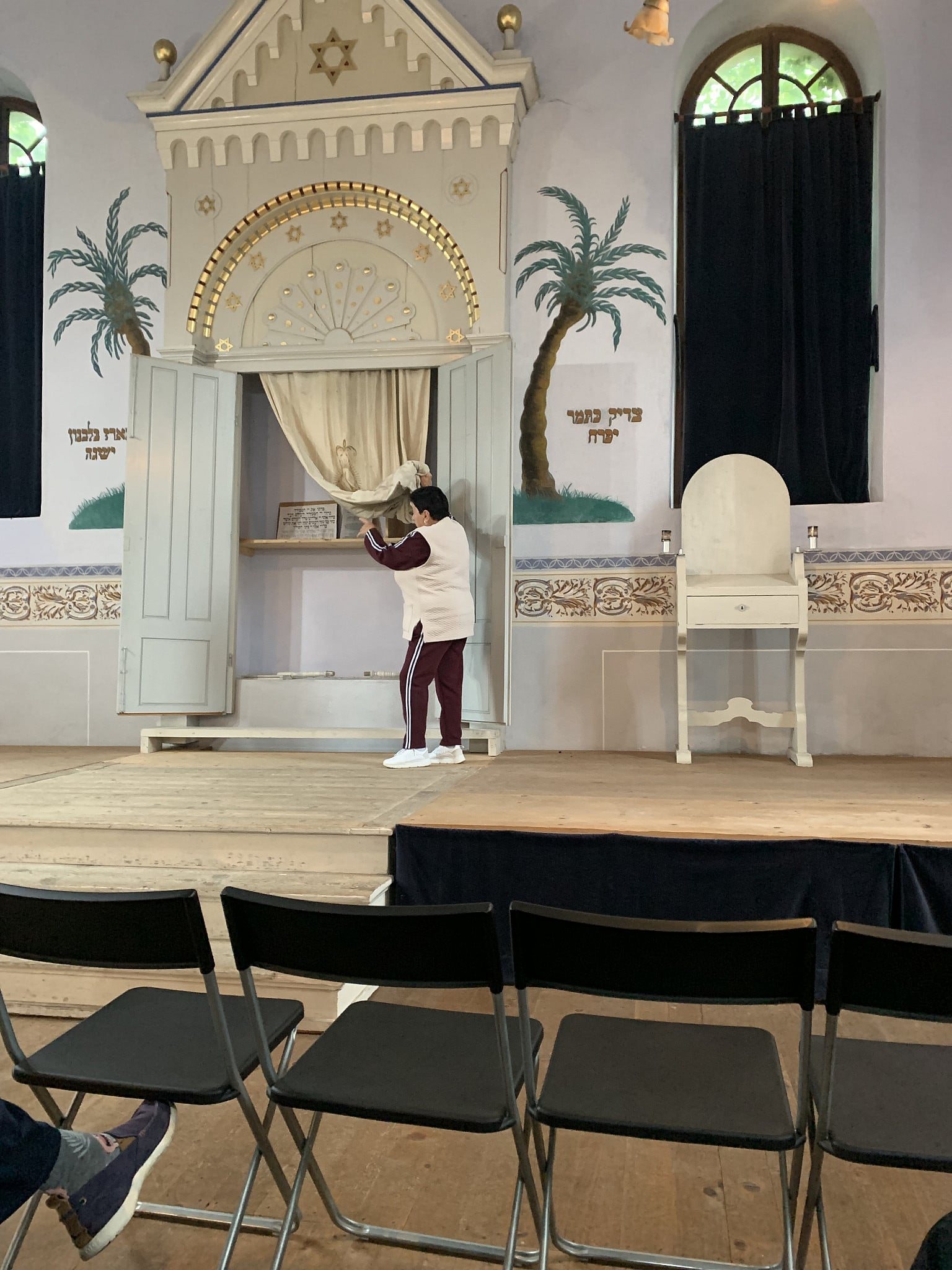
I immediately felt connected to this little place. I pictured men reverently taking the Torah scrolls from the intricately carved, white-painted Aron Kodesh at the front of the room, as light from the single round window above the ark illuminated their faces. The women watched the service, and everyone heard the rabbi’s words spoken from the square, white-painted wooden bimah in the middle of the sanctuary.
All eyes would have been drawn to whimsical palm trees, painted directly on the wall on either side of the ark. Accompanying the trees are gold-lettered inscriptions from Psalm 92: on the right “צדיק כתמר יפר” (The righteous shall flourish like the palm tree), and on the left “כארז בלבנון ישגה” (he shall grow like a cedar in Lebanon.)
But it was not the congregation’s destiny to flourish or grow.
Like other Romanian Jewish communities during the Holocaust, Sighişoara’s Jews had their property confiscated and were subjected to heavy persecution and other restrictions. In 1942, defying the evil and danger around them, the congregation opened a school where children were taught in Yiddish. Around the same time, the tiny community gave refuge to 2,000 Jews from surrounding villages when they were expelled from their homes.
Ultimately, around half of Romania’s Jews, roughly 400,000 people, were murdered by the Nazis and their local collaborators. Some say Sighişoara’s Jews were largely spared from the mass deportations to Auschwitz that devastated Jewish communities of Northern Transylvania. Others report that Sighişoara’s Jews were taken to the Târgu Mureș ghetto in May 1944 and then deported to Auschwitz.
In 1948, Sighişoara’s Jewish community temporarily grew to about 286 people. This increase, at least in part, reflected movement from neighboring areas where surviving Jews had been evacuated.
Over time, Sighişoara’s Jews joined the larger movement of Romanian Jews emigrating to Israel. They left via informal means, covert routes, refugee ships and other arrangements.
The congregation dwindled: there were about 35 Jews in 1966, 10 in 1977 and two in 1992. The last congregation service took place in the 1980s. There was a final minyan in 1985.
Ultimately there were no Jews left in Sighişoara to mourn the dead, remember community traditions or physically take care of the still-holy building. Its doors were closed for over twenty years. The building fell into disrepair and its fate seemed sealed.
But this wistful, lovely little place resonated with David Blum, a New York lawyer who visited in 2007. Although he had no ties to the community, or even to Romania, he financed the synagogue’s renovation in memory of his parents and grandparents.
For the past nineteen years, the synagogue has been lovingly cared for by Viorica, its gentile next-door-neighbor. When ordinary tourists, learned rabbis and distinguished dignitaries come to visit she runs to open the door – eager to share the synagogue’s special charm and difficult history. Viorica takes no money for her efforts and even pays out-of-pocket for synagogue repairs. Speaking through a translator, she told us she “loves Jews” and feels “half Jewish.”
Only a few people in our small group (thirteen Americans and two Brits) knew much about Shavuot or even about Judaism. Yet we all wanted to somehow commemorate the holiday and honor this lost community.
Avrel, a retired optometrist who tutors bar and bat mitzvah kids in his Reform congregation, stepped into the void. He led us in a rendition of Psalm 92 “Mizmor Shir L’Yom HaShabbat.” The words powerfully echoed the synagogue’s golden inscriptions about the righteous flourishing like palm trees and growing like a cedar of Lebanon.
During our own time of war, other words of the Psalm hit home: “Though the wicked may thrive like grass, and doers of evil seem to flourish, yet their doom is sure to come, for Yours is the ultimate triumph.”
We lit our candles and stood to recite Kaddish, remembering all the victims of the Holocaust. Our very brief “service” ended with a tearful rendition of Hatikvah, Israel’s national anthem. Viorica knew the words and joined in.
Night was upon us, and yet we lingered, not wanting to leave Viorica, this special place and our collective spiritual experience. But all things must end, and we eventually parted ways.
Now, during the High Holidays, I recall the light, prayer and sense of community we brought to an empty, still-sacred place. In retrospect, the memories and values I brought back home with me are even more significant.
I recall the simple beauty that lay within a plain unimpressive exterior. I think about David Blum and his generous tzedakah that changed the fate of this lovely little place.
I picture Viorica, whose selfless care for a memorable building and custodianship of its precious Jewish memories embody goodness.
I won’t forget the evil that revisited the little synagogue in 2014, when it was the victim of attempted arson and, again, in 2015, when it was spray-painted with swastikas and SS insignias. I realize the battle to defy hate and preserve Jewish memories and heritage doesn’t end.
Sighisoara’s congregants saw a painted mural of Jerusalem’s Western Wall and plaza every time they left the synagogue. Little did they know that their distant ancestral home would be the lifeline for hundreds of thousands of Romanian Jews. I will never forget the miracle of Israel.
Yom Kippur’s Yizkor service urges us to bind the souls of the dead in the bond of life. I am now connected to the Jews of Sighişoara. I stood where they prayed, lived their lives and watched their children grow. I hope to carry on their efforts to help brethren in need and emulate their strength in sustaining religious and communal life even during terrible times.
I went to see an “abandoned” synagogue but found a community of people waiting to be remembered. I will remember them.