Sirens, Silence, and a Sun-Soaked Flag in Wartime
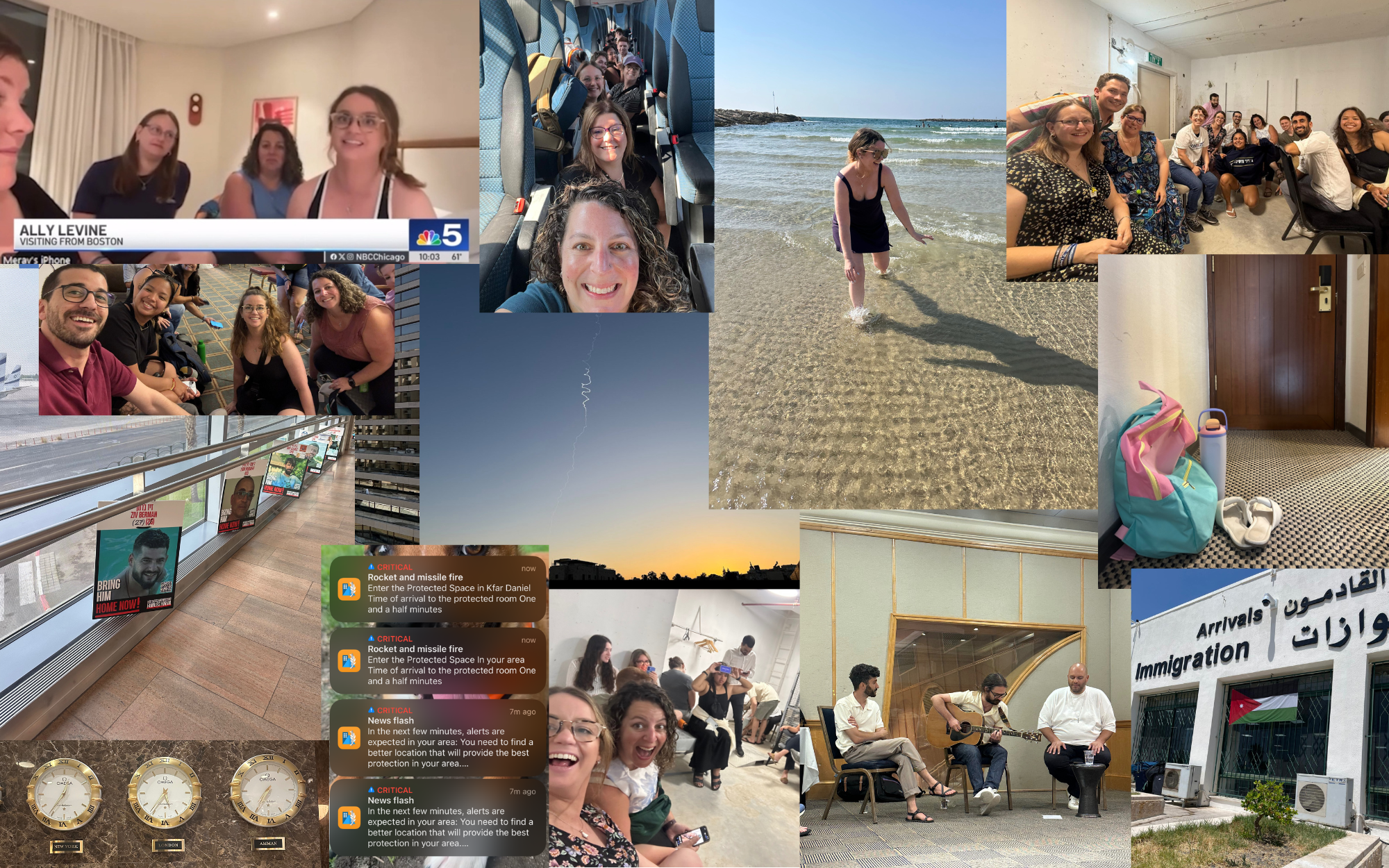
On Friday morning, June 13, after a night of missile sirens, I walked down to the beach in Tel Aviv. The air was thick with heat and the leftover anxiety of too little sleep, but the Mediterranean sparkled like it didn’t care what happened overnight. I needed to see it. I needed to remind myself that life still existed outside of the miklat.
As I made my way toward the water, I saw something that stopped me in my tracks: a giant Israeli flag stretched out between two poles, repurposed as a sunshade for a group of beachgoers. Some lounged beneath it on towels, others tossed a ball in the surf. The flag billowed in the warm morning breeze, unapologetically present. It felt, in that moment, like the perfect symbol of everything I was experiencing: defiance in the face of terror, pride in the face of fear, and a stubborn, joyful insistence on being here, alive, and unbowed.
It’s the image I keep coming back to, even now.
I hadn’t planned on spending my summer semester dodging missile fire. I was in Israel for graduate school, part of an “Israel Educational Experience” course with fifteen classmates and four incredible educators. The goal was to study place, identity, and peoplehood by immersing ourselves in the country’s complex, beautiful, and complicated daily life. I’ve been to Israel countless times, but this was supposed to be something different. It was meant to be immersive in a reflective, academic way.
I landed at Ben Gurion Airport at 8:00 AM on June 12. The arrival hall is always emotional for me, but it hit differently this time, walking past poster after poster of the hostages still being held in Gaza. Twenty months. Too long. I tried to focus on the small rituals that always ground me in this place: breakfast at Abulafia, reconnecting with friends, strolling through Neve Tzedek with ice cream in hand.
That evening, we laughed, ate, and toasted to being together in Tel Aviv. I went to sleep grateful, exhausted, and entirely unaware of what was coming.
At 3:07 AM on June 13, the first siren sounded.
I shot out of bed as the shrill wail filled the air, a sound I recognized but hadn’t expected to hear on this trip. Adrenaline hit before comprehension did. Along with my classmates, I hurried to the miklat, the bomb shelter, down the hall from my hotel room. None of us really knew what was happening yet. Text messages started pouring in from home. Israel had struck Iranian military sites. The expectation was for retaliation.
I stayed in that shelter for what felt like an eternity. When the sirens stopped, there was an eerie kind of silence. Not peace, just a quiet made of tension and held breath.
And then the next morning, we kept going. We met with our security team for briefings, listened to a Nova survivor share his story, and sat in lessons about Jewish ritual and theology. During the night, we sheltered from missile barrages and played Heads Up in the miklat. What else could we do? The war was on, but so was life.
The days that followed blurred together in a way only sleep deprivation seems to manage.
Sirens. Shelters. Pizza dinners. Classes. Shabbat prayers. Trips to the beach. Go bags. Every quiet moment felt like stolen time. Every loud one, a brutal reminder.
Our educators, brilliant, compassionate, and impossibly composed, kept our learning moving. Even when the “classroom” was a hotel basement or ballroom. At night, I barely slept. I could get maybe three consecutive hours before another alert dragged us back to safety.
I had to learn quickly what being prepared meant. I went to sleep each night with my go-bag packed and ready by the door: portable chargers, water bottles, medications, protein bars, my Kindle. My shoes were placed carefully next to my bed. I kept my hotel key within arm’s reach so I wouldn’t get locked out in the chaos. Even something as mundane as showering became a tactical operation: making sure my phone was on full volume nearby, my go-bag and slip-on clothes within reach, just in case the siren wailed mid-shampoo.
Each day faded into the next. The adrenaline dulled into a kind of resigned rhythm. By Sunday, June 15, it was clear we had to move to Jerusalem. The hotel in Tel Aviv was swaying under the force of nearby strikes. I packed my suitcase and boarded the bus.
Within minutes of arriving at our new hotel, we were ushered on a “tour” of the shelter space. Naturally, a siren sounded while we were mid-tour. By now, we moved like clockwork: grab your phone, walk calmly.
At night, I’d stare out at the city lights and feel both infinite pride and a gnawing ache. How was this real? How was it still happening? And how were we still managing to hold seminars, laugh, and swim between alerts?
The call to leave Israel through Jordan came at 11:30 on the night of June 16. By then, Israeli airspace was closed. Our educators arranged for eight of us and three staff members to cross into Jordan at dawn. It was a choice, technically, but not really.
Some of our classmates stayed behind. For a variety of reasons, personal, logistical, and complicated, not everyone could leave with us. That reality gutted me. As relieved as I was to have a way out, it was impossible not to feel the weight of those left behind. It still is.
Leaving felt both inevitable and impossible. At 8:00 AM on June 17 our bus departed. At 9:04 AM, another missile alert. We sheltered on the bus as Iron Dome intercepts filled the sky. Our security guard pointed out the window, as though this were a sightseeing tour, and told us to watch. The entire bus shook from the concussions. And then we drove on.
The border crossing was long, stiflingly hot, and filled with small humiliations. It took nearly six hours to get through the Israeli side, the in between, and Jordanian control. The moment that gutted me most wasn’t the siren, or the heat, or even the interminable waits. It was being told to remove my Star of David necklace, the one I’ve worn every day for fifteen years, the one I bought at the Tel Aviv artist market on my very first trip to Israel.
In my heart I was the Israeli flag sunshade on the Tel Aviv beach, but here I was hiding my Jewishness at a border crossing.
Turns out even Jordan wasn’t entirely safe. Sirens sounded there too; not for sheltering, just to announce missiles overhead en route to Israel. From the hotel window in Amman on June 18, I watched them streak across the sky toward Jerusalem. My friends were back in the miklat. I called them while the missiles were still in the air. There are no words for what that feels like. It was one of the most helpless, gut-wrenching moments of my life, and it will stay with me forever.
By Thursday, June 19, we started hearing rumblings that the U.S. was getting involved. Late that night, we got another message: we needed to be fully packed and ready to leave at 7:30 AM. Flights were opening up, and we had a narrow window to get out before the risk of Jordanian airspace closing too.
Now that I’m home, I don’t know how to hold it all.
I’m grateful. I’m heartbroken. I’m proud. I’m angry. I’m lucky. I’m traumatized in ways I’m still unpacking with my therapist, my sister, my fiancé, my parents, and my classmates. I experienced mere days of what people there endure for lifetimes. And I keep coming back to the same image.
That flag.
A sunshade in the early morning light.
A bold, ordinary act of stubbornness.
A message, clear as daylight: We are still here and we’re not going anywhere.
I am that flag on the beach.
I am the necklace hidden at a border crossing.
I am the sirens and the silence.
And I am still here.
Am Yisrael Chai.