
Six Biblical Stories That Could Help Untangle Israel’s Political Crisis
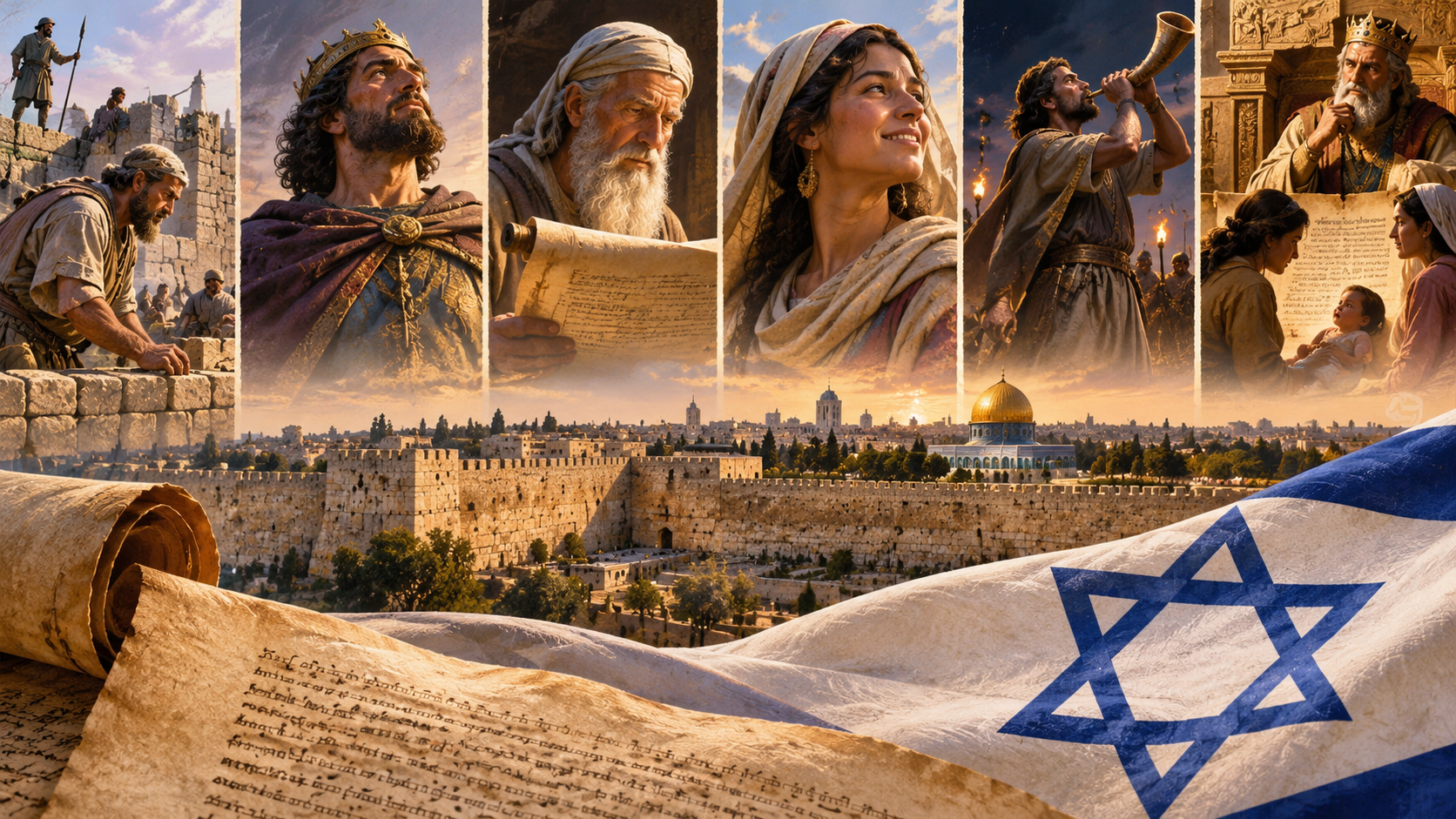
Israel’s newly elected Knesset has been sworn in, but the country still has no new government. The October 27 elections produced a political arithmetic that is proving exceptionally difficult to translate into a governing coalition. Neither of the principal blocs commands a parliamentary majority, and the possible routes to one involve disagreements over military service, political cooperation, and the participation or support of Arab parties. Another election remains a possibility.
Meanwhile, Iran is hardly standing still.
On November 10, Iran’s Islamic Revolutionary Guard Corps released footage of what it described as a new underground missile facility, displaying ballistic and cruise missiles and their launch systems. The facility’s location and actual capacity remain undisclosed, but the message was unmistakable: Tehran intends to demonstrate that its military capabilities remain formidable. Iranian officials have also warned that retaliation for another attack could extend beyond the Middle East.
Following two direct confrontations between Israel and Iran, a third appears increasingly likely. What remains unknown is when it might begin, how it would unfold, and what might trigger it. Israel cannot afford to let prolonged political negotiations distract from its security.
Whatever government eventually takes office will inherit these dangers. It will need sufficient parliamentary support to govern, but also the unity, judgment, and determination required to make extraordinarily difficult decisions.
Could six stories from the Hebrew Bible offer some useful lessons for achieving that urgent objective?
In Nehemiah 4:7–23, we find the account of Jerusalem’s walls being rebuilt under the constant threat of enemy attacks. The people faced opposition from enemies determined to frustrate their work. Yet the rebuilding continued. Some labored while others stood guard, and those carrying materials remained prepared to defend themselves. Nehemiah understood that rebuilding the city would accomplish little if its inhabitants neglected the dangers surrounding it.
The lesson for Israel today seems particularly relevant. Political disagreements, however legitimate, cannot be allowed to overshadow the responsibility to protect the nation. At a moment like this, Israel’s security must take precedence, particularly in the face of the existential threat posed by Iran. Approximately 440 kilograms of uranium enriched to 60% remain unaccounted for under international verification, a stockpile that, if further enriched, could theoretically yield enough weapons-grade material for approximately ten nuclear weapons. For a country as geographically small as Israel, the consequences of even a limited nuclear attack could be catastrophic. Negotiations over ministries, legislation, and competing domestic priorities matter, but the next government must remain capable of confronting such dangers. Jerusalem’s walls could not be rebuilt safely without vigilance. Neither can a country’s political future.
Another lesson emerges from the story of David.
In 2 Samuel 5:1–5, the tribes of Israel finally come together to recognize David as their king. Following the death of Saul, Israel had endured years of division and confrontation between rival houses. David had already been anointed by Samuel and had earned recognition through his military leadership, yet the path toward a united kingdom was neither immediate nor peaceful. Eventually, the tribes came to Hebron and acknowledged him as their king.
What makes this account valuable is the willingness to move beyond previous hostilities. Those who had once stood on opposing sides ultimately recognized the importance of common leadership. Their differences did not simply disappear, but they ceased to prevent political unity.
Israel’s present political divisions are real, and some concern fundamental questions of national identity and security. Nevertheless, the history of David’s accession reminds us that past confrontation need not permanently determine future cooperation.
Unity, however, requires discernment.
Ezra 4:1–5 recounts how those identified as adversaries of Judah and Benjamin offered to participate in rebuilding the Temple in Jerusalem. Their offer was rejected. The narrative subsequently describes efforts to discourage the people of Judah and obstruct the construction.
The episode raises an uncomfortable but necessary question: how should those responsible for a nation’s future distinguish sincere cooperation from participation that could undermine their common purpose?
A government cannot function if its members enter it intending to frustrate its essential responsibilities. Political agreements require more than parliamentary calculations. They require reasonable confidence that prospective partners genuinely intend to support the work they have agreed to undertake.
Yet discernment must never become an excuse for prejudice. That brings us to Ruth.
In Ruth 1:8–18, a Moabite woman makes an extraordinary declaration of loyalty to her Israelite mother-in-law, Naomi. After losing her husband, Ruth chose to remain with Naomi. Although Naomi encouraged her to return to her own people, Ruth refused to abandon her. Her declaration remains among the most moving expressions of loyalty in Scripture: “Your people shall be my people, and your God my God.”
Ruth’s origin did not prevent her from demonstrating extraordinary affection and solidarity with Naomi and her people.
Her story offers a particularly important reflection for the Arab political parties whose parliamentary support could determine who becomes Israel’s next prime minister. Nobody should be expected to abandon an Arab identity, religious beliefs, or legitimate political concerns. Yet any party seeking to influence the formation of Israel’s government should be prepared to express openly and unequivocally its commitment to the nation’s preservation and the security of its Jewish population, especially at a time of such extraordinary danger.
If a prospective coalition partner cannot demonstrate that commitment through its words and actions, both political blocs have every reason to question whether relying on its support would produce a government capable of confronting the threats ahead. The same standard should apply to every party, regardless of its constituency.
Such solidarity must also be mutual. A government responsible for Israel’s future must recognize the dignity and security of all its citizens.
In matters of national security, particularly in Israel’s circumstances, a house divided against itself cannot stand.
The story of Gideon introduces another consideration: numbers alone do not guarantee effectiveness.
Judges 7:1–22 tells the story of Gideon’s army being reduced to just 300 men. Facing the Midianites, Gideon initially commanded thousands of men. Yet his army was reduced first to 10,000 and then to just 300. The final selection involved observing how the men drank water. Some biblical commentaries interpret the manner of drinking as a sign of vigilance and readiness, although the passage itself emphasizes that the victory was not to be attributed to Israel’s numerical strength.
For those negotiating a governing coalition, the distinction between numbers and effectiveness deserves consideration.
A coalition may possess an impressive parliamentary majority yet remain divided over the threats demanding its immediate attention. Conversely, a smaller political grouping with a shared understanding of national priorities might demonstrate greater cohesion and determination. Of course, even the most disciplined minority must secure the parliamentary support necessary to govern.
The question, therefore, extends beyond how many legislators can be brought together. It concerns whether they can act together when their country’s security is at stake.
Our final story takes us to the court of Solomon.
In 1 Kings 3:16–28, Solomon faces a dispute between two women claiming to be the mother of the same child. Unable to resolve their competing claims through testimony alone, Solomon proposed dividing the child between them. One woman accepted the proposed division. The other immediately pleaded that the child be given to her rival instead, so long as his life was spared. Solomon recognized her as the true mother.
The most profound element of this story is the mother’s willingness to surrender something infinitely precious to protect the person she loved.
She was prepared to lose her claim rather than see the child destroyed.
Perhaps this is the most difficult lesson for those involved in Israel’s political negotiations.
Would its political leaders be willing to relinquish a cherished demand, a ministerial position, a longstanding rivalry, or even an opportunity to lead if such a sacrifice could make possible a stable government capable of protecting the nation?
Compromise should never require abandoning principles essential to national security. But neither should political ambition become so important that it prevents leaders from recognizing when a concession might serve a greater good.
The six stories offer different lessons: vigilance, reconciliation, discernment, solidarity, shared priorities, and sacrifice. None provides a ready-made formula for assembling a modern parliamentary coalition, and none requires identifying today’s politicians with the figures of ancient Israel.
They do, however, leave us with a question worth asking at this dangerous moment.
If Israel’s political leaders genuinely place the future of their country above their own ambitions, what are they prepared to give up to protect it?
For the true mother who stood before Solomon, the answer was clear. The child’s life mattered more than her right to hold him.
Israel’s leaders may soon have to decide what matters most to them, too.