Sleepaway Camp Oberlangen: The 10-Year-Old No One Came to Collect
This month, all over America, 10-year-old girls are packing bug spray, stationery, flashlights, and a stuffed animal smuggled past the “one comfort item” rule.
They will sleep in bunks, sing after dark and cry a little from homesickness. Eight weeks later, their parents will drive up the gravel road and take them home.
In the winter of 1944, a 10-year-old girl arrived at an all-girls camp too.
Camp Oberlangen. Stalag VI-C. About 1,700 girls and women behind barbed wire on a frozen German marsh near the Dutch border — all of them soldiers of the Warsaw Uprising, all of them prisoners of war.
Among them was my mother-in-law.
The packing list
Edna arrived at camp with two medals and a lie.
She carried the Cross of Valor, Poland’s decoration for exceptional bravery in combat, and the Medal for Wounds and Injuries, awarded after German shrapnel tore into her body. The lie keeping her alive was her name.
The camp roster identified her as Stefcia Skólkowska: a Polish Catholic orphan, a soldier of the Home Army, prisoner of war number 224040.
Her real name was Edna Szurek. She was a Jewish child born at 18 Miła Street, later enclosed within the Warsaw Ghetto. If anyone discovered who she was, the prisoner-of-war status General Tadeusz Bór-Komorowski had fought to secure for his women soldiers might not protect her. She could simply disappear.
Camp is where children learn to be away from their parents.
Edna had no parents left to be away from.
The bunks
At American summer camps, bunks smell of pine and sunscreen. At Oberlangen, 200 women slept in a room, in rotting barracks sinking into the marsh.
There was no heat during one of the coldest winters of the war. Two iron stoves burned damp peat that produced more smoke than warmth. Lice lived in the bedding, bedbugs in the boards. Pneumonia and bronchitis moved from bunk to bunk.
Oberlangen was not supposed to exist. The Germans had removed it from the prisoner-of-war register as unfit, then quietly reopened it as a penal camp for the women of the Polish Home Army. The Red Cross did not know they were there.
The Germans offered them a way out: renounce prisoner-of-war status, become civilian laborers and receive better conditions.
The women refused.
They had earned the word soldier during 63 days of street fighting in Warsaw. They would freeze before surrendering it.
The woman who kept them soldiers
Their leader was Lieutenant Maria Irena Mileska, code name “Jaga.”
Jaga was not warm. She was strict, relentless, and uninterested in being liked. She ran the camp as a Polish military unit because she understood something the Germans did not: in captivity, discipline is armor.
Her message was unmistakable: You are not prisoners who used to be soldiers. You are soldiers who happen to be imprisoned.
Under Jaga, the women created a chapel, a school, lectures, theater, and singing at night. When 10 prisoners who had left Warsaw pregnant began to give birth, Jaga announced that the first baby would arrive naked because its mother owned nothing. Women unpicked handkerchiefs, blouses, and bed linen, and sewed bonnets, gowns, and diapers. Red Cross cartons became cradles.
Jaga never said the word love. She just organized it.
Edna was 10 and could not read. During the uprising, she had carried messages folded between her fingers, a courier who could never betray what she could not decipher. In a freezing classroom barrack at Oberlangen, women soldiers taught her the alphabet.
Mail day
At sleepaway camp, mail day brings letters, cookies and candy from home.
At Oberlangen, parcels arrived only in trickles. Some were stolen by guards or held at a railway station miles away. Those that reached the prisoners often contained cigarettes.
Edna did not smoke, so she traded them.
Then a shipment arrived containing small jars of a creamy tan substance no one in her barrack recognized. An older prisoner told her what it was.
Peanut butter.
Edna tasted it and immediately decided that every cigarette she owned was worth trading for more.
But mail day had a shadow. Some women had begun looking at Edna and her 16-year-old sister, Miriam, too closely. When those women took cigarettes or chocolate from the sisters’ parcels, Edna and Miriam did not protest. A care package was a small price for silence.
Still, for one moment on a frozen German marsh, peanut butter reminded a child that somewhere beyond the wire was a world worth returning to.
The secret
Edna’s secret could kill her.
Since the age of 6, she had performed the perfect Catholic prayers, the perfect Polish diction, the perfect blankness whenever anyone mentioned Jews. Now she had to perform in her sleep, surrounded by 200 witnesses. One Hebrew word murmured in a dream could expose her.
Miriam carried the same secret. The sisters could not even comfort each other openly as sisters. Stefcia and Marysia were not supposed to be Edna and Miriam.
Even their love had a cover story.
Pickup day
At the end of American summer camp, parents arrive. Trunks are loaded. Children cry, promise to write and go home.
At Oberlangen, liberation came on April 12, 1945, when soldiers of General Stanisław Maczek’s 1st Polish Armoured Division reached the camp. Polish men who had fought their way across Europe found 1,700 emaciated Polish women soldiers standing at attention behind the wire. Some found wives and sisters they had believed were dead.
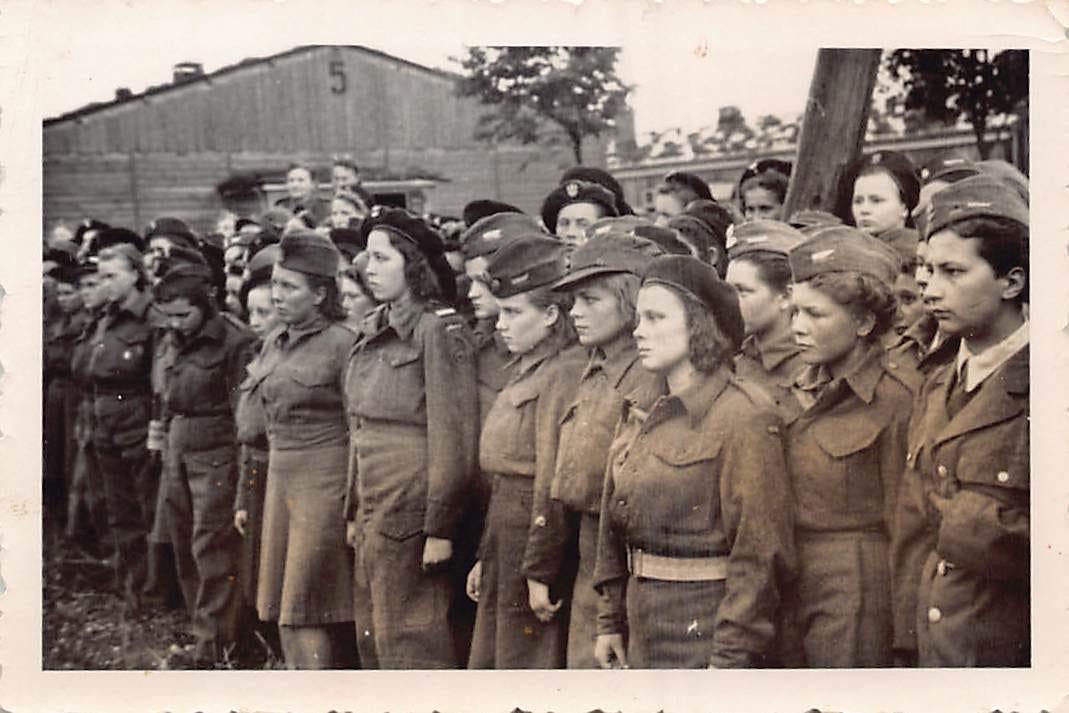
Weeks later, General Bór-Komorowski came to inspect the liberated ranks. That inspection appears in the photograph above: women soldiers standing before the barracks. Somewhere among them was a 10-year-old with two medals and a false name. Edna kept these photographs in a box for the next 70 years.
But there was one difference between her camp and the camps our daughters and granddaughters leave for each summer. It was the whole difference.
No one came to pick her up.
No parents waited at the gate. No home stood at the end of the road. Warsaw was rubble. Her mother had starved in the ghetto. Her father was never coming back.
Liberation left a 10-year-old facing a question no child should hear:
Free to go where?
And she still could not tell anyone her name.
Two weeks later, Jaga told her that a Jewish officer had arranged for a car to take her to Brussels. Edna recoiled. She had lived so long as a Polish Catholic orphan that she no longer trusted the very identity that might save her. Later, when a Jewish chaplain offered Jewish survivors passage to the United States, Edna and Miriam insisted they were Catholic.
The war was over. The performance wasn’t.
This summer, when the buses pull away and a child cries because eight weeks feels like forever, remember what that homesickness means: there is a home, and someone in it counting the days.
Edna would have to build all of that from nothing.
A country. A family. A name.