What's in a Word? Synonyms in the Hebrew Language
Sleepy Heads – tardeimah, sheinah, tenumah, linah, and durmita
In the story of the creation of Eve, the Bible relates that Hashem put Adam into a deep slumber, so he would not feel his Creator surgically removing one of his ribs to create Eve. The way the Bible (Gen. 2:21) phrases it, Hashem placed a tardeimah upon Adam, and Adam slept (yashein). In this essay, we will introduce three Hebrew words for “sleeping”: tardeimah, sheinah (the noun form of yashein), and tenumah, plus we offer some basic explanations as to the difference between them. Afterwards, we continue with more explanations as to how these three words differ from one another, as well as a discussion of the Hebrew word linah and the Zoharic word durmita. In exploring these different words for the same concept, we consider the etymological basis for each expression, and whether or not they are all truly synonymous.
The triliteral lexicographers — like Ibn Chayyuj (945–1000), Ibn Janach (990–1055), and Radak (1160–1235) — all write the root of sheinah is the three-letter root YOD-SHIN-NUN. In line with this, Rabbi Yitzchak Zeldin (18th century Germany) writes in Shoresh Yesha notesthat the root YOD-SHIN-NUN bears two meanings “sleep” and “old,” before commenting that both of these meanings are one and the same. Although the meaning of this comment is a bit unclear, it seems that he meant to explain like Rabbi Hirsch (to Gen. 24:1) that the older a person gets, the more his energy has been sapped and drained, which leaves him more tired and needy of “sleep.”
The biliteralist Menachem Ibn Saruk (920–970), in his Machberet Menachem, traces sheinah to the biliteral root SHIN-NUN. In adopting a similar approach, Rabbi Shlomo Pappenheim (1714–1814) defines the core meaning of that root as “doubling.” As a result, he lists the words shnayim/shnei (“two”) as derived from this root, as well as shanah (“repeat”), shinun (“sharpening,” a repetitive action done by rubbing a blunt metal against a stone), and shinui/shoneh (“change,” because when something is repeated, it inevitably changes, as it is impossible to exactly replicate what was before). Following this rubric, Rabbi Pappenheim writes that sheinah isanother derivative of this root, because when one is sleeping, one rehashes all of one’s thoughts from throughout the day, as though thinking about them a second time. Other words Rabbi Pappenheim sees as related to this root include shein (“tooth,” because most people grow two sets of teeth: one as a baby and one as a child), shanah (“year,” a unit of time determined by the sun reaching the same spot in the sky annually), and yashan (“old,” because such a person or item has experienced many a shanah).
Interestingly, Rabbi Aharon Marcus (1843–1916) writes that the core element of the word sheinah is the letter SHIN, which he claims is universally associated in all languages with “quiet” and “silence.” For example, the universal way of quieting a person is by shushing them, an onomatopoetic term derived from the “sh…” sound. Seemingly, Rabbi Marcus intends to say that when a person is asleep, he effectively remains silent, so the very word for “sleeping” is associated with “quietness.” [For more about other Hebrew words for “quiet/silence,” see “To Remain Silent” (March 2020).]
Moving on to the term tardeimah, all the early Hebrew lexicographers (including Ibn Saruk this time) trace the word to the three-letter root REISH-DALET-MEM. Rabbi Samson Raphael Hirsch (to Gen. 2:21) writes that the root REISH-DALET-MEM is related to the root REISH-TAV-MEM (“tying/binding”), via the interchangeability of DALET and TAV. He explains that when a person experiences tardeimah, all of his bodily senses are metaphorically “tied down,” as he loses his ability to independently/consciously move around, just as if he were physically fettered and tied up. Rabbi Hirsch speculates that when Elijah the prophet asked Hashem to kill him, he sat under a rotem tree (I Kgs. 19:4), because that particular tree has some sort of narcotic effect that is conducive to falling asleep.
On the other hand, Rabbi Hirsch argues that when one enters a state of sheinah, this refers to ordinary sleep, whereby a person’s senses may be weakened and languid, but he is not totally detached from them. He finds support to this notion from the fact that yashein is related to yashan, ishon layla (Prov. 7:9, “the black of night”) and ishon bas ayin (Ps. 17:8, “the black of the eyeball, i.e., the pupil). All of those terms refer to the “lack/deficiency” of something else: “black/darkness” refers to a lack of light, yashan (“old”) refers to the lack of youngness/freshness, and yashein/sheinah implies a sleeping person’s lack of sentience and animation (albeit not a totally blackout).
Rabbi Pappenheim sees tardeimah as a tributary of the two-letter root REISH-DALET. He explains that root as primarily referring to “descending/downward movement” (yeridah). Accordingly, he explains the verb rodeh (Gen. 1:28, Lev. 25:43) in the Machiavellian sense of “governing/lording over others” by keeping one’s subordinates or constituents “down” in a way that they cannot assert their own independence, while the ruler remains on top of the hierarchy. Rabbi Pappenheim even sees meridah (“rebellion”) as related to this root, because it denotes the plebs breaking free from said yoke of the elite. Based on this, Rabbi Pappenheim argues that tardeimah refers to a type of sleep which “overpowers” a person by unwittingly making him fall asleep against his will. In other words, when a person did not purposely lay down to go to sleep, but instead dozes off and is overcome with sleep in middle of whatever else he was doing, this sleep “lords” over him and is therefore called tardeimah.
In Modern Hebrew, radum (a cognate of tardeimah) refers to a person who has been “sedated” or “tranquilized” (e.g., through local anesthesia), but may still technically be awake and lucid.
The word tenumah is pretty straightforward, with the triliteralists (like Ibn Chayyuj, Ibn Janach, and Radak) seeing its root as NUN-VAV-MEM, and the biliteralists (like Ibn Saruk and Rabbi Pappenheim) seeing its root as NUN-MEM. The Mishnah (Yoma 1:7, Pesachim 10:8, Megillah 2:2) uses the term mitnamnem (“dozing off/nodding off”), a diminutive of tenumah formed by doubling its two core consonants. The Talmud (Megillah 18b) explains that this particular term refers to the state of being “half-asleep”: nim (an Aramaic form of tenumah) but not totally nim, tir (“awake”) but not totally tir. This state of sleep is characterized by the feature that if one calls the sleeping person by name, he would respond; but although the sleeping person cannot provide a logical answer to question, he can recognize a correct answer.
The piyyut Melech Elyon (customarily recited on Rosh Hashanah) contrasts human kings, who are susceptible to such things as tenumah and tardeimah, with the King of Kings, whose potency lasts forever without respite. Rabbi Chaim Kanievsky (1927–2021) finds an allusion to this in the Midrash (Bereishit Rabbah §8:10) which relates that when Hashem first created man, all the ministering angels thought he was God, so Hashem made man fall asleep, so that they will all realize that Adam is a mere mortal.
But what is the difference between tenumah and tardeimah? And how do they differ from sheinah?
Ibn Ezra to (Gen. 2:21, Ecc. 12:2) ranks these three words in terms of the intensity of “sleep.” The way he puts it, tardeimah is a more intense sleep than sheinah, while sheinah is more intense than tenumah. Radak (to Gen. 2:21, Ps. 121:4, and Sefer HaShorashim) also cites this, and adds that Hashem imposed on Adam a deep sleep, which would allow him to not feel the pain of the surgery required to create Eve from his person. After the Bible says that Hashem imposed a tardeimah on Adam, it says vayishan (“and he slept”) — using another word for “sleeping” (Gen. 2:21). The way Radak explicates this passage, this second term refers to a later stage in the story. At first, Hashem put Adam in a state of tardeimah so that he will not feel the pain of having part of his body surgically removed. But afterwards, Adam was in a state of sheinah (where he could feel pain), while he recovered from his operation.
Peirush HaRokeach (to Gen. 2:21) also explains that tardeimah refers to an especially “strong sheinah,” under which Adam would not feel the removal of a rib. In that spirit, he also explains (to Gen. 15:12) that Hashem brought a tardeimah upon Abraham before the revelation at the Covenant Between the Pieces, so that Abraham will not end up waking up before receiving the full prophecy that He intended to relay.
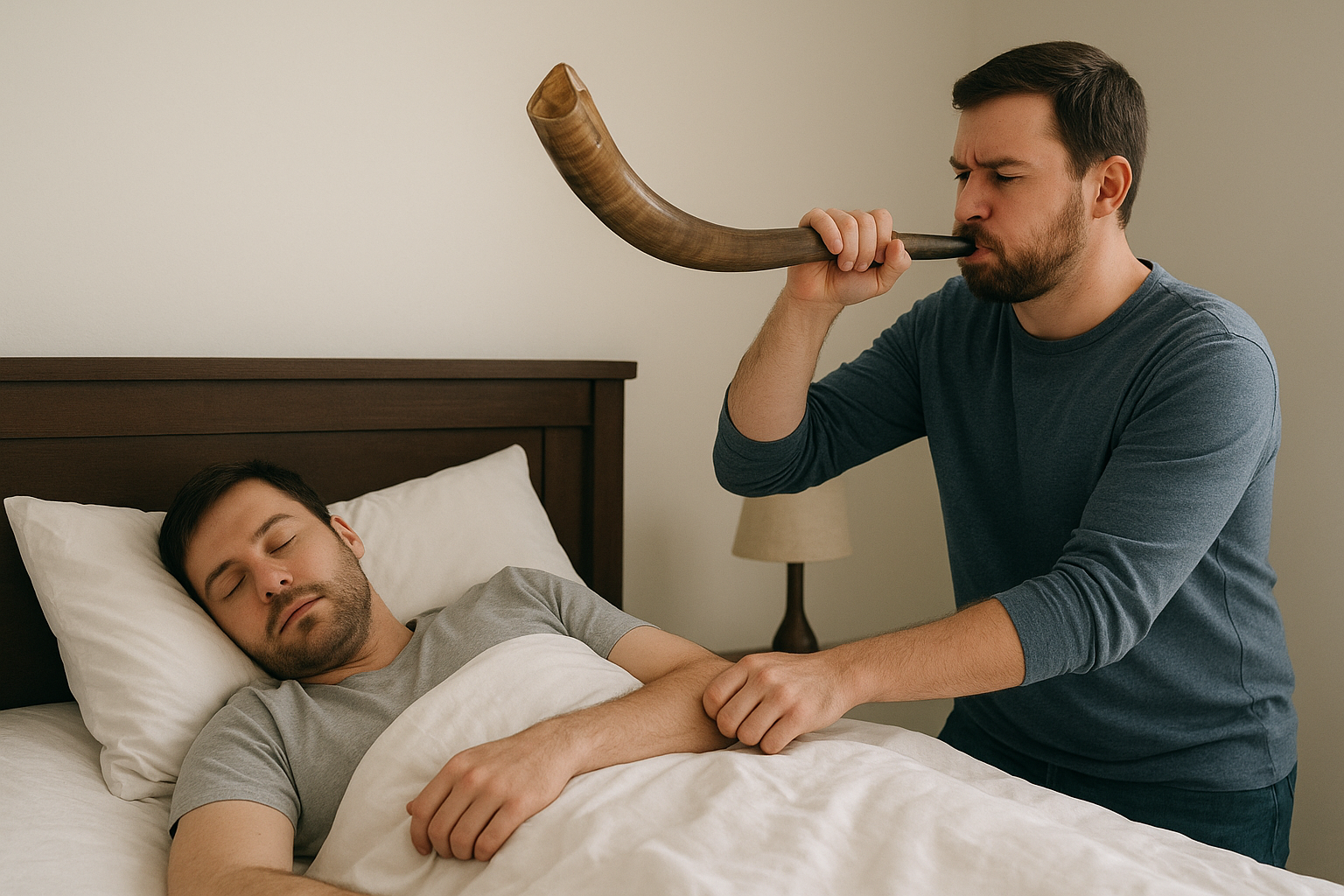
Maimonides famously writes (Laws of Teshuvah 3:4) that although the commandment of blowing Shofar on Rosh HaShanah is simply the King’s order, there is another element to it, and that is to serve as a wake-up call for sinners to repent. In his words: “Awake O sleeping ones from your sleep (sheinah), and those who slumber should wake up from your deep slumber (tardeimah), seek out your deeds and return in repentance.”
Rabbi Moshe Sternbuch (Chief Rabbi of Jerusalem) infers from Maimonides’ wording that this passage refers to two different types of sinners. Following Ibn Ezra’s model for understanding the difference between sheinah and tardeimah, he explains that one sinner serves Hashem properly in general, but has only recently fallen out of line, such that he is likened to a person engaged in sheinah, a less intense form of sleep, from which one can be more easily roused. The other type of sinner is suffering from a more long-term condition, by which he has strayed from Hashem in a more intense way. That sinner is similar toone engaged in tardeimah, as he is stuck in a more intense slumber and it takes more effort to waken him and stir him to repent.
Rabbi Wertheimer cites a similar explanation, and ties this to the two different sounds blown by the Shofar on Rosh HaShanah, with the tekiah (a more basic sound) intended to send a message to those sinners are in a sheinah, and the teruah (a more complex and broken-up sound) to arouse even those sinners who in a deeper tardeimah and require more effort to be pulled out of their stupor. [For more about the words for “waking up,” see my earlier essay “Wake-up Time” (Dec. 2021).]
Also following Ibn Ezra’s basic approach, Rabbi Yosef Nechemias (to Prov. 6:11) writes that there are five terms for “sleep” in Hebrew: tenumah is the least intense, sheinah is more intense, and tardeimah is the most intense, while linah refers to the time for sleeping (see below), and shechivah refers to the act of laying down to go to sleep.
When King Solomon warns against being lazy and indolent, he exhorts “do not give sheinah to your eyes, nor tenumah to your eyelids” (Prov. 6:4). In his commentary to that verse, Rabbi Eliyahu of Vilna (1720–1797), also known as the Vilna Gaon, explains that sheinah represents a person who is deeply immersed in his sleep, such that he has lost the capacity for thinking; while tenumah represents a person whose eyelids may be physically shut, but whose minds is still nonetheless at work. Elsewhere, the Vilna Gaon (to Brachot 60b) explains that when one engages in sheinah, one’s eyes are also at rest, while when one is engaged in tenumah, one’s eyes may be physically closed but they are not technically at rest. Although I’m not sure what exactly the Vilna Gaon means, neurologists recognize that there are two modes of sleep, with one mode characterized by “rapid eye movement” (REM). Perhaps the Vilna Gaon meant to somehow allude to this concept.
Rabbi Avraham Bedersi (in his Chotam Tochnit), the earliest scholar to work on Hebrew synonyms, contrasts sheinah — which he connects to “rest/tranquility” — with tenumah, which he associates with “indolence/laziness.” In explaining the meaning of tardeimah, he first defines it as the end of a long sleep (seemingly the deepest portion of one’s sleep cycle?), but then suggests that it is the type of sleep that one falls into when in a state of extreme fright. He offers a Biblical proof-text for this last approach by citing the verse which first describes a tardeimah as falling upon Abraham, and then immediately describes a “dark fear” falling upon him as well (Gen. 14:12). According to this, the difference between the three terms in question lies not in the quality or quantity of sleep, but in the conditions and attitudes related to one’s sleep.
Elsewhere in that work, Rabbi Bedersi compares the term sheinah (whose meaning he asserts is well-known) with the term hozim (in Isa. 56:10), which he sees as referring to an especially long-lasting slumber like a dog who oversleeps. Interestingly, though, Rabbi Bedersi admits that most other commentators explain hozim as “people who say exaggerated or unrealistic statements” in a sort of state of delirium (like the Modern Hebrew hazui). As a synthesis of these two explanation, Rabbi Tedeschi explains that hozim refer to people who say nonsensical things in temporary ecstatic bouts of insanity — including those who talk in their sleep.
Rabbi Moshe Yitzchak Tedeschi-Ashkenazi (1821–1898) writes that when one experiences tardeimah, his sleep overpowers him. Because of this, he relates that word to the root REISH-DALET, which refers to “ruling/lording over” (similar to Rabbi Pappenheim’s approach cited in Part I). He sees the second term, sheinah, as an onomatopoeic expression, whose originally form, yashein, derives from the snoring sound of a sleeping person. Finally, when it comes to tenumah, Rabbi Tedeschi-Ashkenazi writes that this word relates to ne’um (“the word of”), because it denotes a state of sleep whereby one can still coherently talk. [See “Balaam’s Numa” (June 2021) for more on the word ne’um.].
Rabbi Meir Leibush Weiser (1809–1879), better known as the Malbim, writes (to Isa. 5:27) that sheinah refers to the regular, naturally-occurring type of sleep that a person experiences, while tenumah refers specifically to a type of sleep that is caused by extraordinary exhaustion and tiredness. Elsewhere, Malbim (to Ps. 121:4) offers a slight variant on this explanation, writing that sheinah is an umbrella term (hypernym) that includes all different types of sleep, while tenumah is a specific type of sheinah (hyponym) that is induced by extraordinary tiredness.
Rabbi Naftali Tzvi Yehuda Berlin (1816–1893), also known as the Netziv, in his work HaEmek Davar (to Gen. 2:21) disagrees with Ibn Ezra’s ranking of the words in question (see Part I). Instead, he argues that tardeimah does not denote a deeper form of sleep than sheinah, but rather that tardeimah denotes a lighter form of sleep (like that of one who is just falling asleep). He explains that this is why in the case of Adam, the Torah first reports that he fell into a tardeimah and then that he was in a state of sheinah. (Rabbi Wertheimer entertains possible support for this position from Targum Onkelos to Gen. 2:21, but ultimately rejects that proof).
Similarly, Rabbi Ezra Reuven Dangoor (1848–1930), the Chief Rabbi of Baghdad, explains that tenumah is the first stage of sheinah. In doing so, he does not explicitly write that tenumah denotes a lighter quality of sleep, but rather that tenumah is simply an earlier chronological stage in the sleep cycle. Rabbi Wertheimer infers the same idea from Maimonides’ commentary to the Mishnah (Pesachim 10:8), further arguing that sheinah is a general term for “sleeping,” while tenumah refers specifically to the beginning of the sleeping process, i.e., when one first falls asleep.
Finally, Dr. Alexander Kohut (1842–1894) cites a passage from the hitherto-unpublished work Ikkarei HaTalmud by Rabbi Avraham Zacut (1450–1515). He writes that tenumah implies a lighter form of sleep than sheinah, as it refers to somebody whose suffering prevents him from falling fast asleep (perhaps an insomniac), sheinah refers to the natural sleep that most people engage in nightly, and tardeimah refers to a deep form of sleep thar befalls a person who is subsumed in his suffering such that he has no other recourse but to go to sleep (in the same way that a suicidal person gives up on life and dies).
The Biblical Hebrew term linah and its cognates are often used to denote the verb for “sleeping over.” For example, Abraham’s servant asked Rebecca “does your father have space for us la’lin?” (Gen. 24:23), and she responded that there is place for him la’lun (Gen. 24:24). In that story, the servant meant to ask if there is ample room for him to stay the night, and Rebecca answered in the affirmative. Words related to linah are derived from the triliteral roots LAMMED-VAV-NUN and LAMMED-YOD-NUN (or just LAMMED-NUN according to Ibn Saruk), although Shadal (to Gen. 24:23) already clarifies that both of those roots mean the same exact thing (despite having different middle letters).
Nonetheless, it should be made clear that, technically-speaking, the word linah has nothing to do with actually “sleeping.” Rather, it refers to “leaving something overnight,” which generally includes the time that people “sleep” — even though the word itself does not automatically entail “sleeping.”
To illustrate this point, cognates of linah are used when the Torah prohibits leaving sacrificial meats overnight past the time allotted for their consumption (Ex. 23:18, 34:25, Deut. 16:4), leaving a day-worker unpaid overnight (Lev. 19:13), or leaving an executed criminal’s corpse hanging in public overnight (Deut. 21:23). In all of those cases, the subject of the linah is not even a living person and certainly does not “sleep.” It’s just something left overnight. In fact, Rabbi Pappenheim sees the word linah as etymologically-related to the Hebrew word laylah (“night”), tracing both terms to the biliteral LAMMED-LAMMED (see also Ha’Ktav Ve’Ha’Kabbalah to Deut. 21:23).
In Biblical Hebrew, the word malon (Gen. 42:27, Ex. 4:24, Josh. 4:3, Isa. 10:29), which derives from the same root as linah, refers to any place or lodging where one stays overnight, but in Modern Hebrew that term has come to be used specifically to mean “hotel.”
The root LAMMED-VAV-NUN also gives way to words that refer to “complaining,” which is a totally different concept from linah. Rabbi Samson Raphael Hirsch (to Ex. 15:24) bridges the gap between these two meanings by explaining that they both broadly refer to the notion of seeking protection and safety. In the case of linah, it refers to a person seeking safe accommodations where one can spend the night, while in the case of “complaining,” it refers to a person seeking solace in his suffering by verbally airing his complaints and grievances with the hopes that somebody will help save him from his plight.
The Midrash (Bereishit Rabbah §17:5, §44:17) teaches that the term tardeimah appears in three contexts in the Bible: Sometimes it refers to a sleeping slumber (like in the case of Adam), sometimes it refers to a prophetic slumber (like in Gen. 15:12, when a tardeimah fell upon Abraham before he received a prophecy), and sometimes it refers to mortima. Some commentators explain mortima as referring to a “death-like slumber.” They understand the word mortima asa loanword borrowed from the Latin mortis — the etymological forebear of the English words mortal, mortuary, mortician, and mortgage. Other commentators see mortima as akin to an animal’s winter hibernation. Radal and Yidei Moshe (to Bereishit Rabbah there) actually suggest emending the Midrash to read durmitah, instead of mortima.
What is durmitah?The Zohar (Vayigash 207b, see also Naso 142b) uses the word durmitah and associates it with mitah (“death”), presumably because of the phonetic similarities between the two words (even though durmitah is spelled with a TET and mitah is spelled with a TAV).
Rabbi Chaim Vital (1543–1620) claims that the word durmitah is the Zoharic Aramaic term for “sleep,” implying that is used by the Targum to translate the Biblical Hebrew word tardeimah. However, as Rabbi Eliyahu David Rabinowitz-Teomim (1843–1905), also known as Aderet, correctly points, the Targumim never use durmitah as a translation of the Biblical tardeimah. Rather, Targum consistently uses an Aramaicized form of the Hebrew sheinah — sheintah (Gen. 3:21, Prov. 19:15, Job 4:13, 33:15) — to render the Hebrew tardeimah. In fact, the Zoharic word durmitah is not at all an Aramaic word, and appears nowhere else in any Aramaic document (including the Talmud or any other Aramaic text).
As far as I can tell, durmitah is actually of Romance etymology. I theorized that durmitah is related to the Latin word dormire (“sleeping”), which an ancestor of the English words dormant (as in French, dormant means “sleeping,” just like durmiendo does in Spanish and dorment, in Catalan) and dormitory. Rabbi Dr. Yitzchak (Jared) Greenblatt, a prominent Aramaicist, concurred with my suggesting, adding that when Greek or Latin words are borrowed into Hebrew or Aramaic, the t-sound is typically represented by the letter TET (instead of TAV), and such is this case in the word durmitah (see also Rema to Even HaEzer §129:31).
Truth be told, this Latin etymon dormire is said by linguists to derive from the Proto-Indo-European root drem-. In light of this, perhaps we ought to reconsider the connection between durmitah and tardeimah, seeing as how the root drem- (the apparent etymological basis for durmitah) can be viewed as a metathesized form of tardeimah, because it uses the same three consonants as that Hebrew word, but switches the order of the first two. [By the way, linguists agree that the etymology of the English word dream has nothing to do with any of this.]
Related Topics