Teaching the Holocaust through stories of Jewish Resilience
Small Miracles in the Darkest Times
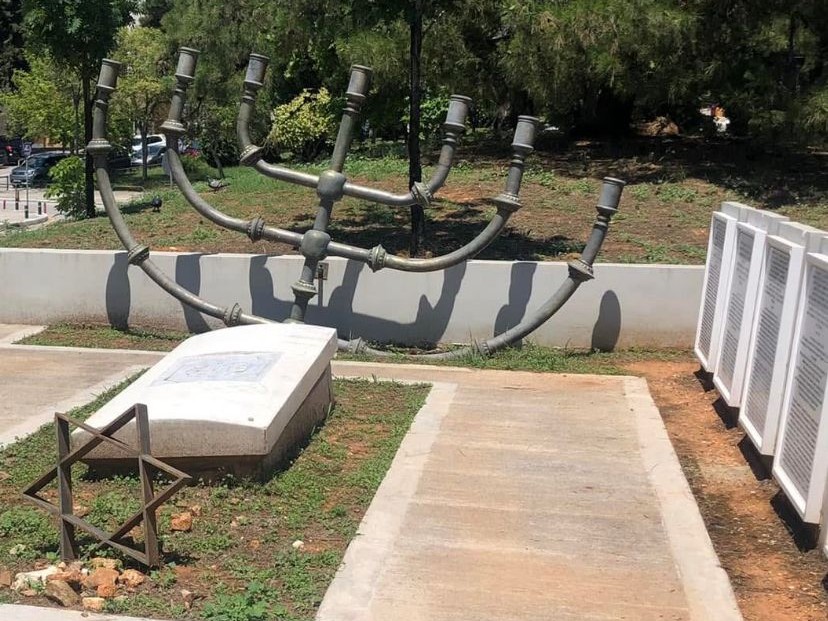
Monument at a former Jewish Cemetery at Aristotle University of Thessaloniki, Greece (Source: Eleftheria Koukoura)
By guest blogger Lynne Feldman.
“Master of the Universe, after all we have seen in Auschwitz, and all we have seen in burnt-down and destroyed Warsaw, we turn to you in this last moment with one request: protect this last remnant of the people of Israel and this last remnant who are giving their souls for the sanctity of the Lord. On the ruins of Warsaw, we stand and declare in a great voice, ‘Hashem is our G!d!’”
The words of Cantor Moshe Ben Avraham, spoken on the eve of Yom Kippur as he cleared the rubble left by the Warsaw Ghetto uprising, echo in our hearts.
On this Yom Kippur eve, Cantor Moshe, a cantor from Thessaloniki, Greece, was part of a forced labor group with Jews from France, from Bulgaria, and from Greece like him. (The Nazis did not want to use Polish Jews who might be able to communicate with the local Poles in Warsaw.) Moshe stood in the open air with fellow Jews who did not speak his language, forced to clear rubble from the place where the Warsaw Ghetto once stood, where other Jews took up arms and resisted as much as they could, and prayed. “Listen Mi Kerido,” he says in his testimony, “I couldn’t pray for long – the hunger and the work. I nearly lost my mind, but I did look up to the heavens and beg.” What they prayed was not the usual prayers that Jews have been reciting every Yom Kippur for generations, but it was still a form of a Vidui (confession), a form of a Tachnon (pleading, requesting). For Cantor Moshe, it was a miracle.
In many testimonies survivors refer to miracles, especially around the High Holy Days (Rosh Hashanah and Yom Kippur). What is a miracle? For survivors, a miracle was hearing a shofar blowing, finding a machzor (a prayer book for the High Holy Days), sometimes even finding something a bit different to eat. In the ghettos, a miracle was managing to gather a full Minyan (10 Jewish men needed to say certain prayers) and be able to complete a full prayer service, clandestinely, quiet but alive.
Testimonies from the camps describe how on Yom Kippur, things were different. People from different cultures and different languages, people who didn’t agree with each other, got together, sometimes in silence, sometimes united in words of prayers, in solidarity.
“Mi Kerido, let me tell you about the wonder, the miracle that happened in Auschwitz…..” Cantor Moshe starts his testimony. He continues to describe how everything was silent as they lay in the barracks in Auschwitz. They knew, the Greek men in the barracks, that it was coming up to Yom Kippur, the Day of Atonement, the holiest day in the Jewish year. From a distance they heard it, all the way from the Sonderkommando’s barracks: the blowing of a shofar. “Mi Kerido, they [the Sonderkommandos] didn’t care. They knew they had an expiration date of 3 months [the Sonderkommandos – Jewish prisoners forced to clean out the gas chambers – were murdered and replaced every 3 months] and that nothing would be done to them, so they blew the shofar as long as they could.” It was Rosh Hashanah.
I carry Cantor Moshe’s story with me. When I tell his story, I hear more than the shofar in Auschwitz or the whispered Tachnon in Warsaw. I hear the stubborn heartbeat of our people, the hope, the strength to keep standing, to keep living. His miracle becomes my reminder that even when words fail and strength runs thin, we can still look up, still whisper, still believe. In telling his story, we too become part of that chain, keeping the echo of his prayer alive.
Lynne Feldman is the Director of Holocaust Scholarship and General Manager at Teach the Shoah. Lynne is a pioneer in guiding with storytelling, certified as an Educational Holocaust guide by Yad Vashem and a Poland Tour Guide by the Israeli Ministry of Tourism. Based in Tel Aviv, Lynne is also a dedicated Holocaust scholar and researcher with an MA in Holocaust Studies from the University of Haifa.
Related Topics
Related Posts