
Smoke – 9/11 and Rosh Hashana
 Somewhere in the middle of the Amidah on the first night of Rosh Hashana, in a paragraph most of us don’t pay much attention to, we ask that wickedness vanish like smoke: V’chol harish’ah kulah k’ashan tichleh.
UV’CHEIN TZADIKIM — REDEMPTION: Uv’chein tzadikim yir’u v’yis’machu, visharim ya’alozu, vachasidim b’rinah yagilu, v’olatah tik’potzpiya, v’chol harish’ah kulah k’ashan tichleh, ki ta’avir memshelet zadon min ha’aretz.
Therefore, may the righteous see this and rejoice, and may the upright exalt, and the faithful sing in joy. Iniquity will shut its mouth, wickedness will vanish like smoke, and You will abolish the rule of tyranny on earth.
In a normal year, this would just be another word of many that I read these holy days that I don’t fully grasp. Smoke is a figure of speech. It just means, well, gone.
This year, however, we’ll be standing and saying it on the evening of September 11.
Twenty-five years to the day. The names read aloud in downtown Manhattan, Washington DC, Shanksville, and then sundown, and candles, and a table set for a festival. We wish each other a happy new year. So, the smoke won’t be a figure of speech this year. It will be a photograph we’ve seen a thousand times, one that no matter how many times we see it, sends a chill down our spines. Two towers against a September sky of that particular blue, and the column going up and up and refusing to disperse for anybody.
There’s something else about Friday night. When Rosh Hashana falls on Shabbat, we don’t blow the shofar. The one anniversary in twenty-five years when you might want a hundred blasts of raw noise, and our tradition silences the blasts and gives us words instead.
I suppose, while we’re at it, the honey is strange too. Twenty-five years since the worst morning of my generation’s adolescence or “awakening” and we mark the day by dipping sweet fruit in even sweeter honey and ask for a sweet year.
But hey, this is what we’ve always done. At the Seder we recline like free people and spend the evening talking about our slavery, and we spill wine from a full cup for Egyptians who drowned. That table was built by people who understood something confusing: a catastrophe you can’t eat dinner beside is a catastrophe that won’t survive being handed down. “They tried to kill us, we won, let’s eat!” Grief that refuses company dies with the people carrying it. So we stick it on the calendar.
We even give Rosh Hashanah a second name: Yom Hazikaron, the Day of Remembrance. Before anyone passes the honey we have already said out loud what the business of the day is: remembrance.
History
It is a miracle that so many survived.
Which brings me back to the problem with the prayer.
Smoke disperses. That’s just…what it does. It’s the reason it works as an image for something ending. Evil, however, has been considerably more durable than that. And so has our talent for losing the thread of why a thing mattered, which is the quieter half of the trouble. Time softens grief. That’s good. It also, unfortunately, loosens our grip on the cause. That’s bad.
There is a Ben Folds Five song called “Smoke” that’s not about any of this but about a marriage ending. The couple takes the book of their years together and pulls it apart, leaf and page and binding and glue, and burns the whole thing, and the singer says with finality that there will be no second book. Then in the last verse he turns the image inside out. Secrets go up into the air and travel. You can smell them when they burn. Anyone who wants to insist the past is finished is invited to stand there and breathe it in. The past is never dead, it’s not even past. Burning a thing is not the same as being rid of it. Smoke is what evidence looks like once it is airborne.
For anyone born after the attacks this is already history. They can watch the footage, read the accounts, stand at the memorial and put a hand into the letters of the names at Ground Zero. What they can’t do is remember an ordinary Tuesday becoming that Tuesday. They can’t remember anything at all.
In the new Netflix documentary, Turning Point: Generation 9/11 (now streaming), Graff says the following:
There are four attacks, and almost 3,000 people die. But what that misses is what it was like to live and experience 9/11. That we miss the fear, the chaos, the confusion and the trauma of that day.
We didn’t know when the attacks began, we didn’t know when the attacks were over. We did not know, for much of the day, how many attacks there had been. We also didn’t know whether there was another wave of attacks coming in the afternoon of September 11, we didn’t know what was coming on September 12th. We didn’t know what was coming in October or in 2002.
If you miss the fear, the chaos, the confusion and the trauma, you miss the entire reason that the US ends up responding the way that we did.
Sure, recognizing the footage feels like knowing the history, but it isn’t. A child can identify the towers and have no idea why the day is so important. They can’t identify that feeling, deep in the gut, of what is was like not knowing that the planes would hit, the towers would fall, or when the day would end.
Never forget is a promise the living make to each other. At some point somebody has to sit down with a nine-year-old and explain what is actually inside it, and why, for that matter, Never Forget and Never Again keeps failing.
Red bandana
Welles Crowther was twenty-four, an equities trader in the South Tower, a volunteer firefighter back home in Nyack. His father gave him a red bandana when he was a boy and he carried one ever after. The morning of 9/11, people coming down out of the smoke remembered a young man with a red cloth over his face telling them where the stairs were. He brought a group down and went back up. Months later his mother read a newspaper account describing a man in a red bandana, and that’s how Alison Crowther learned what her son did with the last hour of his life.
It’s an incredible story, that’s related in books, a documentary, mentioned in a president’s speech, and a lesson plan in many classrooms that mark the anniversary in the US. I mention it because it has a great shape: a father, a bandana, a mother finding her son in the testimony of strangers. It ends with an easy lesson that we can hand to our children learning the history.
But those who died at their desks have no such pattern or shape available. The kitchen crew at Windows on the World were prepping for lunch. Somebody was doing expense reports. Somebody went up their tower early to beat the traffic. Going to work was enough to entitle every one of them to come home that night, and no family should have to produce an inspiring ending to establish that what was taken from them had value. That is the harder part of remembering. It’s the one that needs us, because nobody is making a film about it.
So take a name off the roster of the 2,977 available. Not a famous one. Read enough to say something about that person’s life before you say anything about their death.
Perpetrators
Then say who killed them. The attacks were planned and carried out by al-Qaeda, an Islamist terrorist organization whose members chose the mass murder of civilians as a method. An account that keeps the grief while going vague on the perpetrators leaves a child with an event they can mourn but not understand. I’m not neutral about this because I watched the same vagueness show up within days of October 7. The same scramble for context that only ever runs in one direction. Twenty-five years bought us less clarity than I would have guessed.
Which is why wickedness is the right word to be standing there saying. It insists that human choices can, and should, be judged. Calling the deliberate murder of thousands of innocent people wicked should be the least controversial sentence a civilization can manage.
And here’s what we can remember. The smoke didn’t vanish. It hung over lower Manhattan for months, and people breathed it, and are still dying of it. Firefighters, cleanup crews, office workers who went back when they were told the air was safe. We’re at the point where almost more people have died now from what was in that air than died on the morning itself. The prayer we recite the first night of Rosh Hashana asks for smoke to disappear and the smoke went into people’s lungs and stayed there for twenty-five years.
Remembering is cheap if it stops at feeling. I think it has to cost you something on the ordinary days.
So the smoke will be in the photographs again on Friday September 11. On Saturday we’ll stand up together in a room with no shofar blown and ask for the end of the wickedness that put it there, and then we’ll walk home and eat.
Names
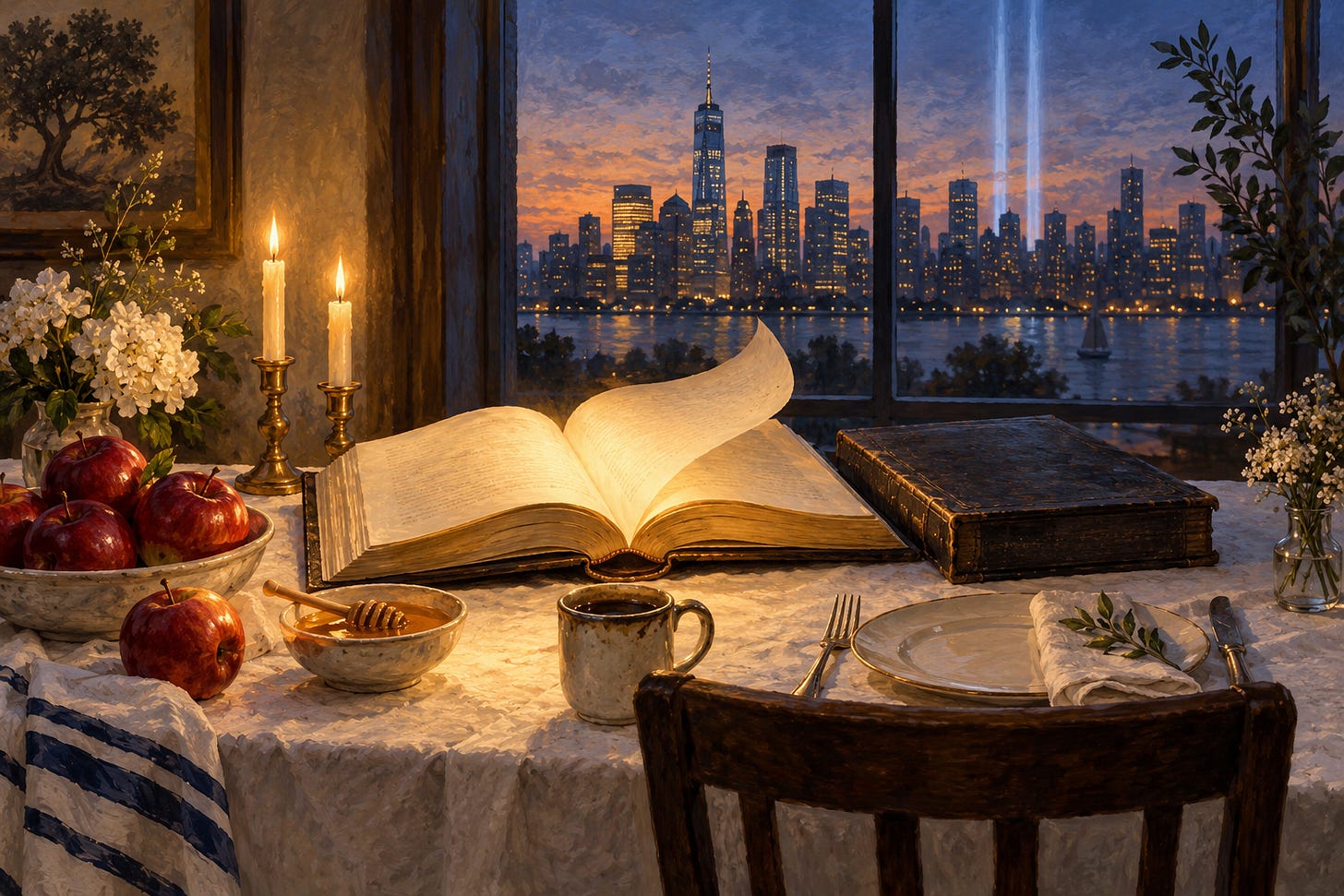
Because here’s what we’re actually asking for over those two days of Rosh Hashana. To be written in. The architecture around us is a book with names in it, and we spend ten days making the case that ours belong there for another year: the Book of Life. Folds sings that there will not be a new book, not another one, ever. We turn up every autumn and ask for just that.
Downtown Manhattan they’ll be reading from a different list: the Book of Death. It has close to three thousand names in it and it’s finished. Nobody is being added and nobody is coming off. Two rosters on one day, and the difference between them is that one is still open and we are standing inside it, asking.
So we turn to each other and say shanah tovah u’metukah. A good year, and a sweet one. Not just survival. Sweetness, specifically, which is a strange and almost greedy thing to request while the feeling of watching two planes explode still chills your bones.
I don’t think it’s greedy. I think it is the point. Every person on that list was entitled to an ordinary sweet year, coffee, and traffic and a kid’s soccer game in October, but evil men with a plan decided they were not. When we ask for sweetness we’re stating what human beings are owed. The asking is a form of testimony.
Ketivah v’chatimah tovah. May you be written and sealed for good. Say it to someone this year like you mean it, because you are saying it to a person who is still here, and that’s not nothing. It was never guaranteed.
Shana tova u’metukah
This original essay was posted on Catch.