"These fragments I have shored against my ruins"
Snow Over the Ghetto, Budapest 1945
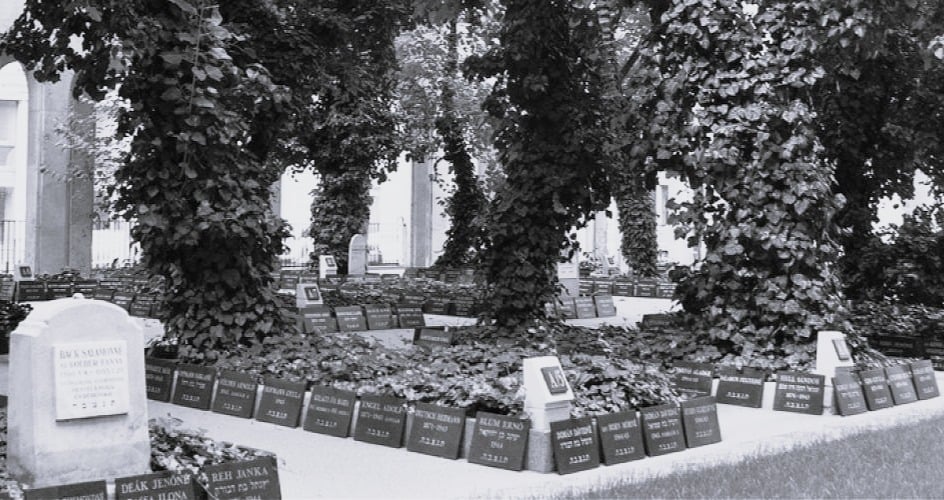
Common graves in the Dohány Street Synagogue courtyard
(Photo courtesy of the author)
Until the day she died, whenever it snowed, she remembered that winter in Budapest in 1945, when the snow lay thick across the rooftops like eiderdown, deceptively soft. As it fell, she thought of Frau Holle and the old German fairy tale in which snow drifts down when the bedding is shaken.
But in Budapest the snow had not been magical. It had covered bodies and buried fates and names deep beneath it. And it was not pure white; blood had streaked it red. The Danube froze. The streets were silent save for boots and hunger. She slept on bare boards, her breath frosting the walls, listening for footsteps that might mean rescue, or danger, or — as she soon learnt — both. The Siberian cold was not merely physical. It entered the bones of the city.
After Hungary entered the Second World War, deportations and forced labour service began, and thousands of Jewish men, her husband among them, were conscripted into brutal labour battalions. Although many died under these conditions, most Jews in Hungary were not yet in immediate danger until the German occupation of 19 March 1944. From April, segregation, ghettoisation and the deportation of provincial Jews began at extraordinary speed. Unlike the long‑standing ghettos of Eastern Europe, Hungarian Jews spent only a few weeks in ghettos before deportation. Mass transports began on 15 May and were halted on 7 July, just before they would have reached Budapest.
In the 1930s she had earned her doctorate in Berlin. A decade later, reason and culture had vanished, books burnt to ash on pyres and corpses to smoke in crematoria. There was no beauty left in Budapest, only the notice nailed to her door and the order to move into one of the yellow‑star houses where Jews were herded before the ghetto walls closed.
In the capital, Jews were first forced into these “yellow‑star houses” in June. After the failed attempt to exit the war on 15 October, the Arrow Cross seized power and immediately imposed forced labour, followed by the first death marches towards the western border in early November. International protest forced the regime to stop the marches and instead order the creation of ghettos in Budapest.
She was alone; her husband had already gone, taken in the first sweep. Then came the discovery: she was pregnant. She did not weep; she calculated. It was not a time that allowed for sentiment. She still had a few friends in Budapest, a handful of people she could trust. A whispered address, a roll of banknotes, a doctor who asked no questions. Bleeding, she walked back to the room she shared with strangers and called home, past shuttered shops and broken glass, telling herself they would have other children when he returned.
The first ghetto was the so‑called “international ghetto” in Újlipótváros, established on 15 November in buildings under neutral diplomatic protection. Despite this, Arrow Cross raids, robberies and murders continued. In early January, neutral diplomats transferred around ten thousand people from this area into the main ghetto, believing their chances of survival would be higher there. So, she moved.
The Budapest central ghetto (“nagy gettó”) — Europe’s final ghetto, and among its largest—was announced to the Jewish Council on 18 November 1944. Negotiations over its boundaries, provisions and protection failed. A ministerial decree defining the area appeared on 29 November, and the ghetto was sealed on 10 December.
Roughly 40,000 people were forced into 4,513 flats within the designated 0.3 km² area bounded by Dohány Street, Kertész Street, Király Street, Csányi Street, Rumbach Sebestyén Street, Madách Imre Street and Károly Boulevard. Around 12,000 non‑Jewish residents had to leave their homes. The ghetto was enclosed by high wooden palings, guarded at four gates, and could be exited only in exceptional circumstances. New arrivals were stripped of their valuables at Klauzál Square.
Numbers rose rapidly as people from yellow‑star houses, Arrow Cross raids and escaped labour servicemen were pushed inside. By early December, around 33,000 people were present; by January 1945, the population had swollen to 70,000–80,000. Conditions were catastrophic: food rations amounted to only 700–800 calories a day, sanitation collapsed, and with the Soviet siege tightening, deaths rose to 80–120 per day. The Red Cross could not prevent mass starvation and disease.
In the second half of December, thousands of children were forcibly transferred from protected orphanages into the ghetto. At Raoul Wallenberg’s urging, around ten thousand holders of diplomatic protection also moved from the international ghetto into the central ghetto, which by then offered marginally better chances of survival.
On 17–18 January 1945, Soviet forces reached central Pest. The Arrow Cross guards vanished, and residents immediately dismantled the wooden barricades for firewood. Approximately 68,000 people survived the siege within the ghetto. More than 3,000 unburied bodies were found, many later interred in mass graves beside the Dohány Street Synagogue.
On 18 January 1945, the imminent danger was over. For a fleeting moment she was free.
Later she learnt that her husband would not return at all, that he had fallen somewhere in the west on the long forced march, killed by a mine hidden in frozen ground, covered with soft white snow. The hope that had flickered when the palings came down went out with him. She never called it death. She only said, as so many did, that he “didn’t come home”. It was easier that way, more survivable, and more acceptable, for victims and perpetrators alike.
There was a life to rebuild, and a country too, though neither would ever resemble what had been lost.
Related Topics