
An Unapologetic Jewish Educator
Social Media Glee: October 7th and Charlie Kirk
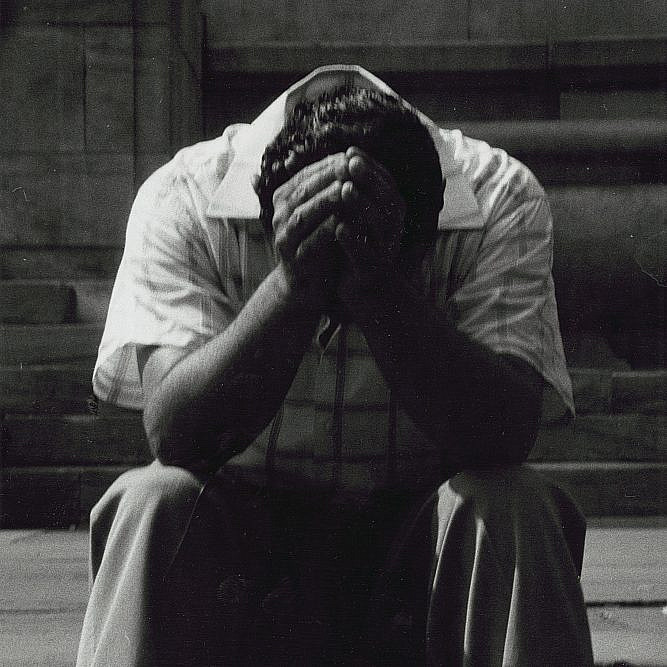
Man sitting with his head in his hands. Photograph by Angelo Rizzuto, 1958. Library of Congress, Prints & Photographs Division, Anthony Angel Collection. No copyright restrictions.
October 7th and the murder of Charlie Kirk. Two acts of violence, 705 days apart. Different in scale and intent. The one a pogrom, aimed at wiping out the Jewish presence in the Middle East. The other a cold-blooded political assassination, targeting the leader of a movement that has turned countless young Americans to the right. Besides their potentially era-defining consequences, they would seem to have little in common.
These events may in themselves share little, but the response on social media is strikingly similar. On X, on Instagram, on Bluesky, Facebook, TikTok—anywhere people like to share their unvarnished opinion, you will find, without much effort, glee over the murder of Charlie Kirk. In addition to outright glee, you will find smug dismissal, rationalization, coded expressions of support, and wordy defenses. I won’t share any links because such responses don’t deserve the attention and you have almost certainly seen them already.
Ordinary Americans are aghast at what they are seeing. How can anyone glory in the brutal assassination of a father in front of his wife and kids? In front of thousands as part of a public debate in a country at peace? It’s inhumane, sickening. The reaction reveals a moral rot. Worse yet, the moral rot appears to have reached our acquaintances, friends, teachers, family.
American Jews are familiar with this feeling of horror. We have experienced it day in, day out since Hamas launched its brutal attack on the Jewish people two years ago. On the morning of October 7, 2023, a Jewish holiday, Hamas terrorists launched a barrage of thousands of missiles into Israel to cover their ground forces, who broke through the border fences around Gaza and began slaughtering anyone they found. The terrorists and their civilian accomplices shot children point blank, burned people alive, raped women, and dragged their dead and dying victims back over the border to parade them through the streets, all while livestreaming the carnage. Around 1,200 people were murdered, of practically every race, faith, and nationality, and 251 taken hostage.
Many Jews took to social media to learn more and to express their shock and disgust at what was occurring. Imagine their surprise when they found their homepage, their feed filled with mutuals erupting in giddy excitement at the news. As terrorists butchered civilians, while the Israeli military scrambled to put up any defense, people were commenting heart emojis on pictures of terrorists descending upon innocents and on posts that glorified the massacre that took place. Campus groups wrote manifestos justifying the atrocities. And this was before Israel had dropped one bomb.
Such responses have not ceased. The war that Hamas continues to wage rather than surrender, despite the resulting devastation, has kept social media churning. By contrast, because Kirk’s murder was a single event, the gleeful posts will eventually slow to a trickle as the news diverts our attention. We may be inclined to shake our heads in disbelief as many did after the summer of 2020 and chalk up the reactions to the heat of the moment. The news cycle will not continue to give people the chance to expose their noxious views. But make no mistake: what Americans saw in the hours after Kirk’s murder goes deep.
This assassination brings us to a crossroads. We have been granted a glimpse of what segments of the American public really believe about free speech, Christians, and traditional values. For these radicals there is no room for debate and exchange, no room for disagreement. Which is how we know they aren’t speaking out of hotheadedness. They are deadly serious.
In this fateful moment, the average Christian or conservative American must learn from the experience of American Jews, and vice versa. Christians and conservatives must learn from Jews that what their opponents say online, they genuinely mean. Indeed, we should believe those who say they want to destroy the system, and know that this includes political killing. Meanwhile, Jewish Americans must learn from Christians and conservatives that the country that has been so good to us is under genuine threat. An America that dynamites its foundation in Judeo-Christian beliefs and values won’t resemble any America in which Jews would want to live. The murder of Charlie Kirk was of a piece with the murders of Yaron Lischinsky and Sarah Milgrim, and with the firebombing at Boulder, and with all the antisemitic attacks we’ve lately witnessed.
I single out these three groups—Jews, Christians, and conservatives—because they are the targets of a rising intolerance that is vehemently denied. If Kirk’s murder was of a piece with recent antisemitic attacks, it was also of a piece with the Annunciation Catholic School shooting a week and a half earlier and the Abundant Life Christian school shooting in December 2024. Our national conversation only grudgingly admits Jews as targets of violent prejudice, let alone Christians and conservatives despite the rising number of attacks against them. There are of course many people who are appalled at the murder of Charlie Kirk who fall into none of these groups. I’m glad about that. I hope they can influence those in their circles who gloated. My solicitude here is for those of us who have no chance to influence them. Those of us who need to come together in case influence fails.
I said this assassination brings us to a crossroads. Perhaps it brings us to the brink. The divide between the real world and the digital feels every day more permeable. Who knows if a hand coming through a phone screen won’t send us all flying into the abyss?
Related Topics
Related Posts