
Social Stupidity and the Necessity of Jewish Vigilance
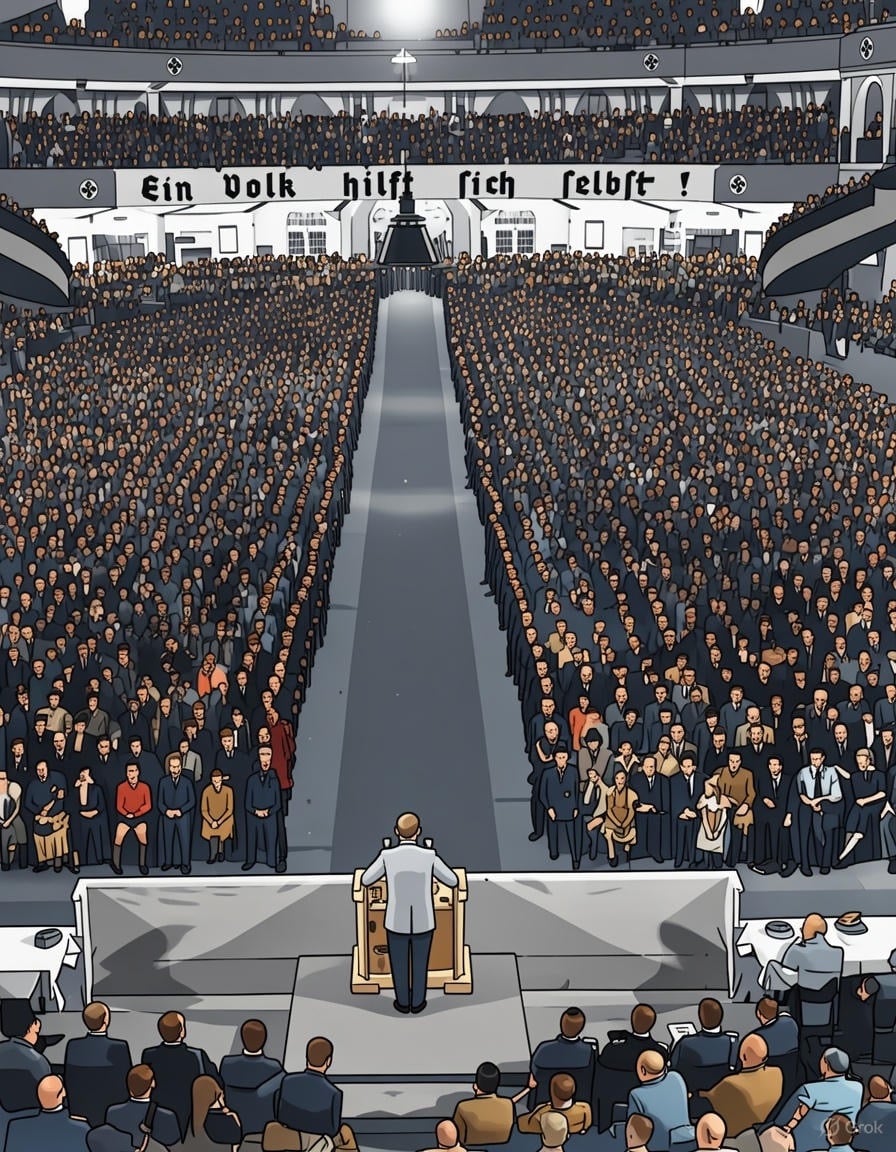
The most dangerous moment in history is not when people hate —it’s when they stop thinking.
Hatred can be confronted. Evil can be named. But when entire societies surrender judgment to slogans, silence, and social pressure, cruelty no longer requires intent.
It only requires participation.
After the collapse of moral judgment in Germany, writing from prison, Dietrich Bonhoeffer issued a warning that still unsettles because it remains true:
“Stupidity is a more dangerous enemy of the good than malice.”
Evil can be confronted. Stupidity, once social, cannot. This distinction is not academic. It is playing out — visibly and predictably — in how much of the world has processed the war launched by Palestinian terrorists on October 7.
How Thinking Collapses
Societies do not lose their moral bearings all at once. They slide into them through a recognizable sequence:
Exposure → Rationalization → Repetition → Normalization
This is not a moral accusation. It is a psychological pattern.
Exposure
An idea enters the public bloodstream — through headlines, viral videos, slogans, and feeds. After October 7, exposure was unavoidable. Claims — some true, many false, heavily distorted — arrived everywhere at once.
Exposure alone does not radicalize, but saturation lowers resistance.
Rationalization
This is the hinge point — the most dangerous stage. Here, people do not say, “This is wrong.”. They say, “It’s complicated.”. “Context matters.”. “I don’t support violence, but…”. These are not neutral qualifiers. They are moral escape hatches — ways to preserve self-image while suspending judgment.
Once an idea is rationalized, it becomes repeatable.
Repetition
What is repeated no longer feels extreme. Slogans compress complexity into certainty. Hashtags flatten history into moral theater. Repetition does not require conviction — only compliance.
Claims that once demanded evidence begin circulating freely, detached from facts and insulated from scrutiny.
Normalization
At this stage, the idea is no longer debated. It is assumed. Dissent becomes suspicious. Silence becomes safety. Questioning feels disruptive. Normalization does not require hatred.
It requires only that enough people stop thinking.
The Big Lie and the Exhaustion of Resistance
This is where the logic of the Big Lie takes over.
The Big Lie succeeds not because it convinces, but because it exhausts resistance. Over time, questioning it begins to feel more disruptive than acquiescing. The social cost of dissent outweighs the psychological reward of truth-seeking.
At that point, belief becomes irrelevant. What matters is dominance. A falsehood repeated loudly, confidently, and everywhere does not need to persuade. It only needs to become familiar. Familiarity dulls skepticism. Silence replaces scrutiny.
This is precisely the condition Bonhoeffer warned about: a society no longer governed by judgment, but by momentum.
1938 Didn’t Begin With Hate — It Began With Thoughtlessness
Germany did not collapse into catastrophe because every citizen suddenly hated Jews. It collapsed because enough people outsourced their thinking to the crowd. Radio and rallies have been replaced by algorithms and feeds. Slogans then. Hashtags now. Propaganda then. Viral repetition now. Silence then. Cancellation now.
History does not repeat because lessons were forgotten. It repeats because stupidity is always available.
When Normalization Turns Deadly
This is not theoretical.
Just days ago, authorities uncovered a plot for a mass attack on Jews in Manchester, England, as well as a major attack being foiled in Los Angeles. Whether these plots reached execution is beside the point. Such violence does not emerge in isolation.
It grows in environments where ideas have already been normalized — where dehumanization circulates unchallenged, where moral guardrails were removed long before violence appears. The perpetrators are not the crowd but the crowd is the condition.
Why “Ending” Jew-Hatred Was Never Enough
For decades, Jewish advocacy rested on a hopeful assumption: that if hatred is exposed, it will be rejected. History reports otherwise.
Jew-hatred has survived empires, enlightenment, emancipation, documentation, education — and even Auschwitz — not because it is persuasive, but because societies repeatedly abandon independent judgment.
That is why I shifted from #EndJewHatred to #SurviveJewHatred. It is not pessimism. It is realism.
After 3,000 years, survival has never depended on convincing the mob but rather has depended on recognizing the moment the angry mob stops thinking.
You cannot argue a slogan back into nuance. You cannot shame a normalized lie into retreat. You cannot educate a crowd that has decided not to listen.
Survival requires something harder: clarity without illusion, memory without sentimentality, and the refusal to surrender judgment — even when belonging demands it. Bonhoeffer understood this. History confirms it.
Hope is sacred to Jews. It is the name of our anthem for a reason but Jewish hope has never meant blindness. It has never meant surrendering judgment to the crowd. And it has never meant trusting that history will simply “correct itself.”
I look around now and I see Jews murdered in Manchester, in Washington, D.C., in Boulder, on Bondi Beach. I see plots uncovered, attacks carried out, names added quietly to a list societies keep pretending is closed.
Sadly, I do not see this ending any time soon. Not because hope has failed but because hatred adapts, and stupidity spreads faster than conscience once people stop thinking. So when I say #SurviveJewHatred, I am not surrendering hope. I am refusing illusion.
Survival has never depended on convincing the mob or waiting for hatred to exhaust itself. It has depended on recognizing the moment a society stops thinking — and refusing to surrender moral responsibility when it does.
Jews have endured not because the world learned, but because we did.
Hope carried us forward and clarity kept us alive.